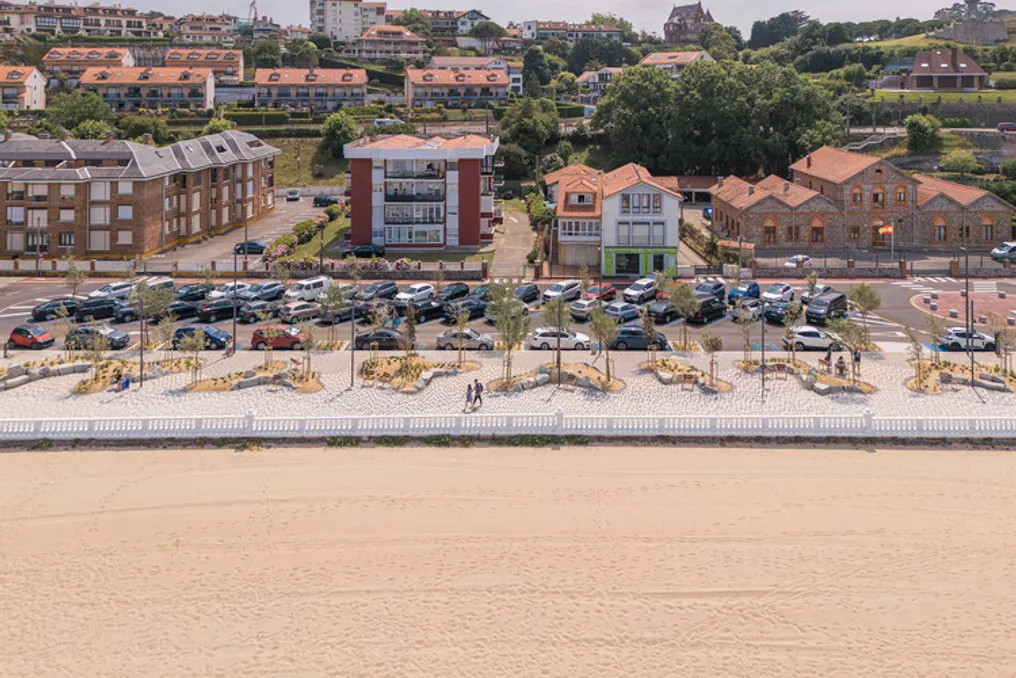
The architectural intervention, developed by Hector Navarro and ARKHITEKTON, transformed an area previously occupied by a narrow sidewalk and a large parking lot into a new public space for the city of Comillas. The project did not limit itself to renovating the existing promenade; it created a new waterfront, recovering a notable stretch of coastline for pedestrians and connecting it to the network of urban public areas.
A central aspect of the project addresses the constant presence of sand, characteristic of any coastal area, which is naturally dispersed by wind, tides, or people. Traditionally viewed as an undesirable element requiring continuous cleaning, this proposal reverses that perspective. It embraces this natural process, dissolving the barrier between the city and the beach, creating a place where both environments constantly exchange matter.
Thus, sand ceases to be an inconvenience and becomes an active component of the promenade itself, being integrated into both its permeable paving and its landscape system.
The intervention is structured in two complementary bands. Near the waterline, there is a continuous and open promenade, which functions as a dynamic circulation space, delimited by the historic balustrade that is part of Comillas' collective memory. Further inland, a green strip offers a calmer spatial experience, where vegetation, topography, and resting areas unite in a landscape system inspired by the ecosystems of the Cantabrian coast dunes.
The project does not seek to imitate a dune, but rather to incorporate its fundamental logic. Vegetation assumes a role that transcends the purely scenic, functioning as environmental infrastructure. This helps mitigate the urban heat island effect, increases biological diversity, and, over time, generates shaded areas under the tree canopy, making time part of the architecture itself, recognizing the continuous evolution of the landscape.
The relief features gentle undulations that incorporate limestone blocks recovered from old breakwaters. These elements help shape the terrain and simultaneously serve as informal seating, reinforcing the strategy of material reuse. They are complemented by individual benches, designed with a focus on accessibility and inclusion, stimulating various ways to use the public space.
Paving is a key element of the transformation. Through the combination of concrete blocks with distinct tones and textures, the floor designs undulating sequences reminiscent of the variable patterns of wet sand as the tide rises and falls on the beach.
The project is finalized with several secondary additions, such as permanent ice cream kiosks reminiscent of typical Cantabrian glazed verandas, the modernization of beach access, a new terrace adjacent to the La Caracola restaurant, a redesign of the lighting system, and the complete reorganization of the parking area.
This last reorganization introduces a new pedestrian corridor linking the promenade to the old cannery—currently home to the Civil Guard—as well as a new roundabout that optimizes traffic flow and safety. In addition to these specific modifications, the project establishes a new way of coexisting with the coastline. Sustainable water management, the acceptance of sand as an integral part of the public space, material reuse, the insertion of native flora, and the creation of accessible and inclusive places define an intervention that considers the landscape, infrastructure, and city as a unified living system. In Comillas, the seafront promenade ceases to be a boundary between the city and the beach to become the meeting point between them.