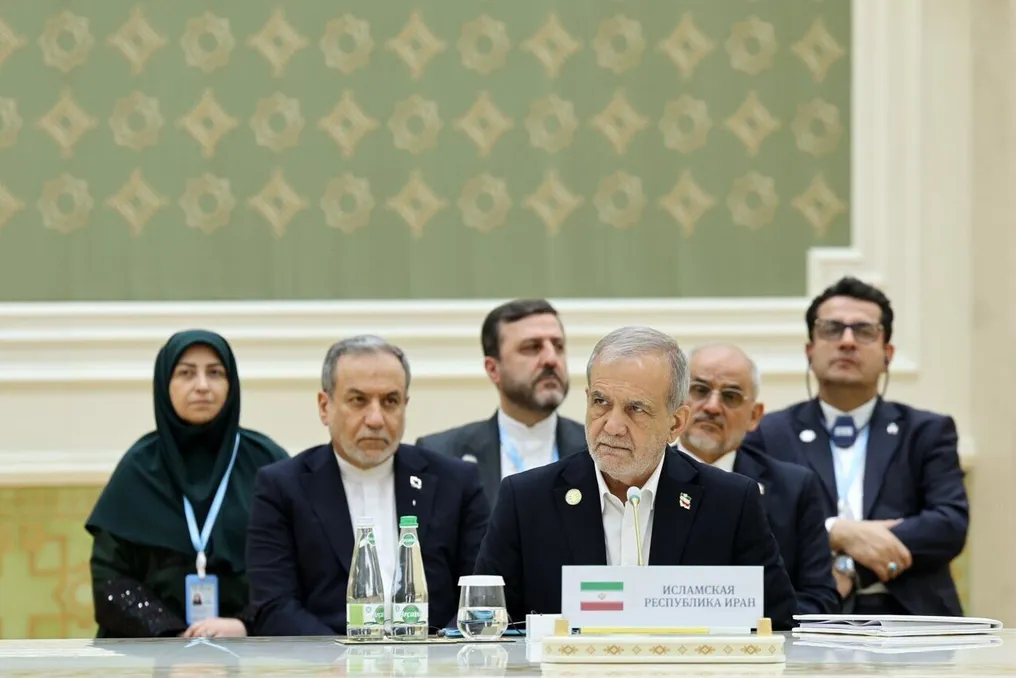
Iranian President Masoud Pezeshkian proposed developing and implementing a long-term regional plan under the Tehran Convention to address the issue of declining water levels in the Caspian Sea.
Speaking at an extraordinary summit of Caspian coastal states in Turkmenistan on Friday, Pezeshkian noted that environmental cooperation can become an important platform for strengthening trust and enhancing regional rapprochement amid global crises, geopolitical competition, wars, unilateral sanctions, and the weakening of multilateralism.
He emphasized that the Tehran Convention and its protocols provide a comprehensive framework for interaction among Caspian coastal states on a range of environmental issues. These include oil pollution, land-based sources of marine pollution, biodiversity conservation, transboundary environmental impact assessments, climate change, and the decline in the water level of the Caspian Sea.
According to Iran, the fundamental principle in combating this crisis must be reliance on science, data exchange, and regional cooperation. Pezeshkian acknowledged that a complete and final understanding of the contribution of various factors to the drop in the Caspian Sea's water level has not yet been achieved.
He added that to identify effective solutions and mitigate consequences, it is necessary to study climate change, rising temperatures and evaporation, shifts in precipitation patterns, changes in river runoff, and human interventions within an integrated scientific system. Given the rapid pace of changes, the region should move from simply observing and describing the crisis to a new phase of joint crisis management.
Pezeshkian also stated that lasting peace, stability, and security in the Caspian region can only be ensured if the coastal states respect each other's sovereignty and legitimate interests, and prevent this strategic waterway from becoming an arena for destructive rivalries or external interference.
He warned that the entry of fuel and pollutants into the marine environment, damage to coastal habitats, water and sediment contamination, and harm to biodiversity can have consequences extending far beyond the immediate site. Therefore, Iran emphasizes the importance of maintaining the peaceful nature of the Caspian Sea and protecting its ecology even in the context of armed conflict.
The President particularly highlighted the central role of the Tehran Convention, which was signed by five Caspian coastal states in 2003 and serves as the main legally binding regional mechanism for protecting the Caspian Sea's marine environment. The Convention recently marked 20 years since its entry into force, and the seventh meeting of its parties was held in Tehran with the active participation of all coastal states.
Welcoming the summit's decision to establish a high-level commission including deputies of the prime ministers of Caspian coastal states, Iran proposed developing and implementing a long-term regional plan in accordance with the Tehran Convention to combat the lowering of the water level.
According to Pezeshkian, the proposed plan should cover at least seven key areas: 1. Joint scientific monitoring of factors contributing to the decline in water levels, along with the development and implementation of a comprehensive regional action plan. 2. Strengthening joint mechanisms to combat marine pollution and protect biodiversity. 3. Enhancing the role of the Tehran Convention, including more effective implementation mechanisms. 4. Adapting coastal infrastructure and ports to future changes. 5. Protecting and restoring wetlands, habitats, and ecologically sensitive areas. 6. Supporting local communities, fisheries, and the livelihoods of millions of people dependent on the Caspian Sea. 7. Mobilizing financial and technological resources for environmental protection and adaptation measures.
Pezeshkian stated that the region faces a historical choice: either passively observe the decline in the Caspian Sea's water level as a natural and inevitable process and await its consequences, or use science, regional cooperation, and political will to reduce damage and increase the resilience of this unique ecosystem. Iran's choice, he said, is cooperation, science, and the protection of the Caspian Sea, as well as preserving a common heritage for future generations. He called on the coastal states to transform the Caspian Sea into a new symbol of regional cooperation, describing it as a bridge connecting nations rather than a dividing line. Pezeshkian concluded: 'The Caspian is not just a sea; it is a common heritage,' adding that protecting this heritage is a shared historical responsibility for all countries in the region.