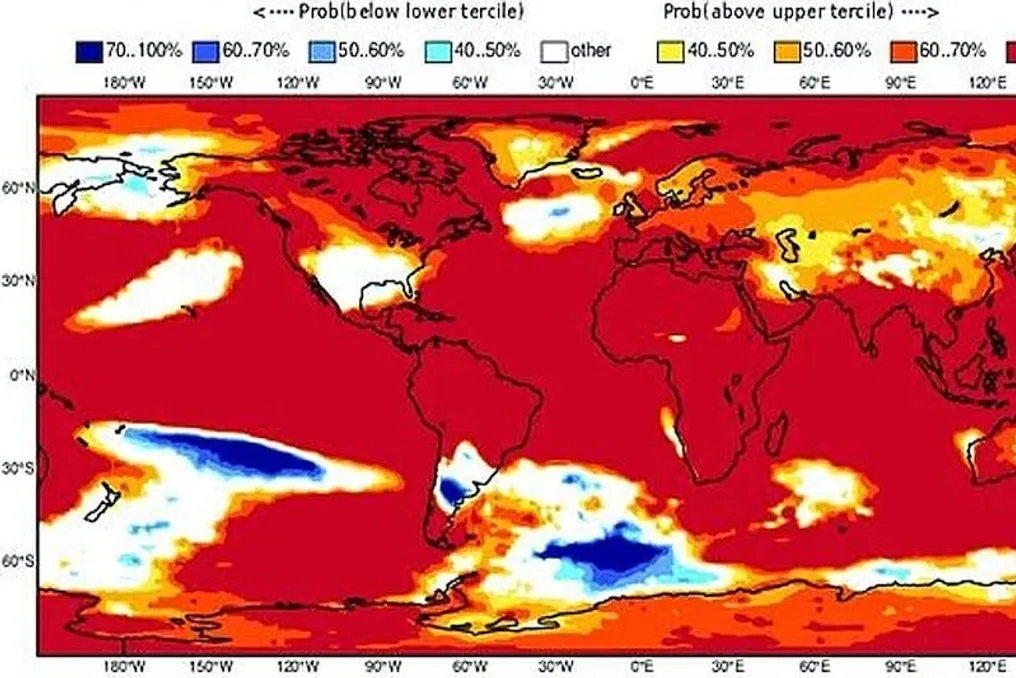
The 'Super-Duper El Niño' phenomenon is intensifying globally. According to data from the World Meteorological Organization (WMO), the sea surface temperature in the eastern Pacific Ocean could exceed the norm by approximately 3.7 degrees Celsius between October and December 2026. This may affect temperatures and precipitation levels in many regions of the world.
The WMO forecasts that El Niño will reach its strongest level around December and may persist until February 2027. During this time, an increase in above-average temperatures is expected in many parts of the globe. Some areas may experience reduced rainfall, while others face an increased risk of heavy rains.
The current El Niño is characterized by significant intensity. Its state can be explained by the sea surface water temperature in the Nino 3.4 region. In June 2026, the temperature there was 1.6 degrees above normal, and by August, it had risen to 2.5 degrees above normal. It is projected that during the period from October to December, this temperature will reach 3.7 degrees. This figure is important because previously, between November 2015 and January 2016, the temperature in Nino 3.4 rose by approximately 2.6 degrees, which was lower than the current forecast.
The impact of El Niño is uneven. Some areas may see increased heat, while others experience reduced precipitation and drought. Simultaneously, some places might face situations with heavy rains and flooding. Thus, El Niño is capable of altering climatic patterns across different parts of the planet. The specific impact on any given country will depend on its local climate and other circumstances.
In the part of the Pacific Ocean where El Niño forms, the water, both at the surface and deeper down, is significantly warmed. In August, the sea surface temperature in the Nino 3.4 region was 2.5 degrees above normal, and now a rise to 3.7 degrees is expected between October and December. Such significant sea warming could also affect global temperatures. Since the overall global temperature is already rising, the increased heat from a strong El Niño could exacerbate this trend. The WMO has also warned of an increased risk of extreme weather events.
Researchers from the University of Chicago's Climate Impact Laboratory have also made predictions regarding this strong El Niño. According to their estimates, around 451 thousand additional deaths could occur between June 2026 and February 2027. A prediction of approximately 15,800 additional heat-related deaths was also made for India. However, it should be noted that this is only a projection, and actual figures may differ.
Currently, the WMO expects El Niño to persist until February 2027. In the coming months, its influence will manifest as changes in temperature and precipitation patterns in various corners of the world.