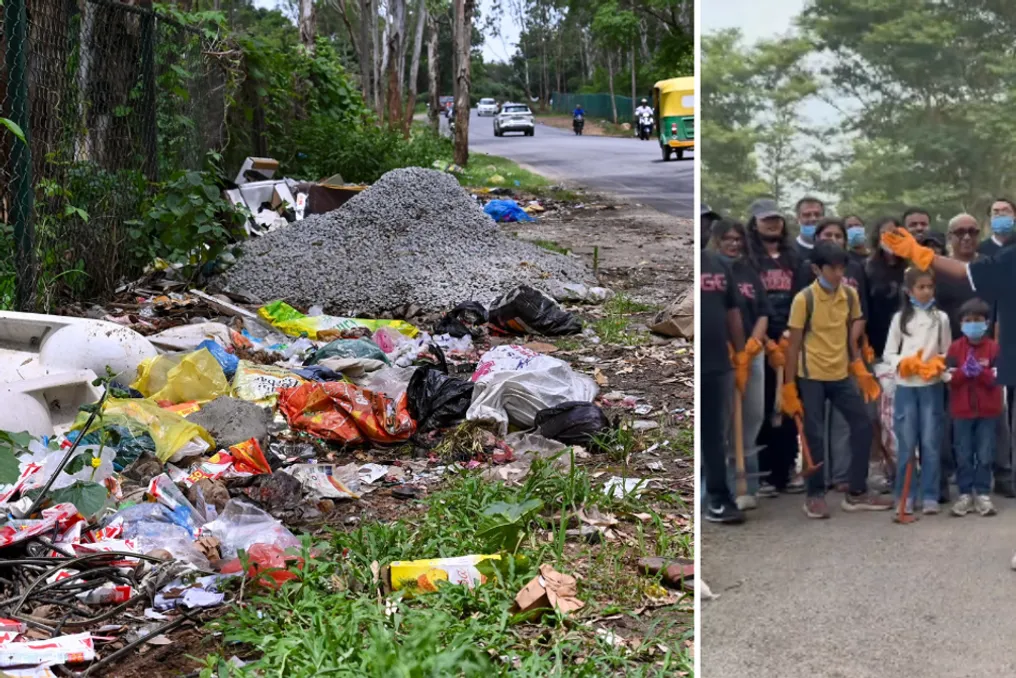
Over four hours in September, volunteers clearing the edge of the Turahalli forest in Bengaluru found more than just plastic. Under piles of discarded packaging and household waste, bags containing dog carcasses, bird food waste, and sanitary and medical waste were discovered. By the time the cleanup was finished, over two tons of accumulated waste had been removed from the forest boundary.
This discovery occurred during the 'Clean Up Turahalli' event on September 12th. The event was led by activist Surendra Singh Chaudhary from Madhya Pradesh, known as Bittu Tabahi, along with local volunteers, ecologist A N Yellappa Reddy, and members of India Plog Run.
For Bittu Tabahi, this was his first major cleanup drive outside of Madhya Pradesh. Previously, he had drawn public attention for documenting his efforts to clean up the heavily polluted Ajnar River in Rajgarh district, where he spent his own money on tools and repeatedly returned to remove accumulated garbage.
In the Turahalli area, he expected to find mostly plastic. However, as he told The Times of India, 'At first, I thought it would only be plastic waste, but when I started cleaning it up, I was shocked to find dog carcasses and medical waste under the plastic piles.'
This finding points to a broader issue: when an urban forest turns into an unofficial dump, the waste does not remain in one place.
A Forest That Lives Brighter Than the City
Although Turahalli is located within the expanding urban landscape of Bengaluru, studies show that its ecological value extends beyond simply having trees in the city. A study conducted in 2023 by researchers from Kuvempu University examined the bird biodiversity in the forest between April 2020 and May 2022. It recorded the presence of 139 species of birds belonging to 54 families and 19 orders. Researchers identified the Small Turahalli forest as an important habitat for both resident and migratory birds.
Plastic, food scraps, and animal remains can affect wildlife interactions at the forest edge, and waste that is buried or decomposes can enter the soil and subsequently the water.
What Biomedical Waste Can Be Left Behind
Medical waste is not just another form of household garbage. Indian regulations regarding biomedical waste require that medical waste be sorted and treated using specialized methods, rather than being thrown away with regular municipal waste. The Central Pollution Control Board also warned about the need for proper collection, treatment, and disposal, as such waste can pose environmental and health risks.
There is another issue: biomedical waste can contain microorganisms that are difficult to destroy. A 2026 study by researchers in Karnataka published in the Journal of Pure and Applied Microbiology examined hospital biomedical waste from medical institutions in three districts of Karnataka and identified biomedical waste as a potential reservoir for multi-resistant pathogens, including methicillin-resistant Staphylococcus aureus.
None of these studies establish that the Turahalli soil is contaminated with antibiotics or resistant bacteria; this requires specific sampling and on-site testing. However, they explain why dumping medical waste into an ecologically sensitive environment is not equivalent to leaving ordinary trash.
Garbage cleanup is only the beginning.
The cleanup drive in Turahalli demonstrated what happens when people decide to take responsibility for a landscape that has long been used as a dump. An excavator was brought in to remove waste too deeply buried for manual cleanup, while volunteers worked for hours along the forest boundary.
Turahalli is home to documented bird diversity and has played a role in Bengaluru's water landscape. Therefore, every bag of trash removed from its edges is more than just a cleaner patch of land; it is a small step toward preserving the urban forest as a wildlife and community resource.