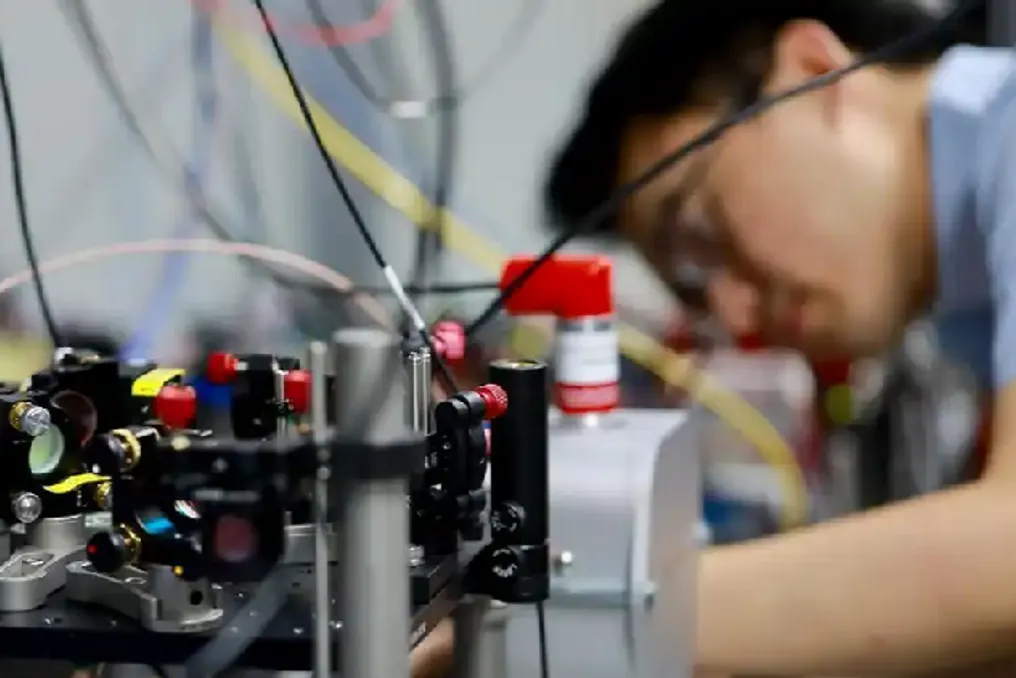
Chinese researchers have created nuclear optical clocks that utilize the nucleus of the thorium-229 atom to maintain time, marking a significant step forward in the development of a new generation of high-precision clocks.
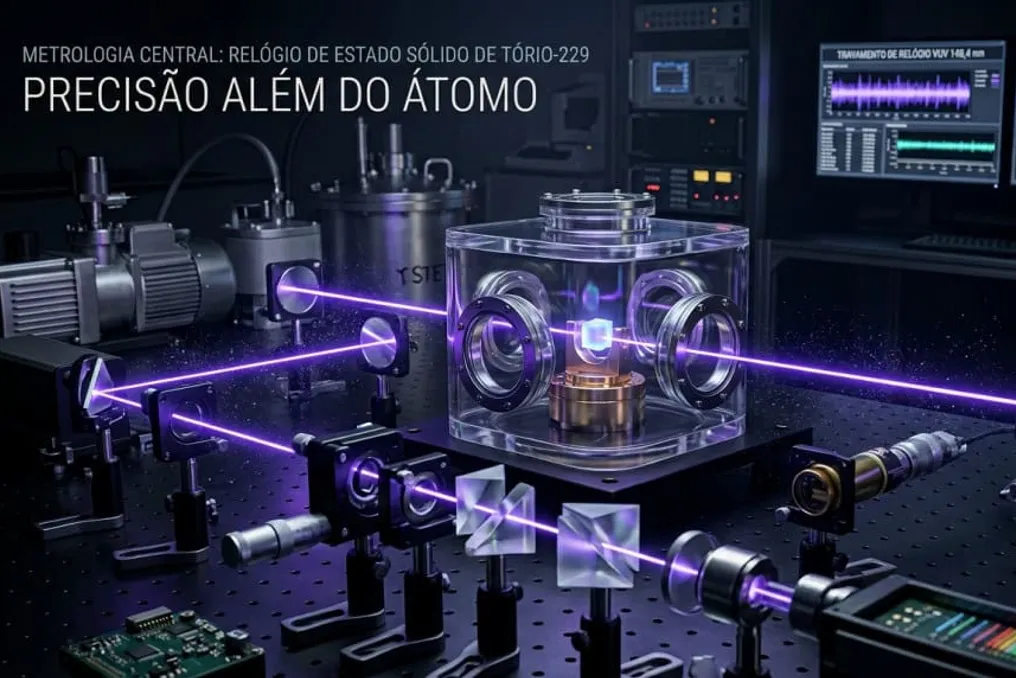
The team led by Dean Shiqiang from Tsinghua University employed a specially developed continuous ultraviolet laser and a tiny crystal containing thorium-229 to precisely measure the transition within the atomic nucleus. The team then synchronized the laser frequency with this nuclear transition, allowing the system to function as a nuclear optical clock.
These results were published in the journal Nature on Wednesday. The Chinese group and a European team independently achieved the work of nuclear optical clocks around the same time.
Modern most accurate optical clocks are based on electron transitions in atoms. In contrast, nuclear optical clocks use the transition inside the atomic nucleus as a time standard. Since the nucleus is significantly smaller than the surrounding atom, it is less susceptible to external influences, potentially allowing for even higher chronometric accuracy.
This technology can also offer advantages in terms of size and engineering solutions, with potential applications in satellite navigation and deep space exploration, where high time accuracy is critical.
The main obstacle was the need for a continuous laser with a wavelength of 148 nanometers, which is necessary for accurately exciting the thorium-229 transition. Dean's team was the first to develop such a laser.
Furthermore, the team managed to solve the shortage of thorium-229. Using only 1.4 micrograms of this isotope, the researchers produced a millimeter-sized calcium fluoride crystal doped with thorium in a single batch. The amount of material used was about 200 times less than that used by the European team.
The nuclear clocks of the Chinese team demonstrated second-level stability that is nearly an order of magnitude better than that of the European team, thereby confirming the potential of nuclear clocks as a new standard for high-precision time measurement.