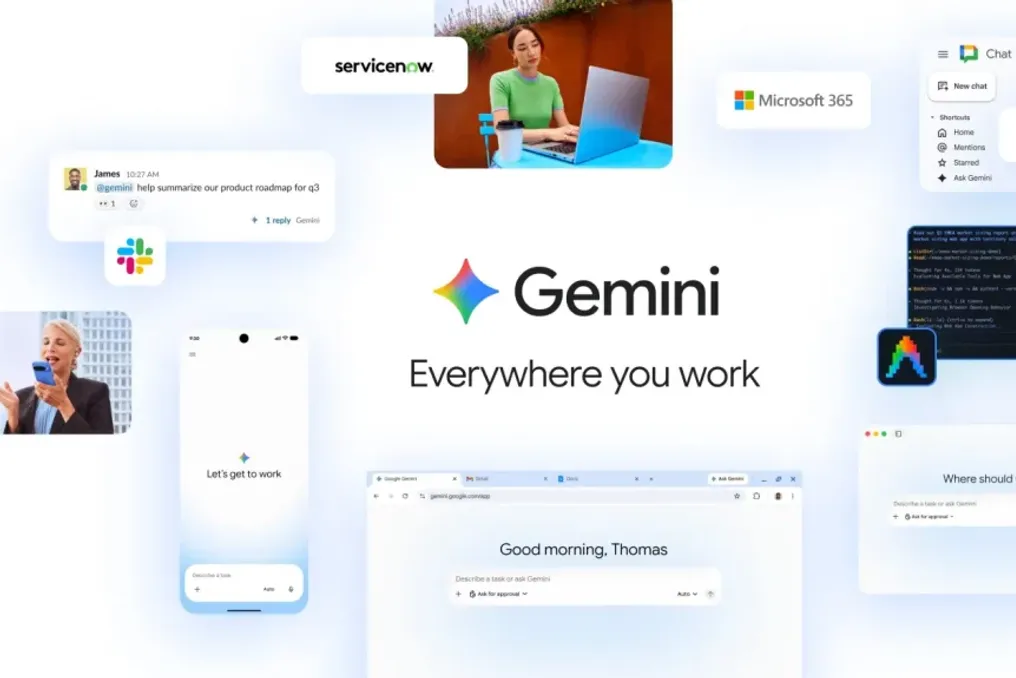
Google Cloud has introduced the 'Gemini agent,' a new artificial intelligence solution aimed at the corporate environment. The company describes this system as a universal and singular agent for work, designed to perform knowledge tasks, generate multimedia content, and develop or execute code.
This innovation will be integrated into Gemini Enterprise, Google Workspace, and third-party services. The intention is to transform how users interact with AI: the user simply defines the objective, and the system takes care of determining all necessary steps to complete the task.
In daily professional life, the Gemini agent has the ability to identify activities that can be delegated. For example, if a manager sends an email requesting the most up-to-date version of a project in a slide presentation, Workspace Intelligence recognizes this demand and offers the option to forward it to Gemini with just one click.
Furthermore, the tool can organize meetings without requiring the user to provide names or email addresses. By using the history of a previous event and the conversation space, the system identifies the necessary participants, checks calendars, and initiates communication to find a convenient time, even including external people.
The functionality of the Gemini agent transcends isolated tasks; it can operate on behalf of a group, acting as a project manager, or assume specific roles within an organization, such as a financial analyst.
To fulfill each assignment, the system selects the AI model it deems most appropriate. AI models are systems trained to process data and produce results, whether they are answers, texts, or code. Currently, the Gemini agent employs the Gemini and Claude families, although Google plans to offer future support for other open-source and private models.
When an activity requires multiple phases, the Gemini agent can use sub-agents, which are AI systems working in collaboration with the main agent, to segment the work. These sub-agents can operate sequentially or in parallel, covering processes that extend over hours or even days.
The architecture also maintains a centralized cloud repository containing memory, context, and personalization. Google categorizes this system into four distinct groups.
Within Gmail, Google Docs, Sheets, Slides, and Chat, the Gemini agent can be invoked by mentioning @Gemini. This feature is also available across various devices and channels, including command line, Slack, and Microsoft 365.
More information about the integration
An API, which functions as a means to connect different software, enables the integration of this technology into third-party applications. In this format, termed by Google as a 'headless agent,' Gemini can function in the background without needing its own interface.
Currently in private preview with restricted access, the Gemini agent will soon have wide availability for Google Workspace customers who have specific Business and Enterprise plans.