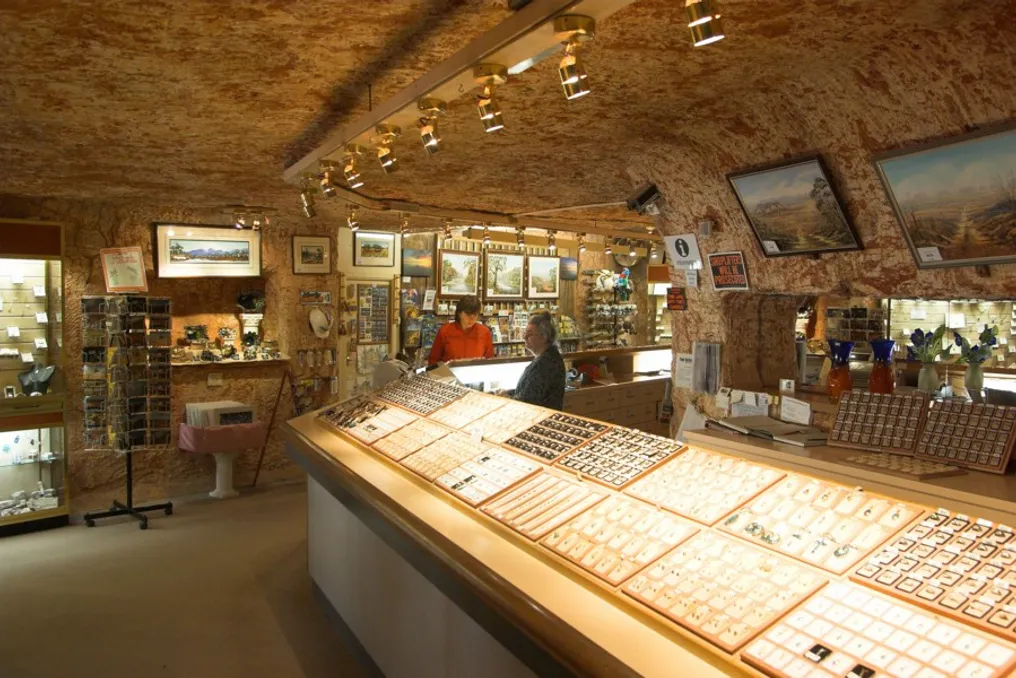
Coober Pedy, an isolated locality situated in the northern extremity of the state of South Australia, is notable for an unusual feature: with just over three thousand residents, practically all establishments, including shops, hotels, and churches, are located below the surface.
The landscape presented to the traveler resembles a science fiction setting. In the middle of the arid Australian desert, the horizon is characterized by sandstone formations with excavated holes, where a large part of the population resides. These underground homes evoke the structures seen on the fictional planet Tatooine, known from the Star Wars saga.
Coober Pedy also holds the title of 'World Opal Capital' due to the exotic and beautiful mineraloid that historically represented the municipality's main economic value. A significant portion of the global opal production comes from the region's mines, specifically in the Stuart Range, adjacent to the Great Victoria Desert.
Before the arrival of European settlements, the territory of Coober Pedy was inhabited for thousands of years by nomadic Aboriginal peoples, who moved in search of water and food resources. Mining activity gained momentum in early 1915 after a group of explorers called the New Colorado Prospecting Syndicate accidentally discovered opals in the area. Gradually, the settlement grew, and in 1920, the community officially adopted its name, which is an adaptation of 'kupa-piti,' an Aboriginal term often translated as 'white man's hole.'
Between the 1960s and 1980s, mining established itself as an extremely lucrative industry. To escape the high temperatures, which frequently reached around 50 degrees in the hottest months, residents began building their residences and businesses underground. This practice resulted in a partially subterranean city, where houses, commercial establishments, bars, hotels, cafes, and even places of worship were designed beneath the surface.
In recent decades, due to the depletion of mineral reserves and increased operational costs of mining, Coober Pedy has redirected its economic focus to tourism. Thus, this buried town has transformed into a picturesque tourist attraction.
A prominent tourist spot in the area is the Old Timers Mine, a historic mine inaugurated over a hundred years ago and maintained as a museum. This site allows guided tours through ancient hand-dug tunnels, in addition to displaying a 1960s underground residence that retains its original furniture.
The underground dwellings, known as *dugouts*, constitute another notable attraction. Among them, Faye’s Underground Home is one of the most visited and has a unique history: it was built manually by three women over eight years. Faye Nayler, moreover, was the first woman to work in an opal mine in Coober Pedy. This residence, with its vintage aesthetic, still features a peculiar underground pool.
Among the natural attractions of the Australian desert, it is recommended to visit the Kanku-Breakaways Conservation Park, a conservation area marked by hills of vibrant colors and arid landscapes that, according to reports, can resemble the surface of Mars. This destination is ideal for appreciating the unique beauty of southern Australia and watching a beautiful sunset.
Near this park, there is another place popularly known as 'Moon Plain'. It is an extensive rocky area that closely resembles the lunar soil. Due to its peculiar appearance, this region has served as a backdrop for several Hollywood film productions, such as 'Mad Max – Fury Road', 'Deadly Eclipse', and 'Red Planet.'