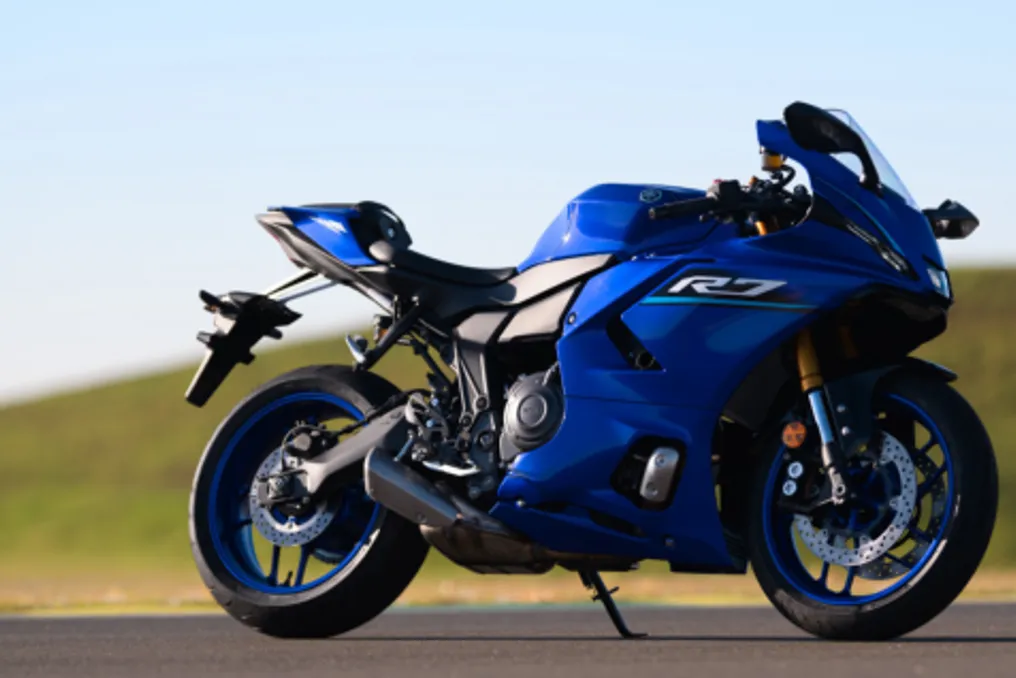
Yamaha has confirmed the price of its R7 motorcycle in the Brazilian market, setting a suggested value of R$ 60,690, which does not include shipping or insurance costs. The arrival of the sport bike at dealerships is scheduled for November.
The model, whose confirmation occurred during the Interlagos Festival 2026, only awaited the definition of price and launch date. The production phase of the bike will begin in Manaus, Amazonas, starting in October.
The standard Yamaha R7 line will be available in two shades: Racing Blue, which is a metallic blue, and Midnight Black, featuring a metallic black.
Other options and specifications
In addition to the standard line version, the manufacturer will offer the special edition Yamaha R7 70th Anniversary, a limited run of only 70 units. This special model will cost R$ 61,290, also without shipping included. This represents an increase of R$ 600 compared to the conventional version.
Although Yamaha's official statement does not specify changes in this commemorative edition compared to the standard R7, in celebratory editions, modifications are usually limited to paint and graphics.
Mechanically, the Yamaha R7 is equipped with the CP2 twin-cylinder engine, which features a crossplane crankshaft, a displacement of 690 cm³, and a liquid cooling system. This engine generates 73.4 hp at 8,750 rpm and a torque of 6.9 kgf·m at 6,500 rpm. It uses the same engine unit as the Tracer 7 and MT-07, both already sold in Brazil. The cylinders have DiASil coating, a technology that, according to Yamaha itself, helps reduce vibrations and improve heat dissipation.
The throttle control is electronic (YCC-T), meaning the rider's command response is managed by the electronic control unit, allowing for the implementation of more advanced electronic features. The clutch is assisted and slipping, providing a lighter lever and preventing rear wheel lock-up during sudden braking.
A notable feature of the R7 is the bidirectional quickshifter, which allows gear changes without needing to engage the clutch, both when accelerating and downshifting.
Electronic highlights and design
The great differentiator of the R7 lies in its electronic system. The sport bike incorporates a six-axis Inertial Measurement Unit (IMU), developed from the superbike R1. This IMU tracks the inclination and movements of the motorcycle in real time, providing the R7 with several functionalities:
This set of features is considered very advantageous for track days, while in daily use, most of these systems act as an additional safety mechanism.
The instrument panel is a 5-inch color TFT display, offering four display schemes and automatic adjustment capability between day and night modes. The Y-Connect functionality connects the bike to a mobile phone, enabling map navigation or navigation via arrows through the Garmin StreetCross application.
For those who use the bike on circuits, there is Track mode, which displays performance data and lap times. Furthermore, the system integrates with the Y-TRAC application, used to record and analyze how the rider drives. The R7 also features cruise control and speed limiter.
Structurally, the Yamaha R7 uses a 41 mm inverted front fork with a 120 mm travel. In the rear, the Monocross suspension features a horizontally positioned shock absorber and a 121 mm travel.
The braking systems include two 298 mm front discs and one 245 mm rear disc, both with ABS. The wheels are SpinForged type, manufactured using a process that makes them lighter than conventional cast wheels, which contributes to reducing unsprung mass and improving handling.
The motorcycle weighs 189 kg ready to ride. The seat height is 830 mm from the ground, the wheelbase is 1,395 mm, and the tank capacity is 14 liters. The seat height should be considered by shorter riders.
There have been modifications to the fairing design, which has become narrower, and the lower spoiler has been redesigned. According to Yamaha, these changes aim to optimize airflow and cooling. The central 'M'-shaped air intake is the main visual identity element, associated by the brand with its MotoGP motorcycles. The lighting is fully LED, including daytime running lights and front indicators integrated into the rearview mirrors.
With a price of R$ 60,690, the R7 is positioned as the most expensive motorcycle within Yamaha's 700 cm³ family in Brazil. Comparatively, the MT-07 costs R$ 54,790, and the Tracer 7, R$ 59,990. Since they share the same engine, what differentiates the sport bike from its siblings is the electronic package with IMU and its orientation towards track use. For those who use the bike exclusively on public roads, part of this electronic package may see little use. However, for those planning to participate in track days, the R7 represents the most complete option from the brand in this price range.
Yamaha guarantees four years of coverage for the R7, in addition to offering maintenance with pre-established values, following the same conditions applied to other models from the company.