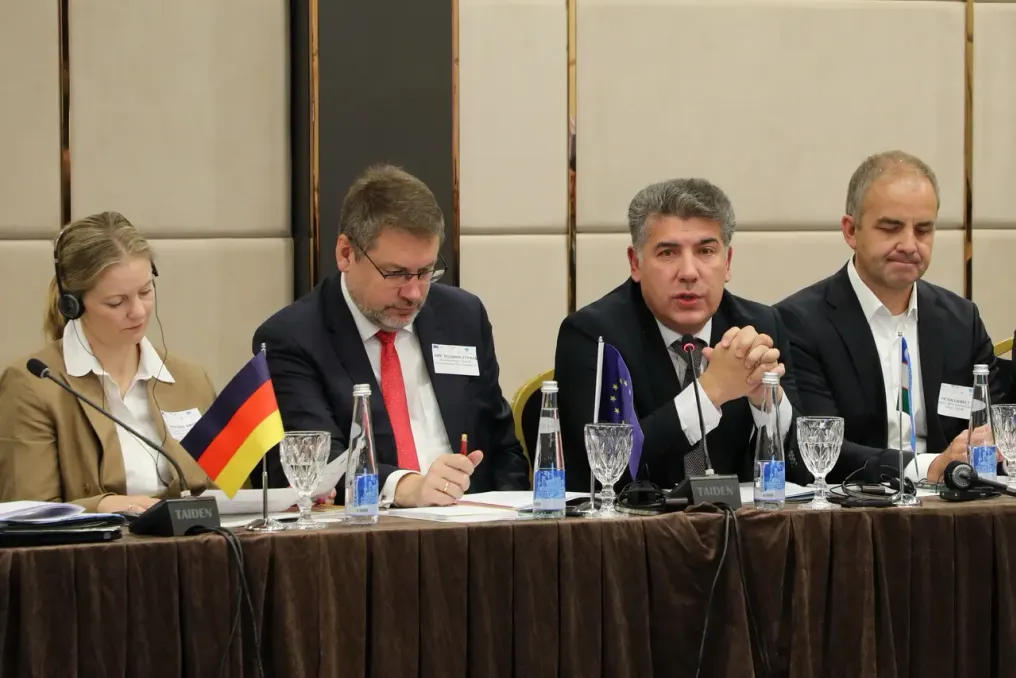
In Tashkent, Uzbekistan, a regional dialogue titled 'From scientifically proven knowledge to evidence-based climate policy—strengthening regional cooperation for enhancing climate resilience in Central Asia' is taking place from October 8th to 9th. The event was organized by the German Society for International Cooperation (GIZ) together with the Institute of Strategic and Regional Studies under the President of Uzbekistan.
Participants in the dialogue included representatives from German federal agencies and research centers, as well as governmental and scientific institutions from Central Asian countries, international organizations, and development partners such as the EU, OECD, UNEP, OSCE, and others.
The main focus was on developing cooperation within the 'Green Central Asia' initiative, launched by the German Ministry of Foreign Affairs in 2020 jointly with the region's countries. This initiative combines scientific expertise, state policy, and regional interaction.
One of the key outcomes was the formation of a Regional Strategy for Climate Change Adaptation in Central Asia, which was developed and approved by five countries in the region. The proposal to adopt this strategy was put forward by the President of Uzbekistan, Shavkat Mirziyoyev, at the Fifth Consultative Meeting of Heads of State of Central Asia in Dushanbe in September 2023.
Speaking to the participants, Akramjon Nematov, First Deputy Director of the Institute of Strategic and Regional Studies under the President of Uzbekistan, noted that the climate agenda has direct practical significance for Uzbekistan. He emphasized that climate change cannot be viewed solely as an environmental problem, as it directly affects food security, water security, energy security, agriculture, economic stability, and the quality of life of the population.
According to Nematov, Uzbekistan fully realizes the scale of these problems. Therefore, at the initiative of President Shavkat Mirziyoyev, the country has initiated a fundamental transformation of state policy: environmental, climate, and water issues have transitioned from a set of sectoral concerns to an interdisciplinary area of the national development strategy, shaping approaches to the economy, water resource use, agriculture, and territorial development.
Nematov also highlighted the strengthening of the institutional foundations of this policy. Environmental rights are enshrined in the Constitution, and a long-term strategic planning system has been established. The National Committee of the Republic of Uzbekistan for Ecology and Climate Change reports to the President, while scientific and personnel infrastructure is being developed in parallel, including the Central Asian University for Ecology and Climate Change Studies.
In his opinion, these transformations mark a shift in the very model of governance: moving from reacting to consequences to preventing risks, from disparate sectoral decisions to an integrated ecosystem approach, and from predominantly administrative methods to data-driven, science-based, technology-driven, and economically incentivized policies.
In this regard, the expert specifically highlighted the approach of the President of Uzbekistan, according to which climate resilience begins primarily with effective internal transformations. For instance, until 2017, water-saving technologies were applied in only 19,000 hectares, whereas by the beginning of 2026, they will cover 2.6 million hectares, accounting for 60% of irrigated lands. Annual water savings have reached 2.5 billion cubic meters.
Over the past five years, about 6 GW of solar, wind, and hydropower capacity has been commissioned, and the share of green energy in generation has reached 30%. Under the 'Yashil Maqon' project, over 1 billion trees and shrubs have been planted. The level of greening has increased from 8% in 2020 to 14.3% in 2025, and over 2 million hectares of forest plantations have been created on the dried bed of the Aral Sea.
Nematov stressed that these figures are important not in themselves. They demonstrate Uzbekistan's consistent transition to a more resource-efficient and environmentally sustainable development model based on rational water use, expansion of clean energy, ecosystem restoration, and reduction of climate risks.
At the same time, the First Deputy Director of the Institute of Strategic and Regional Studies emphasized that Uzbekistan's climate policy is proactive not only domestically but also regionally and globally. The logic of this approach stems from the obvious fact that climate, water, and environmental risks do not recognize national borders; therefore, the effectiveness of national reforms largely depends on the ability of countries to develop joint solutions.
In Central Asia, President Shavkat Mirziyoyev has consistently proposed practical mechanisms. At the Samarkand Climate Forum, proposals were put forward to launch a Regional Program for the Implementation of Water-Saving Technologies, conduct an annual 'Green Belt of Central Asia' campaign, and establish a Secretariat for the EU's 'Water-Energy-Climate Change' initiative in Tashkent to mobilize funding, technology, and expertise. Furthermore, the head of state called for expanded cooperation with the EU within the Copernicus program for continuous satellite monitoring of glaciers and early risk assessment for mountain ecosystems.
Concurrently, Uzbekistan is bringing the regional climate agenda to the global stage. At COP29, the President of Uzbekistan proposed establishing an International Center for Assessing Climate Losses and Damages, developing a UN-supported declaration on commitment to ensuring the health and environmental safety of river ecosystems, creating a Regional Gene Bank, and forming an Alliance of Global Climate Capitals, whose first forum should take place in Tashkent.
The speaker noted that Central Asia has reached a stage where the main task is no longer so much about developing new frameworks, but about the practical implementation of already achieved agreements. In other words, the regional climate agenda must transition from formulating approaches to systematically implementing them.
In this context, Nematov outlined six practical directions. Firstly, creating a compatible regional system of climate and hydrometeorological data based on comparable methodologies, information exchange, and risk monitoring. Secondly, translating the Regional Adaptation Strategy into a portfolio of specific projects with defined timelines, implementers, and measurable indicators. Thirdly, accelerating joint programs for water resource conservation, cryosphere monitoring, drought management, and early warning, developing the 'water–energy–food–ecosystem' interconnectedness. Fourthly, elevating human capital and scientific cooperation to a regional priority by expanding joint educational programs and academic mobility. Fifthly, developing mechanisms for climate, green, and blue financing with greater involvement of the private sector, development banks, and international financial institutions in implementing water and climate projects. Sixthly, strengthening the ability of Central Asian countries to build coordinated positions where their interests align, while respecting the national priorities of each country.
As the expert emphasized, this is the practical value of the 'Green Central Asia' concept: it connects science, state policy, international expertise, and investment opportunities, allowing the transition from understanding risks to joint solutions, and from solutions to projects and investments.