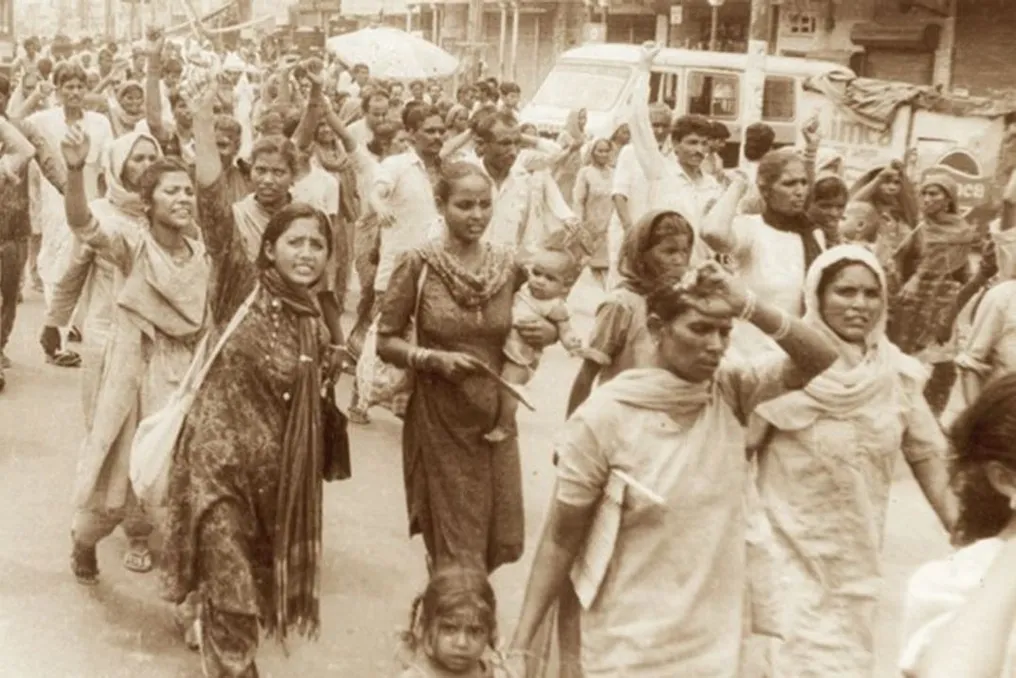
Women's protests in Andhra Pradesh against the sale of hard liquor led to a ban
Read more
The Better India
thebetterindia.com

Women's protests in Andhra Pradesh against the sale of hard liquor led to a ban

In 1991, a group of women from the village of Dubagunta, located in Nellore district of Andhra Pradesh state, organized a protest, forcing a local liquor store to close using brooms, sticks, and chili powder.

Many of these women had recently been learning to read through evening literacy courses for adults. After two years, the anti-liquor movement spread across the state and compelled the government to impose a ban on the sale of this cheap spirit, which was eroding the financial well-being and peace of families, starting October 1, 1993.

How education changed the discussion

The anti-liquor movement did not begin with a protest, but with an educational initiative. In January 1990, the Literacy Mission launched its campaign in Nellore. As the women attended reading classes, they began openly discussing the problems troubling their households, many of whom cited hard liquor as the cause of these issues.

Researcher Rekha Pandey notes that the spark occurred when drunken men insulted the literacy instructors, and the present women drove them away. The publication Deccan Chronicle adds that the story of a woman named Sitamma from the evening school further inspired the activists.

The scale of their discontent was significant. According to Pandey, there were 864 liquor stores operating in Nellore. The agency Feminism in India reports that state excise revenue grew from 39 crore in 1970–71 to 812 crore in 1991–92. In the same year, the average family in Andhra Pradesh earned 1840 rupees and spent 830 rupees on alcohol.

Brooms, chili powder, and the warehouse

Vardhini Resama, then an illiterate agricultural worker around sixty years old, led the women from Dubagunta. As noted by the New Indian Express, she joined the movement in 1991, inspired by the book 'Mahila Meluko.'

Deccan Chronicle reports that they first destroyed toddy barrels, assuring families dependent on that trade, and then stormed the liquor store despite police intervention. Historian Jidigunta Chalapati Rao adds that they attacked the local warehouse and expelled alcohol smugglers, with most early protesters being poor women from Scheduled Caste and Educated Class.

Women from neighboring villages followed them. The Nellore NGO Jagruti filed a public interest lawsuit against auctions, and the campaign turned into a confrontation with contractors, local officials, the police, and ultimately, the minister. Feminism in India records that contractors funded gangs to protect their monopoly, while the government claimed it could not close stores because the money from alcohol sales was used for social programs.

Pandey presents calculations of this argument: the state spent 1.50 rupees for every kilogram of subsidized rice but received 3.50 rupees from alcohol. The women countered by proposing daily wages instead, demonstrating that they offered an alternative rather than just objecting. They also questioned why water and schools were in deficit while hard liquor was always available, as noted by Feminism in India.

When about 50,000 people, 80% of whom were women, marched against liquor sales auctions in 1992, the police attacked the protesters. In 1992, women in Goa also fought against a bar license in the village of Tivrem and succeeded in having it revoked after a long struggle that included demonstrations and visits to government offices.

From liquor ban to total prohibition

The pressure proved effective. Subsequently, the minister banned the sale of hard liquor starting October 1, 1993, according to The News Minute. Since foreign spirits continued to be sold, the women's groups insisted on a complete ban, and N. T. Rama Rao of the Telugu Desam party promised this during the 1994 election campaign. He implemented a total ban on January 16, 1995, shortly after taking office as minister.

What the ban left behind

The ban did not survive the government that introduced it. On April 1, 1997, approximately 28 months after the ban began, the next minister repealed it. Although the effectiveness of alcohol bans is still debated, the idea that women can decide what is sold in their own neighborhoods has resonated since. In 2016, women from the village of Kachabali in Rajasthan campaigned until 94% of voters supported closing the only liquor store in the village.

Resama died on August 7, 2016, at the age of 93. In recent years, she lived in difficult conditions and underwent dialysis after the land allocated to her by the government was seized. Nevertheless, the woman who could not read when she picked up a broom gave her name to the village, and every report of her death referred to her as Dubagunta Resama.
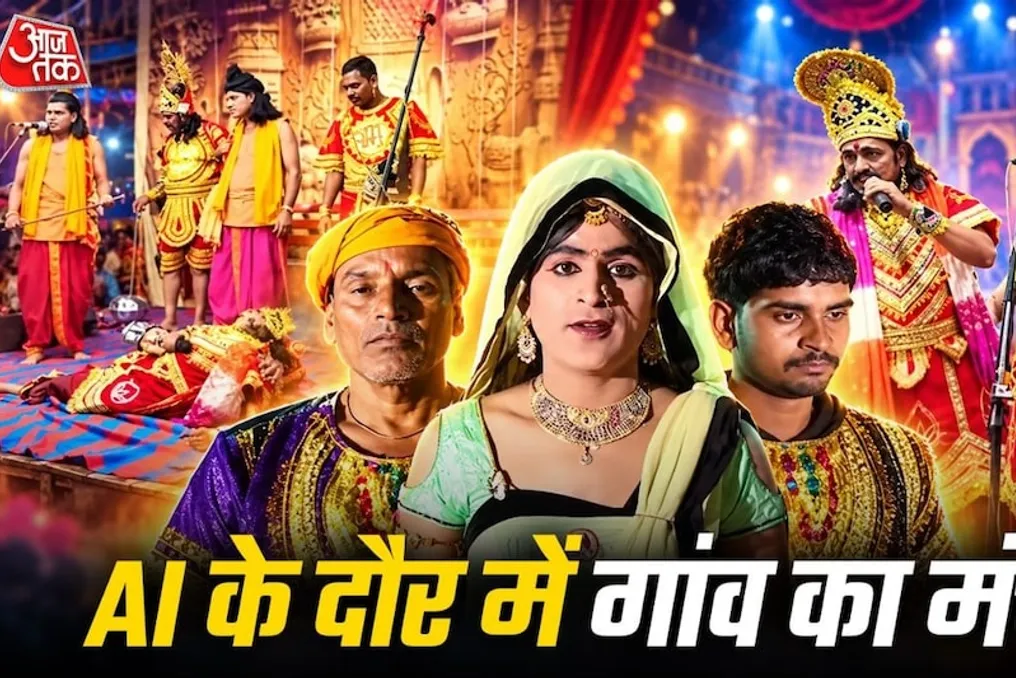
Similar stories

Ramleela Tradition in Agar Malwa Village: Performance Started in 1951 and Continues to This Day
Read more
www.aajtak.in

Ramleela Tradition in Agar Malwa Village: Performance Started in 1951 and Continues to This Day

When evening falls in the town of Tanodia, located in Agar Malwa, Madhya Pradesh, residents begin moving towards the Ramleela ground. They arrive in families, with children or friends. As soon as they reach the ground, attention is drawn to the illuminated stage, ready for the performance, before which a crowd of spectators gathers.

Soon the curtain rises, and Rama, Lakshmana, Bharata, Dasharatha, and Jatayu appear on stage. On the other side are Ravana and Meghanatha. Most of these actors do not come from theatre troupes from Mumbai, Delhi, or Bhopal; they are local residents of Tanodia—teachers, youth, or villagers.

This event lasts for more than one night. From the beginning of the Ganesh Chaturthi festival until Anant Chaturdashi, the story of Ramayana unfolds on stage for a full ten days. This tradition began more than 75 years ago, in 1951, just four years after the country gained independence. At that time, the first Ramleela stage was set up in Tanodia, and the village residents gathered to watch them portray the characters of Ramayana. This cycle continues today, and the light of the tradition burns on the same stage as 75 years ago.

The Ganesh festival in Tanodia is not limited only to the installation and immersion of Ganpati. It is connected to the long-standing tradition of Ramleela, which begins with Ganesh Chaturthi and continues for ten days. Various episodes of Ramayana are shown on stage daily. The climax comes on the day of Anant Chaturdashi, when the event concludes with the royal coronation of Shri Rama. At this time, the atmosphere at the Ramleela ground changes drastically.

Actors prepare on the stage, and spectators take their places: children try to sit closer, while elderly people watch from behind or the sides. As soon as the play begins, mobile phones, televisions, and daily life are forgotten by those gathered. Before them unfolds the story of Ramayana.

A specialty of the Tanodia Ramleela is its actors. The character of Rama is played by a local resident, and Lakshmana by a local teacher. Ravana is played by the same teacher who teaches children during the day. Characters such as Bharata, Shatrughna, Dasharatha, Jatayu, Meghanatha, and Vibhishana are also portrayed by local residents. Thus, the audience sees a person on stage who perhaps just hours earlier was standing in a local shop or teaching at a school.

Teacher Dharmendra Singh Rathore, who plays Ravana, is part of this tradition. He states that it is the cultural heritage of his village, and he participates in it so that the current generation gets acquainted with this tradition. Therefore, playing the role of Ravana is not just acting skill but also a way of promoting the heritage received from the older generation.

Teacher Sarvesh Ghonsale, who plays Lakshmana, also plays an important role. During the day, he is a teacher, but in the evenings during Ramleela, he becomes Lakshmana. For him, Ramayana is not just a religious tale; he believes that the characters of Ramayana teach people how to live an ideal life, which makes this entire Ramleela special even in modern times. Despite the era of mobile phones and artificial intelligence, people still come to watch Ramleela in the evening. They come to see the story, but also to reconnect with their old memories.

Today, entertainment is available in your pocket: take out your mobile phone and watch any movie, series, or video. However, in Tanodia, every year people choose a different path. They leave their homes and head to the Ramleela ground, where they see local residents from their own village portraying the roles of Rama on stage. Teachers perform, villagers portray various roles, and children sit in the front, watching the entire performance attentively.

Thus, Ramleela here is not just an event on stage; it is the entire community acting together. Perhaps this is why Teacher Sarvesh Ghonsale considers this event a way to preserve Indian culture and heritage in the age of AI.

Although the main characters of Ramleela are played by local residents, other artists are invited to add color to the scene. Artists playing the harmonium and dholak, as well as dancers, also participate. Their fees are paid by the Public Ganesh Festival Society. This adds music and dance to the performance, but the true face of the story remains the people of Tanodia.

Generations have changed over 75 years, but Ramleela has remained the same. Imagine that the people who first saw this stage in 1951 probably no longer live. Their children came, and then their grandchildren. Someone saw their father on stage, someone saw their grandfather in the role of Ravana or Rama. Someone watched Ramleela as a child, grew up, and themselves stepped onto the stage. This is the continuity of the tradition.

Popular