The Asian Games in Aichi-Nagoya concluded on October 4th after a two-week competition, in which China secured the top spot in the gold medal table for the twelfth consecutive time. China's technological advancements and design superiority played a key role in all aspects of the Games, from the grand opening ceremony to athlete uniforms and sports venues.
Many Chinese brands and their engineering solutions provided comprehensive systems, demonstrating the strength and flexibility of China's manufacturing and creative industries.
Engineering Solutions at the Opening Ceremony
During the opening ceremony, which featured choreographic performances and visual spectacles, a design team from Dafeng Industry, a Chinese supplier of integrated solutions for the cultural, sports, and tourism industries based in Zhejiang province in eastern China, was responsible for the design, development, and implementation of the stage, the main cauldron, and the digital content.
The team collaborated closely with the organizers, managing the entire process—from creative direction and production to system integration and operational management. A unified platform, running on proprietary Chinese software and hardware, ensured seamless coordination of all critical elements of the ceremony.
Overcoming Environmental Challenges
Nagoya's coastal location presented significant environmental challenges, as the region is susceptible to typhoons and seasonal heavy rains. This required external structures to meet strict standards for wind resistance, seismic safety, waterproofing, and structural redundancy.
Xu Huiwen, Technical Director of the Opening and Closing Ceremonies of the 20th Asian Games and Technical Director of Dafeng Industry's Stage Design Institute, noted that 'the real problem was not one piece of equipment, but the integration of dozens of interdependent subsystems. Even a millisecond delay in lighting, staging equipment, projection, or sound could lead to a major failure.'
Many project issues were resolved using a dual-site coordination model. The team in Hangzhou, Zhejiang province, focused on refining technical plans and developing digital content. Using digital twin technology, they modeled wind flows and light effects around the main cauldron tower at the Nagoya venue, pre-assessed potential risks associated with typhoons and heavy rain, and conducted coordinated subsystem tests and cross-border online reviews.
Meanwhile, the company's smart manufacturing base in Yuyao, Ningbo, Zhejiang, was responsible for equipment fabrication. The entire main cauldron tower was manufactured there, underwent numerous rounds of stress testing and extreme condition trials, and was then packaged and shipped to Japan in August 2026. By conducting extensive debugging and testing in China in advance, the team significantly reduced the amount of on-site construction work required in Japan.
The main cauldron for the 20th Asian Games was manufactured in Yuyao, Ningbo, Zhejiang province in eastern China.
International Experience and Partnership
This is not the first time the team has participated in a large international multi-sport event. Dafeng Industry's technical solutions have previously been used in major events such as the Asian Games in Jakarta, the Beijing Winter Olympics, and the Asian Games in Hangzhou. The company also provided stage support for the G20 summit in Hangzhou, accumulating extensive experience in implementing large-scale engineering projects throughout the process and across national borders. Currently, the company continues to seek ways to export its equipment, creative solutions, and technical standards abroad; its technologies and services have been implemented in over 100 countries and regions worldwide.
Around the Asian Games venues, volunteer Makino moved through the stands in dark green attire, helping to guide spectators. He noted that the uniform was 'incredibly light and breathable. It effectively wicks moisture and dries quickly, which is crucial in high humidity conditions.'
This uniform was manufactured by the Chinese sportswear brand 361 Degrees. As an official Games partner, 361 Degrees provided official sportswear for torchbearers, relay runners, volunteers, and technical staff. The clothing utilizes advanced quick-drying fabrics and ultra-light materials designed to withstand multiple washes without losing performance characteristics. Each cut was optimized using biomechanical modeling and motion simulation research, ensuring athletes and staff remain mobile and comfortable during long periods of outdoor activity.
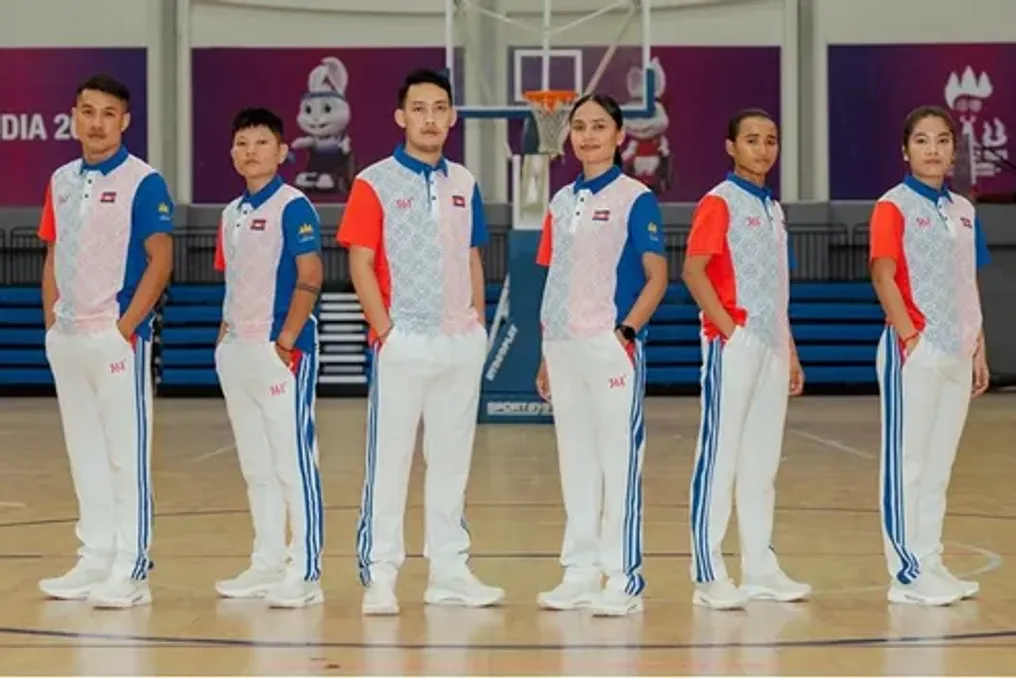
Design details are also present in the uniforms of several national and regional delegations. The Cambodian delegation's uniform draws inspiration from the architectural contours of Angkor Wat, while the Mongolian delegation's uniform features steppe imagery.
For these Asian Games, 361 Degrees developed custom competition uniforms for six national and regional delegations and provided competitive and training gear for the Refugee Team of the Olympic Council of Asia. It is reported that this is the fifth consecutive Asian Games where 361 Degrees has participated, and the total quantity of sportswear supplied exceeds 5.4 million units.
Technical Support for Sporting Events
Inside the gymnasium, the technical team from Taishan Sports, a Chinese supplier of sporting equipment and services based in Shandong province in eastern China, meticulously inspected the equipment. Half a month before the start of the competitions, team members arrived in Japan in groups and began setting up equipment at competition, warm-up, and training venues.
Athletes and coaches are familiar with their technical routines but may not know all the details of the competition equipment. Taishan specialists remain on site throughout the Games to monitor performance and coordinate rapid responses. Wang Wei, Chief Engineer of the support team, emphasized: 'Our protocols allow no deviations. We conduct a full system check exactly one hour before each session—this is a non-negotiable standard.'
In addition to gymnastics, Taishan Sports provides a complete set of competition equipment and comprehensive event support for 16 sports at these Asian Games, including Wushu, wrestling, and cycling. Since equipping the Asian Games in Beijing in 1990, the company has maintained an impeccable reputation: zero failures, zero safety incidents, and zero official complaints.
Wang added: 'From products to services and standards, from elite competition venues to the mass market, we have always moved forward with the mindset of mountaineers striving for great heights. We aim to see Chinese sports brands shine even brighter on the world stage.'