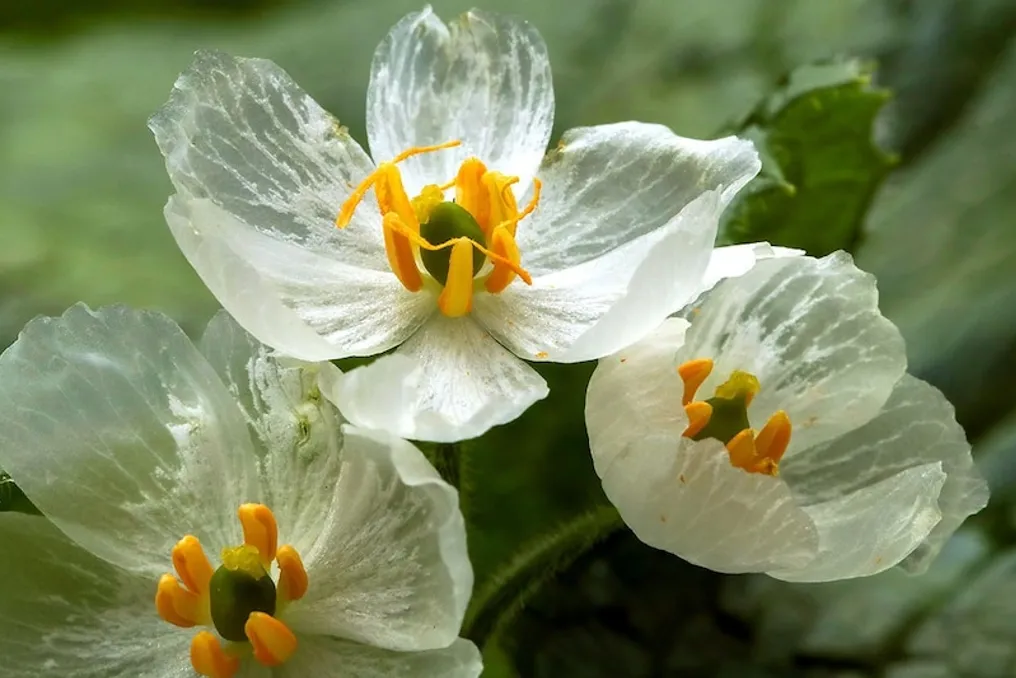
When rain falls on the white petals of the flower, they can become transparent, and this is not the result of any light effect. This unique flower, found in the mountain forests of Japan, is called Diffy Lilia Graey and is also known as the 'skeleton flower.'
In dry weather, the petals of this plant appear white, but after the rain, they begin to look almost transparent. The reason for this lies in the structure of the petals: they contain numerous tiny voids. In their normal state, these cavities are filled with air, which causes light to reflect off the petals, making the flower appear white.
When it rains, these voids fill with water. After this, light begins to pass through the petal much more easily, and they take on a transparent appearance. When the flower dries, this change reverses, and the petals turn white again.
The direct cause of this phenomenon is the structure of the petals. Dry petals contain small air pockets. Due to the difference between air and the rest of the petal, light scatters in many directions, which makes the petal white. When rainwater fills these spaces, the difference decreases, and light passes through the petal more freely. As a result, the white petals begin to look transparent, similar to glass. Thus, the white color of the flower does not suddenly disappear; the rain only changes how light passes through the petal.
The petals of this flower do not become transparent immediately after the first drop of rain. According to a scientific article published in 2023, the petals can become transparent after prolonged light rain lasting about one day. Even after the precipitation stops, the petals may remain transparent for some time until they dry completely, after which they turn white again. Therefore, it is more accurate to say that the color of the flower does not change in the rain, but the transparency of its petals changes.
According to data from Hokkaido University, Diffy Lilia Graey is a perennial plant that can reach a height of 30 to 50 centimeters. It is found in Japan in Hokkaido, Honshu, and Sakhalin, and grows in forests and clearings. Flowers appear around June and July. The plant also has large leaves, which can reach a width of 37 centimeters. The flowers are white and usually consist of six petals. After flowering, fruits form on it, which darken to purple when ripe.
After the rain, when the petals become transparent, their internal veins become clearly visible, causing the flower to resemble a skeleton. This is why it is called the 'skeleton flower.' It is important to note that in the current botanical classification, the accepted scientific name is Podophyllum Graeyii, while Diffy Lilia Graey is a synonym, and both names may appear in different places.
The characteristic of this flower is entirely related to the structure of its petals. Rainwater penetrates the petal voids and alters the mechanism of light passage, causing the white petals to appear transparent. As soon as the flower dries again, air returns to these cavities instead of water, and the petals regain their white color. Thus, the rain does not change the color of the flower, but only temporarily gives its petals a glassy appearance.