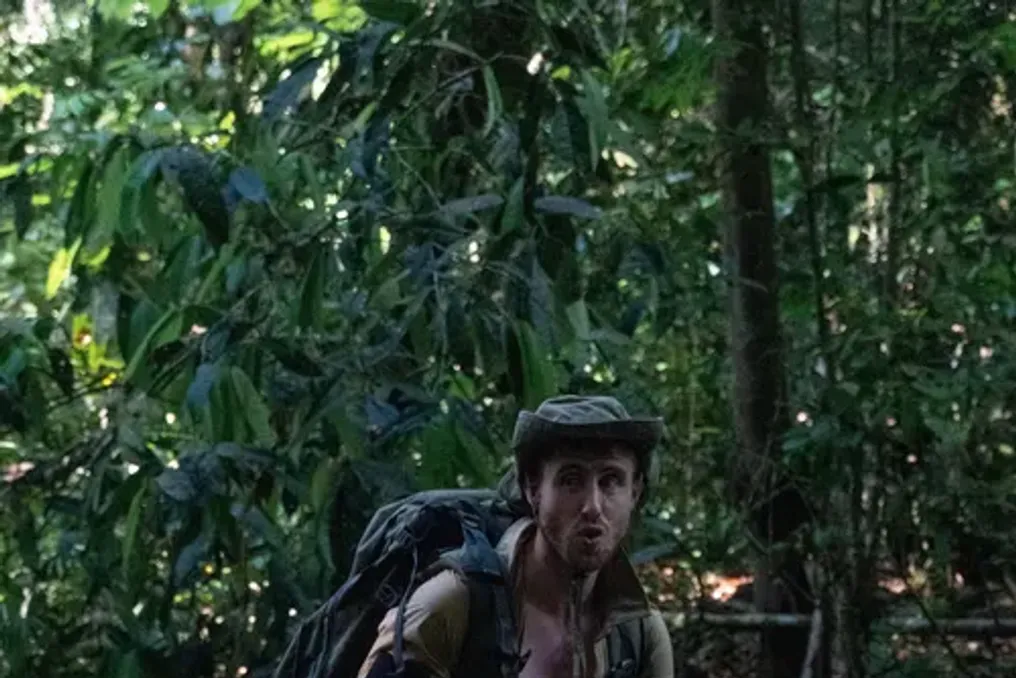
Ash Dix is beginning one of the most challenging expeditions of his career, paddling hundreds of kilometers through the Congo Basin. He is battling isolation, extreme conditions, and threats lurking along the Sanga River.
For most people, the dense forests of Central Africa are a place to be avoided. However, for the British-Welsh traveler Ash Dix, these forests serve as the backdrop for the first and possibly most dangerous mission of a year-long challenge, which will immerse him in one of the world's most remote corners.
Dix undertook a journey of over 700 km along the Sanga River. He is traveling in an inflatable kayak from Nola in the Central African Republic (CAR) to Mossaki in the Democratic Republic of Congo (DRC), where the Sanga River flows into the Congo River.
This expedition is the first part of the ambitious 'Project 6'—a series of six extreme journeys in six different environments over 12 months. The trek is expected to take about three to four weeks, meaning Dix will likely reach Mossaki in late October or early November 2026, depending on route conditions.
However, the journey to the starting point was an adventure in itself. Dix and his team initially headed to Cameroon but discovered that important luggage containing equipment, including inflatable kayak pumps, tents, food, and water, was lost. The team later managed to find the luggage but faced visa issues that prevented them from entering the CAR as originally planned. They eventually reached Nola, the official starting point of the expedition, after a difficult land crossing complicated by bad weather, roadblocks, and fallen trees.
Into the heart of the Congo Basin
The Congo Basin is much more than just one forest or one country. It is an extensive geographical region centered around the Congo River system and its tributaries. Its forests cover Cameroon, the CAR, the DRC, Equatorial Guinea, and Gabon.
This region includes the second-largest tropical forest ecosystem on Earth after the Amazon, covering approximately 500 million acres. It is also one of the planet's greatest biodiversity hotspots, supporting gorillas, chimpanzees, forest elephants, buffalo, and hundreds of other mammal species, as well as thousands of birds, fish, and plant species. The forest also plays a vital role in carbon sequestration and climate regulation.
Nevertheless, for Dix, this extraordinary environment is not just scenery; it is the landscape in which he must survive.
Crocodiles, hippos, and elephants
Dix will paddle hundreds of kilometers through a landscape where there may be no easy escape if problems arise. The Sanga region is home to Nile crocodiles, hippos, forest elephants, western lowland gorillas, and chimpanzees, among others.
UNESCO describes the Sanga Tri-National Park, where the CAR, Cameroon, and DRC meet, as a largely untouched tropical forest ecosystem with exceptional biodiversity. The water itself can also be dangerous. A significant portion of the route will be on an inflatable kayak, and Dix noted that the vessel can be deflated and carried in particularly dangerous areas, such as where hippos congregate.
While dramatic encounters with wildlife might attract attention, Dix acknowledged that animals are not necessarily his primary concern. Among the risks he is preparing for are malaria, infections, intense heat and humidity, contaminated water, and the vast distance to proper medical care.
Days away from help
The remoteness of the expedition is perhaps its most daunting aspect. A medical emergency in a large city might mean an ambulance is minutes away. In the depths of the Congo Basin, the reality can be completely different.
Dix has prepared with medical supplies, satellite communication, food, and emergency evacuation plans. He is traveling with a small team, including a local guide and a videographer. He also plans to spend time studying the culture of the Baaka people, whose generations of experience living in the rainforest provide knowledge that could prove crucial during the journey.
The researcher, who holds five Guinness World Records, called the Congo one of the most hostile environments he has attempted to explore. Despite all the dangers, the expedition is also intended to shed light on a part of the world rarely seen outside its borders.
Dix states that 'Project 6' is dedicated to exploring endurance, human resilience, and documenting the people, wildlife, and environment he encounters. His first mission will take him from the forests around Nola, down the Sanga, and towards Mossaki. By the time he reaches the Congo River, hundreds of kilometers of paddling, nights in the jungle, wildlife encounters, and physical hardships will separate him from the completion of Mission 01. Five more extreme environments await him.