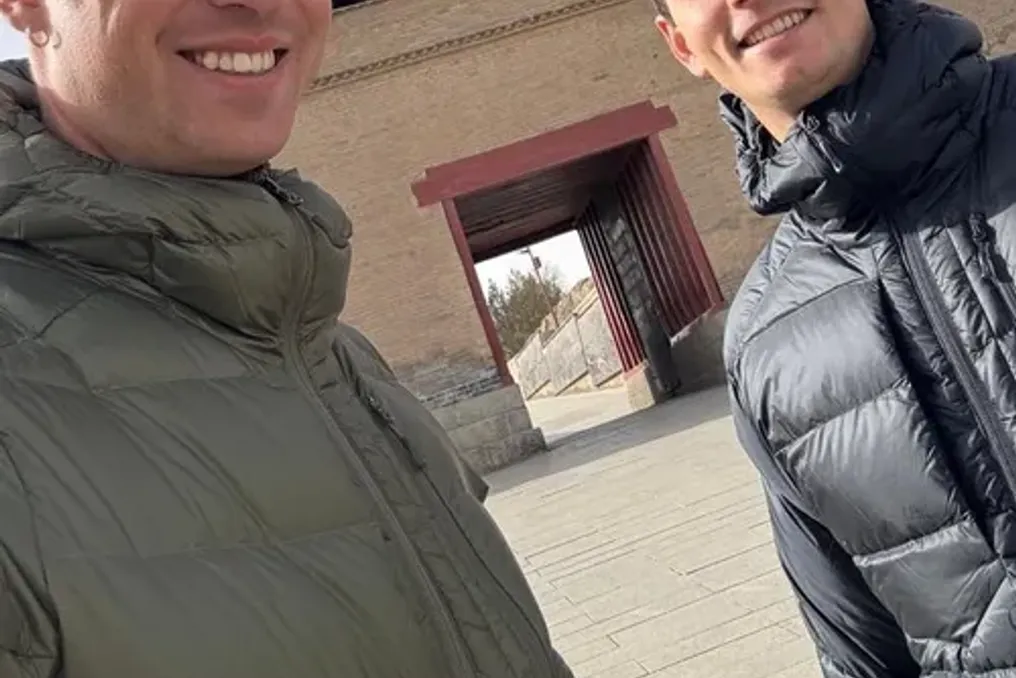
Two French travelers, Loïc Voazot and Benjamin Hamblo, achieved their goal—Shanghai, China—by walking for 518 days. Loïc Voazot expressed extreme joy upon arriving in Bund Shanghai earlier this year, despite his hoarse voice after the long journey.
Across the Huangpu River shone the Oriental Pearl, a landmark of the financial center of Lujiazui in Shanghai. During the entire trip, the men covered the distance from the foothills of the French Alps to the banks of the Huangpu River, crossing 16 Eurasian countries and following the ancient Silk Road eastward. Along the way, they engaged in significant dialogue with both ancient civilizations and modern China.
Before starting the trek, Voazot and Hamblo led regular lives in Paris: Voazot worked in corporate sustainability, while Hamblo managed software products. Both loved nature and hiking since childhood, as they grew up near the Alps. Their knowledge of China was previously based mainly on textbooks, news reports, and a few cultural images. Voazot noted that they were very eager to see China up close, and Hamblo suggested simply walking there step by step.
The idea of a walking journey, initially seeming crazy, gradually solidified in their minds. They agreed that walking was an excellent way to immerse themselves in local culture and meet new people. Three months before departure, they quit their jobs and began preparing for the trip. In September 2024, they set off on their planned adventure.
Every video they posted on their joint social media account began with the phrase, 'Day XX of the journey to China!' China served not only as a clearly defined point on the map but also as a beacon guiding them throughout the long route.
Overcoming Physical Difficulties
The physical demands of such a journey were colossal. According to their plan, they had to cover an average of 45 kilometers daily. By evening, their legs often hurt so much that it was difficult to stand. Nevertheless, they claimed they never seriously considered giving up because they were fulfilling their dream.
A year and one week after starting, they reached Khorgos Port in the Xinjiang Uyghur Autonomous Region in northwestern China, beginning a transition across China lasting more than four months. They were deeply impressed by the sharp contrast between the desert they saw just before crossing the border and the high-rise buildings, bustling streets, and hotel robots they encountered after entering.
They were surprised not only by the urban landscape diversity. They encountered an unfamiliar digital lifestyle in China. With the help of locals, they quickly mastered WeChat, Alipay, and maps, learned to pay for purchases using QR codes, navigated, and booked hotels, as well as learned several useful Chinese phrases.
Many cross Eurasia today in various ways, but few have completed such a long journey relying almost exclusively on their own strength.
Encountering History and Culture
Along the way, they often noted how time and space seemed to merge. Crossing Eurasia, they felt part of the long history of the ancient Silk Road. In Venice, Italy, they visited the former residence of Marco Polo. Upon reaching Zhangze in Gansu Province in northwestern China, they visited the statue of Marco Polo and paid tribute to the 'pioneer' who facilitated exchange between Eastern and Western civilizations.
Many places they passed through—from Georgia and Turkey to Central Asia—were once important hubs of ancient Eurasian trade and transport networks. Hamblo observed that the ancient Silk Road has not disappeared, but merely changed its form: camel caravans are long gone, but they observed trucks speeding along highways and constantly passing freight trains. He concluded that the flow of goods and connections between regions has never stopped, and perhaps even become more active and closely linked.
The walk from Xinjiang to Shanghai allowed both of them to personally experience the vast geographical and cultural diversity of China, as well as visit places rarely seen by ordinary foreign tourists.
"We passed through villages and settlements, saw farmers working in fields, grain drying in courtyards, and the hustle and bustle of roadside stalls. We also saw straight roads, well-developed lighting, and sections of solar panels in remote areas," they shared. In their eyes, the combination of traditional rural life and modern infrastructure created vivid, tangible images of China.
People and Cultural Exchange
The people they met turned out to be more memorable than the landscapes. Some villages might not have seen foreign visitors for years. When children noticed the two travelers, they would curiously gather around. Communicating in a mix of awkward English and broken Chinese, they would happily converse with the pair. Locals often offered them water and snacks, and repeatedly asked if they needed any help.
Invitations to meals also happened frequently, giving them a direct insight into the 'sweet burden' that cultural differences can carry. Hamblo recounted with a laugh that in France, finishing everything on the plate is a sign of respect for the host, whereas here, every time they finished eating, the hosts thought they were still hungry and brought them more food. Eventually, they had to learn to clearly state that they were truly full.
Throughout the journey, they shared their experiences on Chinese platforms such as Xiaohongshu and Douyin. Their bold adventure quickly attracted a large number of followers. More and more users offered advice on routes, weather, and supplies, and some even traveled to meet the pair along the way.
On the last day, about 70 Chinese and foreign followers spontaneously joined them for the final 10 kilometers. Some specifically traveled from other cities to Shanghai to participate. Both said that the moment of completing the journey together with everyone was unforgettable, as they walked and talked in an incredibly warm atmosphere.
Hamblo concluded that this trip changed their one-sided view of China, noting that the country is vast and holds many wonders to discover. For these travelers, arriving in Shanghai was not an end, but rather the opening of a door to a new beginning. Hamblo added that although China and France are far apart on the map, the distance between China and France in their hearts has become much smaller, and they feel closer to the Chinese people.