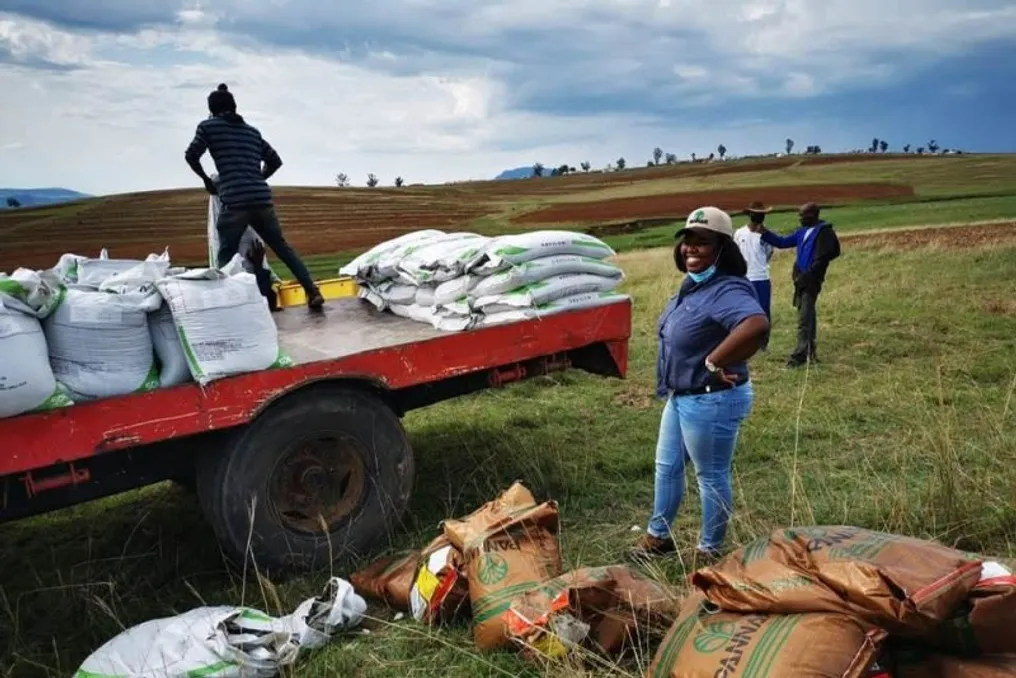
Growing up between rural life and the urban environment created difficulties for Felisa Ndayi, which prompted her to self-improve, work harder, and gain self-confidence. Today, Ndayi is an agronomist and co-founder of Lusa Agri Solutions, which provides farmers with agricultural consulting, training, and crop care services.
Ndayi realized early on that a brilliant mind does not guarantee an easy life in any setting. Although she was born in Tambisa, Johannesburg, at six months old, she was sent to live with her grandparents in the village of Kaba, Diyetwa district, Eastern Cape, while her young mother, Thembakazi, continued to work.
Kaba became her home. Surrounded by her grandmother and aunt, Ndayi began learning at the age of four, becoming the youngest student in the class. In addition to schoolwork, she participated in household chores, including grazing family sheep. She recalls: 'I liked this responsibility, and I carried it out diligently, which pleased my great-grandfather.'
Just before the 8th grade, her mother brought her back to Johannesburg and enrolled her in Observatory Primary School. Coming from a rural school where English was not the main language of instruction, Ndayi faced difficulties communicating in English and was held back four grades. She notes: 'It was a difficult adaptation. I found myself in an unfamiliar environment, and I didn't know my mother very well.'
Her mother organized extra English lessons until Ndayi caught up. Later, she transferred to Athlone High School, where she joined the choir, played basketball, and became a school monitor. Additionally, she secretly volunteered at a children's center and a nursing home, which her parents did not know about. Ndayi says: 'Eventually, the school found out and rewarded us.'
Agriculture was not initially a career Ndayi considered. She planned to become a geologist or architect until her cousin introduced her to soil science and explained that it was a scarce skill at the time.
In 2007, Ndayi enrolled at Fort Heir University for a Bachelor of Science in Crop Science, completing the five-year course in four years. She admits: 'I didn't like the major from the beginning.' By her second year, she started skipping seminars and had to take four supplementary exams until her mother sent her an encouraging message. She recalls: 'I cannot remember every word, but I remember her saying: 'My child, do not despair.'
Ndayi worked hard, passed all four exams, and never looked back. For her thesis, she studied the effect of the corn soil bacterium Bacillus thuringiensis (Bt) on earthworms. Ndayi explains: 'I worked with red worms in separate trays, feeding, weighing, and counting them. My family thought I was crazy! I went from skipping seminars to conducting vacations while caring for worms.'
She then obtained a Master's degree in Soil Science from the University of KwaZulu-Natal, researching how land use changes affect soil properties in Sedara wetlands. Simultaneously, she worked at the KwaZulu-Natal Department of Agriculture as a graduate extension inspector assistant. Later, she worked in agronomy, conducting trials of varieties including maize, potatoes, dry beans, and soy, before moving to plant protection.
Ultimately, Ndayi joined Pannar Seed in the Eastern Cape as a sales representative, working with farmers, extension inspectors, and scientists through demonstrations and field trials. She emphasizes: 'At Pannar, I could work with my hands and interact directly with farmers, extension inspectors, and scientists.'
Later, she became a member of the seed committee at the Eastern Cape Development Corporation, using radio and social media to disseminate agricultural knowledge.
In 2021, Ndayi, along with her business partner Lubabalo Bunu, founded Lusa Agri Solutions. She manages the crop care division, providing consultation on land use, soil fertility, crop care, and business plans. Earlier this year, she developed two business applications. One is used by her administrative staff and interns for information access, and the other is intended for farmers and will serve as a cattle sales catalog.
While building her business, she earns extra income by selling vegetables. Ndayi states: 'I will never use my current situation to discourage anyone from studying agriculture.'
Ndayi believes that her experience has taught her that food security depends on daily decisions on the farm, ranging from soil care and selecting appropriate seeds to water management and maintaining animal health.
Changes in weather conditions, she says, require constant learning and adaptation from farmers. She asserts: 'We cannot assume that familiar planting seasons or practices will always yield the same result. My experience in soil science taught me to understand the land before giving recommendations, and to value soil conservation and careful water use.'
Ndayi cautions against assuming that farmers are uninformed when they are simply not applying certain methods. Sometimes, as she points out, the information simply doesn't reach them clearly. She believes that farmers should question conventional methods and consider new evidence, while scientists and corporations must also listen to farmers and acknowledge the knowledge gained from working with the land.
Ndayi's plan is to own a farm under the umbrella of Lusa Agri Solutions. She urges students aspiring to study agronomy that agriculture offers more than just a job; this knowledge can be used for food production, service provision, consulting, or starting one's own business.