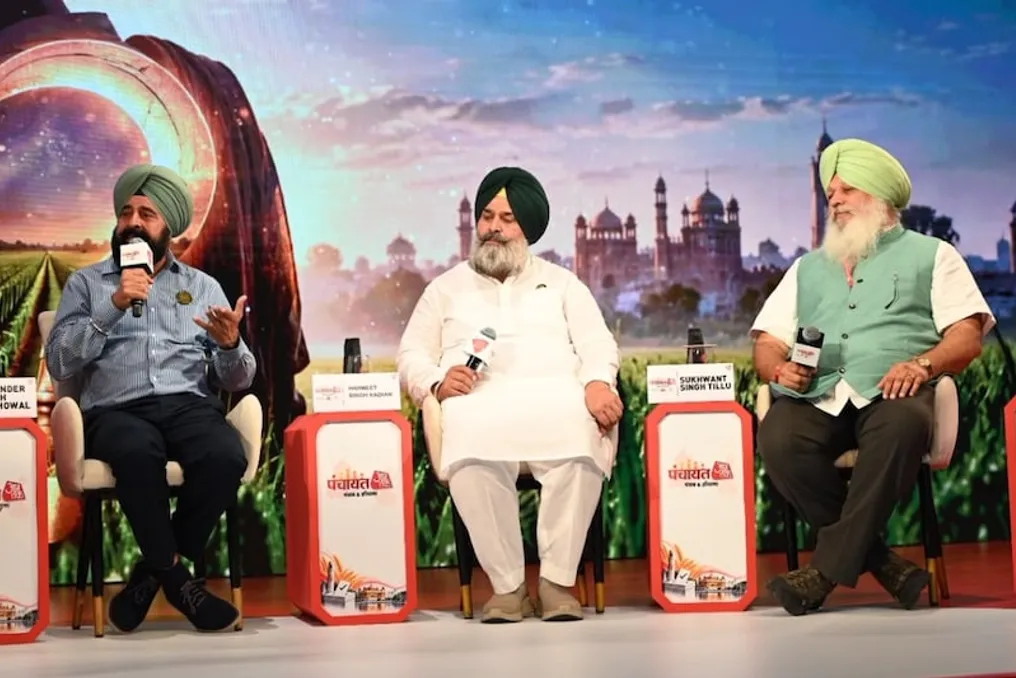
At the Aajtak Panchayat forum in Punjab, opinions among farm movement leaders diverged regarding stubble burning (rice residue) and the associated air pollution. During the event, as a reporter questioned them about stubble management methods and toxic air, the leaders presented various viewpoints and began challenging each other's arguments on stage.
Leaders of farmer organizations openly discussed the current protests in Punjab, the Minimum Support Price (MSP), and the growing debt burden on farmers. When asked if repeated protests were the only remaining path, they unanimously stated that they were forced to choose the protest route because governments were ceasing to accept their proposals.
Harinder Singh Lakhowal, General Secretary of the Bharatiya Kisan Union, mentioned his organization's long struggle for farmers' rights since 1970. He compared the current situation to the period of 1966–1967, noting that the prices of bricks, tractors, gold, and labor had increased by 30–500 times. However, despite this inflation, farmers' agricultural product prices had not risen, leading farmers into a debt trap. He stated that both parties, Congress and BJP, had promised much to the farmers but failed to fulfill their commitments, forcing demonstrations on issues such as MSP, debt waiver, and land acquisition.
Sarwan Singh Pander, leader of the Farmers and Workers Struggle Committee, expressed regret over the economic hardship faced by farmers. He emphasized that no one organizes pickets for a hobby. He recalled that in the 1960s, when MSP was introduced, farmers from Punjab and Haryana, investing heavily in preparing their land, ensured the food basket for the entire country. Nevertheless, looking at economic indicators, the farmer's position was constantly deteriorating, and they were always operating at a loss. He concluded that when all doors are closed, protest remains the last option for a farmer in a democratic country to make their voice heard.
Sukhwant Singh Tillu, Vice President of Punjab Kisan Morcha, asserted that the farmers' demands are entirely justified. Today, Punjabi farmers are forced into unprofitable activities. As long as governments do not develop a firm and sustainable policy regarding income guarantee and MSP for farmers, this struggle will continue.
Vice President Sukhwant Singh Tillu of Punjab Kisan Morcha raised questions about the methods used by farmers and farmer unions concerning stubble burning. Tillu noted that today's farmer is completely dependent on hired labor and burns fields to manage work 'the easy way,' avoiding hard labor. He urged farmer unions to visit villages instead of protesting to raise awareness among farmers and youth. He also pointed out that farmers benefit from central government schemes, such as the Farmer Respect Fund. Furthermore, money is now provided for stubble collection and subsidies for machinery, making field burning irrational.
In response to Sukhwant Singh Tillu's statements, Harinder Singh Lakhowal, General Secretary of the Bharatiya Kisan Union, placed the blame entirely on the cost of agriculture and machinery. Lakhowal stated that in the 1990s, Kurukshetra University and Punjab Agriculture University (PAU) advised burning fields to destroy mold by cutting rice in small pieces. Farmers adopted this method, but now the same institutions say the opposite. He argued that even with a 50% subsidy, the equipment for stubble management is so expensive that small farmers cannot afford it. He added that a machine operating only 20 days a year requires interest payments throughout the year. He claimed that the number of burning incidents in Punjab has decreased by more than 80%, yet the blame for pollution in Delhi and NCR is still placed on Punjab farmers.
Sarwan Singh Pander, leader of the Farmers and Workers Struggle Committee, demanded direct financial assistance (cash subsidy) to prevent stubble burning. Pander noted that small farmers in Punjab lack expensive tractors or funds. He insisted that the government should provide a direct subsidy of 3000 rupees per acre for stubble management. He also reminded that no government helped when crops perished due to floods or other reasons. He stressed that until farmers receive direct financial support, burning incidents cannot be completely stopped.
Concerns over groundwater depletion and global warming
At the event, the farm movement leaders also discussed crop diversification and groundwater level reduction. Pander and Lakhowal noted that due to intense heat and global warming, the rice yield this season dropped from 33 to 30 quintals per acre or even lower. They stated that the only sustainable option to save water for the planet and the future of Punjab is to promote agro-industry and new technologies.