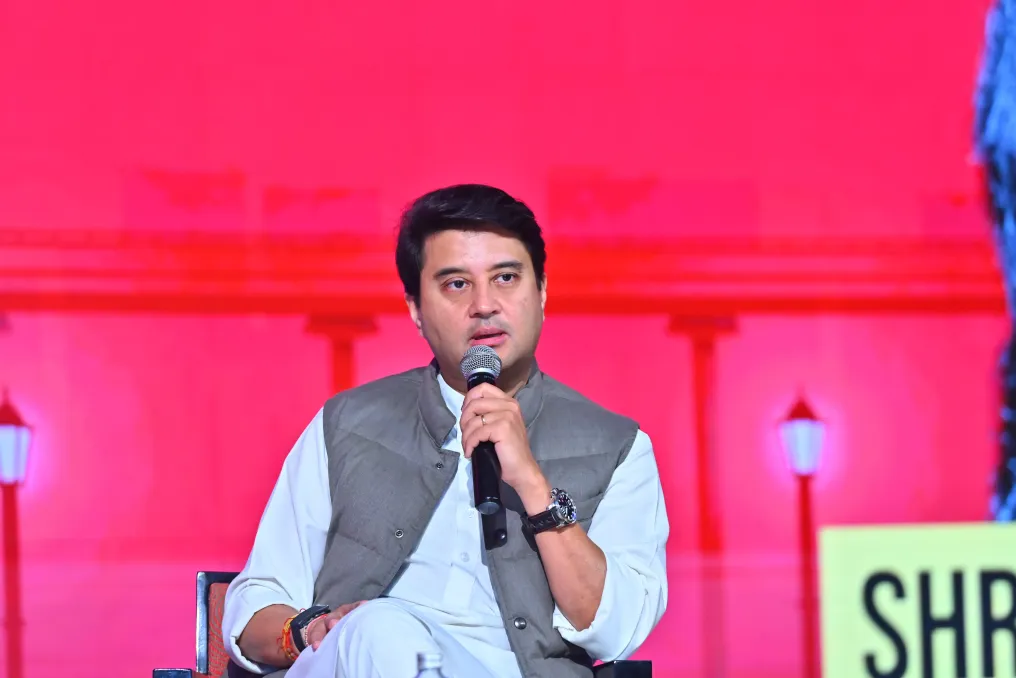
India's Telecom Minister Announces Plans to Reach 1 Billion 5G Users by 2030
Read more
YourStory [india, en]
yourstory.com

India's Telecom Minister Announces Plans to Reach 1 Billion 5G Users by 2030

India's Minister of Communications, Jyotiraditya Scindia, stated that India intends to double its 5G user base, increasing it from the current 550 million to one billion by 2030. He also emphasized the country's determination to lead the global 6G industry, despite previously lagging behind world leaders in 4G technology.

Speaking at the opening of the tenth edition of the Indian Mobile Congress (IMC) in 2026, Scindia noted that 5G in India has become the fastest-adopted technology globally. He clarified that while the current number of users is 550 million, the goal for 2030 is to reach a billion customers.

Regarding 6G, Scindia mentioned that the Bharat 6G Alliance, involving 90 institutions, has already patented 7,700 patents, 4,400 of which are international. The minister stated that although India lagged in 4G, it successfully navigated the 5G phase and is now aiming to become a global leader in 6G.

Furthermore, it was announced that the ITU Council accepted India's proposal to host the World Conference in 2030. Scindia also pointed out that the ITU Telecommunication Standardization Assembly (WTSA) was held in India for the first time in 2024, becoming the largest WTSA held outside Geneva in ITU history.

Describing the development of India's telecommunications sector since the first IMC in September 2017, Scindia reported that the number of broadband subscribers has grown from 60 million to over 1.1 billion, and the total number of mobile subscribers has reached 1.35 billion. The cost of a gigabyte of data has dropped from 268 rupees in 2014 to 8 rupees, which he called the lowest in the world.

In terms of digital infrastructure, he highlighted the significance of UPI, which facilitates 84% of all digital transactions in India and 49% of global digital operations. UPI processes 260 billion transactions annually worth $3.4 trillion, and this technology has been adopted in 11 other countries.

The minister also introduced the BharatNet program, funded by the government with $15 billion, which will connect middle-tier Gram Panchayats to nearly 2.6 lakh villages. This program will also provide on-demand internet access to the remaining 3.8 lakh villages, guaranteeing a 100 Mbps connection to every household.

Concerning manufacturing, Scindia noted that the mobile phone industry, valued at about $2-3 billion in 2014, is now an industry worth $63 billion. India ranks second globally in mobile phone manufacturing, and exports approach $29 billion.
Similar stories

Suzlon Expert Predicts India's Wind Power Could Exceed 250 GW by 2035
Read more
business-standard.com

Suzlon Expert Predicts India's Wind Power Could Exceed 250 GW by 2035

Girish Tanti, co-founder and vice-chairman of the Suzlon group, predicts that due to growing demand, India's wind power capacity could reach 250 gigawatts (GW) by 2035. This forecast significantly exceeds the current government target of 155 GW.

Tanti believes that the government will soon revise this target upwards to approximately 250 GW. He attributes this optimism to high demand levels, supply readiness, and the natural compatibility of wind energy with India's load profile. Furthermore, according to annual demand plans across all states, the need for wind energy is expected to reach about 147 GW by 2035.

An additional 100 GW of demand from the open access market for the Commercial and Industrial (C&I) sector could raise the total demand close to 250 GW. Moreover, a recent government study indicated that transitioning to the least-cost path by adding 93 GW of wind capacity and achieving a total capacity of 250 GW would allow the Central Government to save approximately 2 trillion rupees on imports.

Currently, the sector is moving towards meeting the government's goal of 100 GW of wind power by 2030. To date, about 59 GW of projects have been completed, 29 GW has been auctioned and is under implementation, and another 15 GW is under construction for the open access C&I market. Tanti noted that these figures total around 103 GW, which guarantees the achievement of the 100 GW target by 2030.

This major industry player anticipates that India will become a global supply chain hub in the near future. Exports are planned for Southeast Asia, Europe, and the broader Global South, including Africa and South America. He added that exports to the US will also grow as trade relations improve (for example, between the US and India), and since about 133 countries use wind energy globally, this represents a significant export market for Indian manufacturers.

In Tanti's view, the industry will soon overcome power transmission challenges. Historically, transmission systems were built for traditional energy projects with maturation periods of about four years, allowing for a more relaxed approach. In contrast, renewable energy projects—solar, wind, and hybrid—require only 18 to 36 months to launch. He emphasized that government efforts are aimed at closing this gap, and within 18–24 months, grid construction will align with project timelines. The cycle in India, which is three to four years, is in a good position compared to developed countries where grid construction wait times are four to six years, and this gap will narrow in the coming years.

Currently, India's annual production capacity for wind turbines and components stands at 28–29 GW, which is higher than the expected installations of approximately 8 GW this year. He also reported that annual installations are likely to reach 13.5 GW by 2030. Furthermore, there is a large untapped wind resource, with the potential for onshore generation estimated at about 1.1 terawatt.

Popular