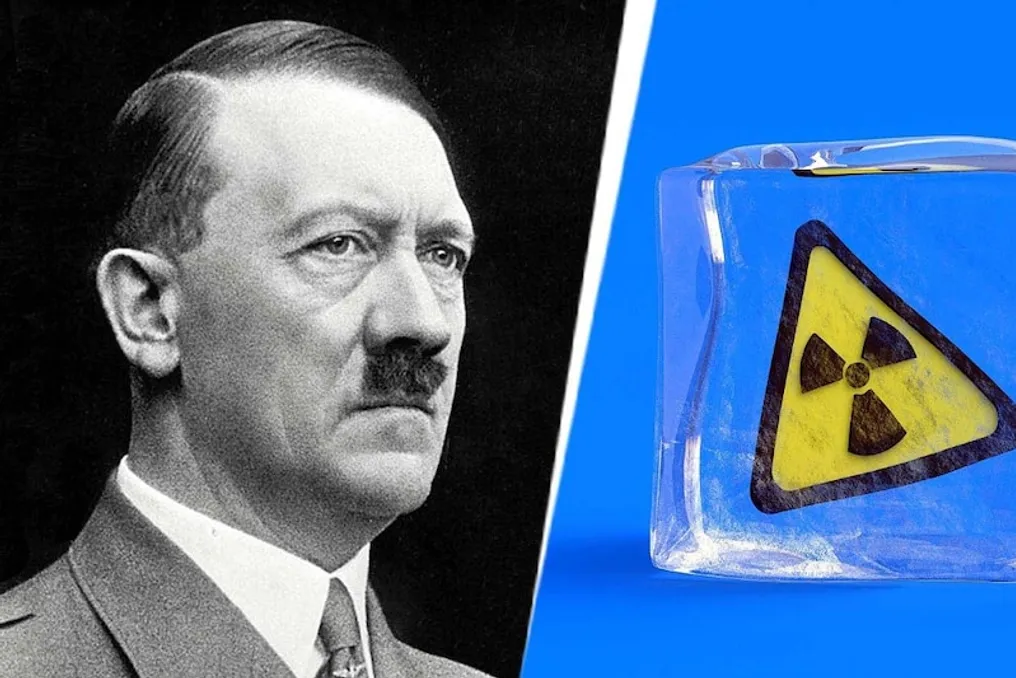
During World War II, Nazi Germany attempted to create an atomic bomb, leading German scientists to work on developing a nuclear reactor. However, a new scientific study revealed that Germany simply lacked the sufficient amount of uranium and heavy water required for such a reactor to function.
Scientists conducted a re-analysis of this German nuclear experiment using old documents, remaining pieces of uranium, and computer models. This experiment was carried out by a team led by German scientist Werner Heisenberg in 1945 and was designated B8. It utilized 664 pieces of uranium placed in heavy water. The goal was to create a reactor where a nuclear chain reaction could proceed continuously, but this was not achieved.
According to the results of the new study, even if all the uranium and heavy water available in Germany had been gathered in one place, starting the reactor would still have been difficult.
The remaining pieces of uranium played a key role in this study. During Germany's nuclear tests, about 1100 pieces of uranium were used, each approximately 5 centimeters wide. To date, only the location of 14 of these pieces is known. The research group examined two of them, which helped scientists understand the characteristics of the uranium used at the time. Subsequently, based on old records, it was determined how much uranium and heavy water were present in reactor B8 in 1945.
Reactor B8 contained approximately 1538 kilograms of uranium and 1549 kilograms of heavy water. Scientists recreated this reactor using computer models to study neutron behavior. The model showed that the neutron multiplication factor in B8 was about 0.94. In simpler terms, if 100 neutrons were produced in one cycle, about 94 useful neutrons remained in the next cycle. For a continuous chain reaction to be maintained, this number needed to be close to 100.
According to new calculations, launching the reactor required about 3000 kilograms of uranium and between 3500 and 3800 kilograms of heavy water. This means nearly twice as much uranium was needed as was in B8. The demand for heavy water also exceeded the available amount by more than twofold. Even when summing up the estimated reserves of the entire German atomic program, only about 2572 kilograms of uranium and 1890 kilograms of heavy water were available, which was also insufficient for a functioning reactor.
Heavy water is necessary in a nuclear reactor to slow down neutrons, which allows the process of uranium atom decay to advance. Norway was the main source of heavy water for Germany; however, during the war, the heavy water production plant was repeatedly attacked. This made obtaining the necessary volume of heavy water extremely difficult for Germany.
Scientists also studied the possibility of replacing heavy water with graphite. Nevertheless, the German graphite contained impurities that absorbed neutrons, making it impossible to start the reactor using graphite.
A successful nuclear reactor could have led to the production of plutonium, which would then be used to create an atomic bomb. However, Germany faced a shortage of necessary materials from the initial stage. The new study does not prove that Heisenberg intentionally hindered the creation of an atomic bomb by the Nazis. Nevertheless, the data clearly show that Germany did not have enough uranium and heavy water to create a successful nuclear reactor, which was the reason for the halt of its atomic program.