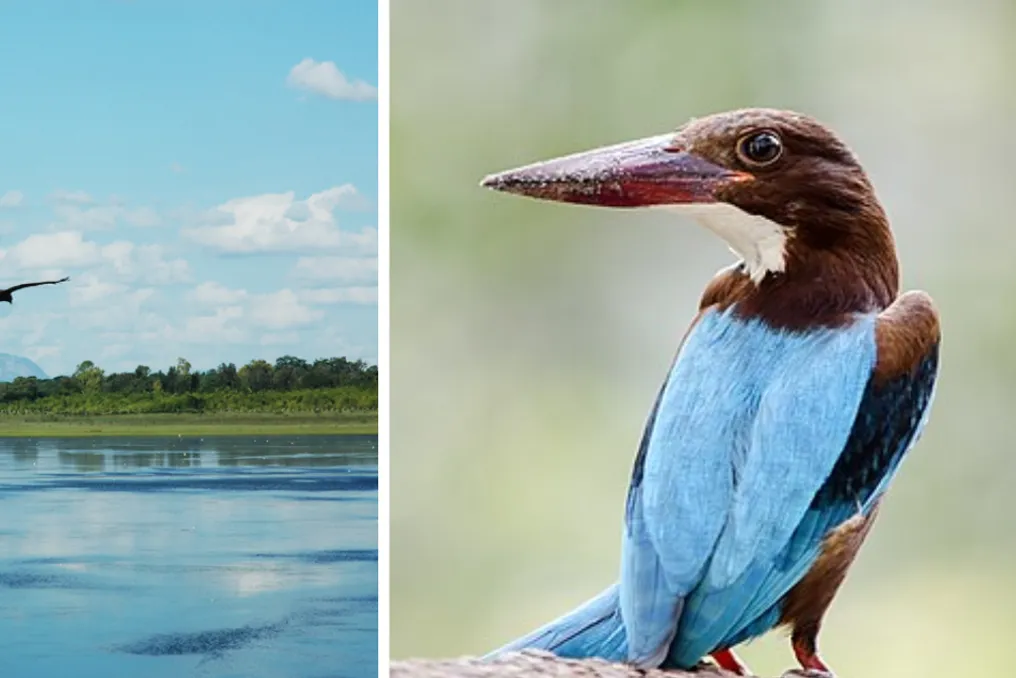
At first glance, Hesaraghatta appears as an undeveloped plot of land on the outskirts of Bengaluru, lacking dense forests or tall trees; only grass, shrubs, seasonal wetlands, and a large lake bed are visible.
However, this seemingly open landscape supports over 285 species of birds, as well as amphibians, butterflies, and other wildlife. Migratory birds arrive here in winter after journeys spanning thousands of kilometers.
Furthermore, the grassland plays an important role as part of the Arkavathi River catchment basin and the Tippagondanahalli reservoir, linking this open landscape to Bengaluru's water supply system. What appears to be unused land from afar is, in fact, a functioning ecosystem.
In February 2025, after nearly two decades of campaigns, research, legal battles, and delays, the Karnataka government officially declared 5678 acres and 32 guntas in the Yelahanka taluk as the Great Hesaraghatta Grassland Reserve (GHGCR).
The notification describes this area as having ecological, faunistic, floristic, and geomorphological significance. Its role as a catchment basin and a water source for Bengaluru is also recognized. Legal protection was secured after many years of effort to prove the value of a landscape often perceived as merely open territory.
It was never just 'empty land'
Grasslands are easily overlooked because much of their biodiversity is not visible from a distance. Researchers in Hesaraghatta have documented this biodiversity for years. Ornithologist S Subramanya, who studied birds in this landscape for decades, documented 133 bird species, 39 species of local shrubs, 10 mammals, and five reptiles in an early biodiversity assessment. His work formed the scientific basis for the landscape protection efforts.
Later reports recorded about 235 bird species, nearly 400 insect species, and around 100 butterfly species, including the rare purple silver line. It was also noted that some insect species found there were described as new to science.
The figures provided by the Karnataka government are even greater. The notification records over 285 bird species, 13 amphibian species, and 111 butterfly species, along with otters and other wildlife. The landscape is also used by thousands of migratory birds arriving from the Palearctic region, including Central Asia and the Arctic.
Among the registered birds is the Lesser Florican, classified as endangered on the IUCN Red List. Raptors also utilize the open habitat, including species such as the large spotted eagle. This is why the landscape cannot be understood simply as land around a lake; it is a system of grasslands and wetlands where different habitats support each other.
As scientist K S Gopi Sundar stated in Mongabay in 2021, Hesaraghatta represents a system of freshwater wetlands, grasslands, and marshes that is becoming increasingly rare worldwide. Its open habitats support insects, which in turn feed birds and reptiles.
Water beneath the grass
Hesaraghatta is located in the Arkavathi basin, and the wider landscape is part of the Arkavathi River catchment, Hesaraghatta Lake, and the Tippagondanahalli reservoir. In 2017, researchers from ICAR-Indian Institute of Horticulture and BMS College of Engineering conducted a study on water conservation and groundwater recharge in the Arkavathi basin around Hesaraghatta.
Using hydrogeological and topographical analysis, researchers identified areas suitable for rainwater harvesting and infiltration. Studies of the broader Arkavathi catchment also documented long-term changes in stream flow and land use, including the expansion of groundwater-irrigated agriculture and eucalyptus plantations.
This makes the open landscape important beyond its wildlife. The grassland is part of a larger system through which rainwater flows, seeps, and nourishes the surrounding catchment basin.
Two decades of the fight for protection
Attempts to formally protect Hesaraghatta entered the courts in 2012. That year, photographer Mahesh Bhat and the public group Arkavathi Matu Kumudvati Nadi Punashthan Samiti, of which he was a patron, filed a public interest suit in the High Court of Karnataka demanding the protection of about 5000 acres of grassland. Development plans threatened parts of the landscape that were also linked to proposals for creating a township.
By the end of 2012, Bhat began working with conservationist Ramki Srenivasan and ecologists Dr. K S Sesadri and Dr. M B Krishna on a formal proposal to grant the landscape legal protection. The proposal called for declaring about 5000 acres, including the lakebed, a Reserve under Section 36A of the Wildlife Protection Act of 1972.
The proposal was submitted to the Karnataka Forest Department around 2013–2014. The department surveyed the area and demarcated its boundaries. Three years after filing the public interest suit, the Karnataka government guaranteed that the land would remain protected while its future was decided. Around the same time, 345 acres that had been leased were returned to the Animal Husbandry and Veterinary Services Department.
Then, nothing happened for years. In 2020, the Animal Husbandry Department supported the proposal presented to the State Wildlife Board. The board rejected it. The campaign also faced local opposition. According to conservationists involved in the campaign, misinformation spread among the local population that the protected status would strip people of rights and could lead to the release of animals such as lions, tigers, elephants, and bears into the grassland.
At one point, a group surrounded Bhat's house and demanded that he stop pursuing protected status. He requested police protection. At that time, Conservation India, founded by Srenivasan, was used to debunk the misinformation and explain what a reserve actually means. Conservationists emphasized that such a reserve could only be established on government land, and existing rights would not be violated. The final notification directly addressed this issue.
When the Great Hesaraghatta Grassland Reserve was notified in February 2025, it specified that people's rights would not be violated. The Karnataka Forest Department also expanded the proposed reserve by more than 500 acres compared to the initial proposal. After two decades of scientific research, legal battles, and public campaigning, Hesaraghatta finally received legal protection. However, the work did not end with the notification.
What protection means now
The notification does not turn Hesaraghatta into an isolated wilderness. The legal status of the landscape has changed. For years, the grassland had to be documented and protected as something valuable—its birds, insects, wetlands, and role in water catchment were part of the argument for its protection. Now, this value has official recognition.
A more important question is how the reserve will be managed: how the grassland will be protected from encroachment and incompatible development, how issues like fires and invasive vegetation will be addressed, and how the people who have long used this landscape will participate in its future. For two decades, Hesaraghatta defenders proved that this open landscape is not a desert. It is an ecosystem, and now it is protected.