When looking for a compact, economical vehicle with personality, the author visited Chevrolet, Fiat, Peugeot/Citroen, and Renault dealerships at the beginning of the year. He was looking for a turbo engine with a manual gearbox to justify the investment in a car that would serve as his main daily mode of transport. However, he did not find the desired combination in any of these brands.
Specifically, there were no differentiated sports cars at the GMB agency, even in automatic versions. The last notable sports car from Chevrolet was the Astra GSi 16v, which had carried the sporty designation for twenty-one years, although the Camaro RS was not considered in this context.
The end of the production of the Astra GSi coincided with the beginning of a new phase in sports cars sold in Brazil. Although the replacement by an Astra SS was a significant loss, other manufacturers had models available on the market.
Between 2006 and 2017, there was an interesting supply of relatively affordable sports cars, although never cheap. Many of these models were priced below current Golf GTI, Corolla, and Yaris GR, as well as Honda Civic Type R, cited as prominent and limited edition examples, difficult to spot outside major urban centers.
It is relevant to note that these cars were simpler compared to their modern equivalents, such as Nivus Gti, Pulse Abarth, and Jetta GLI, although the main difference lay in the diversity and quantity of options available.
Several cars, some launched before 2006 and undergoing generations or improvements until 2017, marked this era.
ASTRA GSI 16V 2003-2005
The Astra GSi, successor to the Kadett GSi, and relative of the Vectra and Corsa which shared the same nomenclature and enhanced engine, was produced until the end of 2005. It did not have a direct successor in the same style, being replaced by a sportier version, the Astra SS, following Chevrolet's tradition of the time.
The GSi featured a striking exterior design. Despite using the same 2.0L 16v engine as the luxury GLS version, it had a shorter gear ratio and larger wheels. The suspension was designed to reduce body roll in curves, and the tires had a lower profile. Internally, however, the finish was described as basic, with standard seats and no prominent side supports, featuring only a more colorful fabric.
Although the factory claimed a top speed of 203 km/h, the acceleration performance was not that impressive. The considerable weight for the time and the high-revving engine, which performed better at high RPMs, did not harmonize well with quick accelerations. In 2005, with the introduction of the two-liter eight-valve Flexpower engine, the family II of 136 horsepower lost some of its power appeal, especially because it consumed only gasoline. The more aggressive nature of the 16V was replaced by a more economical engine that was easier to operate at low speeds, ending the cycle of genuinely national sports cars from Chevrolet in Brazil.
FORD KA XR 2001-2007
The Ford Ka XR stood out for having an engine 60% more powerful than previous versions. This model was not just a subcompact equipped with a larger car engine (like Fiesta and Focus); it was meticulously tuned in every aspect, including suspension, brakes, steering, and gear ratios, thanks to dedicated engineering.
The Ka XR can be compared to an early Sandero R.S.: a common car significantly upgraded with a larger engine and a strong focus on auxiliary components, aiming to make it unique. With 95 horsepower and weighing less than one ton, it replicated the marks of the old square Gol GTi in a straight line, accelerating from 0 to 100 km/h in just over ten seconds and having an estimated top speed of 186 km/h. In curves, it offered stability and precision, giving great security to the driver.
The rear axle that decoupled upon deceleration was not perceived in practice. Conversely, the front shortened the wheelbase noticeably in tight curves. Kept on the correct trajectory, the car demonstrated complete obedience, avoiding sudden swerves. The Ka XR was a remarkable vehicle, which later evolved into luxury versions (Black, with standard Fusion leather seats) and Action 1.6, but its golden legacy remains recognized as a rich and enjoyable driving experience.
GOLF GTI MK4, MK4.5 and MK7, 1999-2017
The GTI models were the most durable among those mentioned, although they were not the most popular. They always maintained a prominent position among those with the financial capacity to acquire them. Volkswagen used Audi's vast technical knowledge to develop new generations of the GTI, focusing on the power of the turbocharger and abandoning complex concepts like the G compressor, which did not succeed.
Between 1999 and 2014, there were three generations (actually two) of the Golf GTI, offering two engine options and four factory tuning configurations. The first model came with a 1.8L 20-valve turbo engine of 150 horsepower, which was competitive with the five-cylinder Marea Turbo of 182 horsepower that year, offering speed and agility, but lacking an extra touch of vigor. An update brought a 180 horsepower version with higher turbo pressure, making the Gol GTI a strong alternative to the expensive and exclusive Fiat Stilo Abarth.
In the next generation (2007), which received a slight facelift on the same body, the power remained the same with regular gasoline, potentially gaining 13 horsepower with high-octane gasoline. This trick was used to compete with the Honda Civic Si (193 hp against 192), which used a naturally aspirated two-liter engine at high RPMs. The turbo tuning was conservative, but with premium gasoline, the GTI was faster than its Japanese rival, registering 0 to 100 km/h in 7.8 seconds, while with regular gasoline it reached 8.2 seconds, almost tying with the Civic Si.
Due to the high cost, especially in the Tiptronic transmission version, the GTI sold little and was produced only until 2009. It is a rare car to find, with about 300 units, and represented the last Golf GTI with a precise and engaging manual gearbox, a lost privilege. In 2013, after a long interval, a renewed GTI imported from Germany arrived on the market, aligned with international models.
Born in the era of electronic advances, this Golf became a testing platform for modifications of various levels. The 220 horsepower from the two-liter TSI engine was more than sufficient, combined with the six-speed dual-clutch DSG automated gearbox, providing robust performance. It was easy to induce slides until the traction control intervened, and gear changes occurred instantly.
This pure and accessible performance, guaranteed by the safety of the suspension, brakes, and steering system, sparked the desire for more power. This led to the popularization of terms like 'stage 1' and 'stage 2'. Originally, the 0 to 100 km/h time of six and a half seconds was already excellent. Despite being beautiful, modern, and pleasant to drive, the GTI became an object of desire and was lamented when production ceased in São José dos Pinhais (2015 to 2019), succumbing to the Golf line, which gave way to the VW T-Cross.
Currently, the GTI's legacy is seen in the high value of well-maintained cars over a decade old. While the standard Golf is pleasant to drive, the GTI reaches its peak, but has become almost a status symbol in 2026 due to the prices charged by VW, being available only in small imported lots.
HONDA CIVIC SI 2007/2014
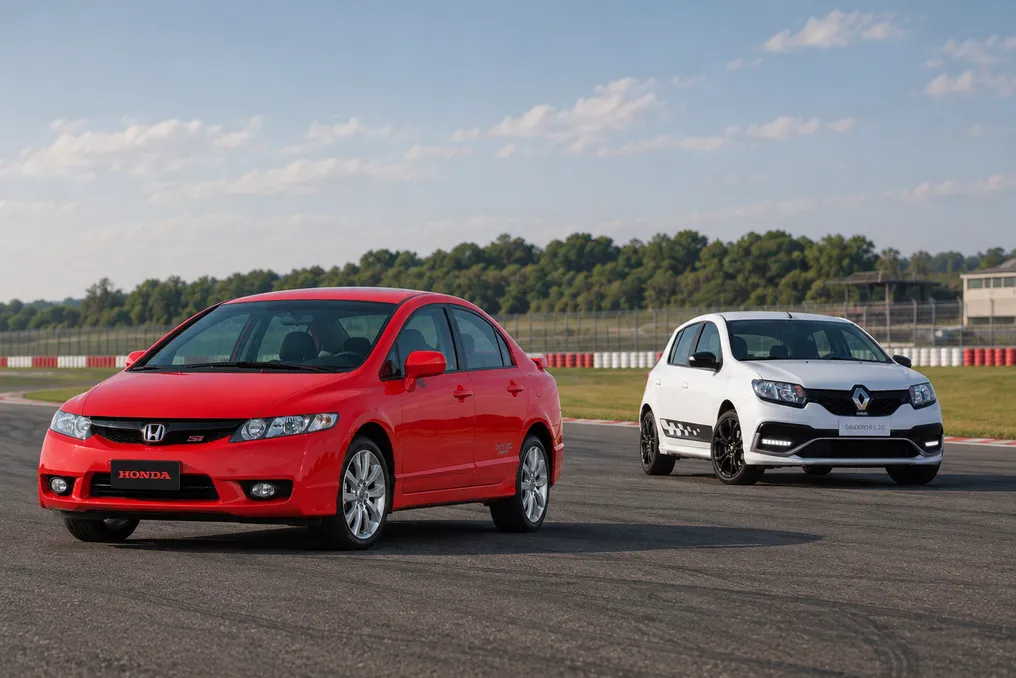
In 2007, the Civic Si began to be manufactured in Brazil, being the sporty version of the eighth-generation mid-size sedan. This car was recognized as innovative from its most basic versions, becoming disruptive compared to the previous generation and winning over many consumers. Its success can be compared to the 1996 Chevrolet Vectra B, as both raised the standard of the mid-size segment in different eras. Honda had a clear advantage over the Vectra B, which never offered a performance version, by making this sporty variant available.