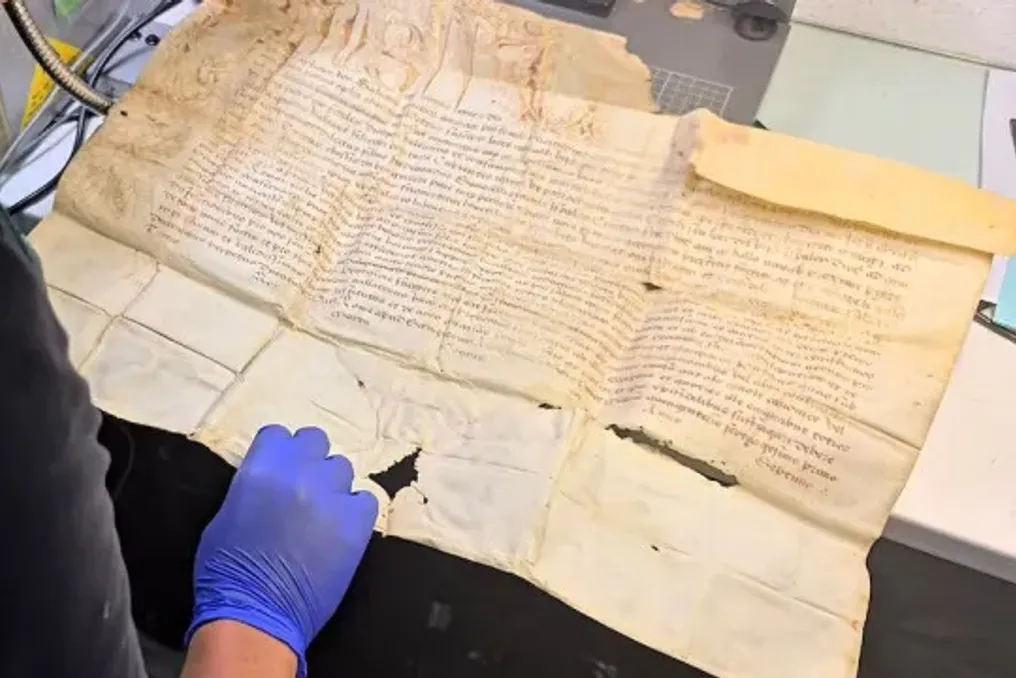
The Spanish Civil Guard discovered a 16th-century papal bull in El Viso del Alcor, Seville, which had been lost for many decades. This historical document is connected to the Battle of Lepanto and was part of the historical memory of the city of Seville.
According to Spanish authorities, this papal bull—an official document issued by the Pope to convey or provide instructions of particular importance—was issued during the reign of Pius V at the Santa Maria del Alcor church. It is also linked to Fernando Arias de Saavedra, the seventh lord of El Viso and fourth Count of Castellar, as well as his participation and that of a group of local residents in the Battle of Lepanto in 1571.
Representatives of the Civil Guard explained that information about the existence of this bull was passed down through generations in El Viso del Alcor, but its trace was lost many decades ago. The lack of data regarding its location even cast doubt on the document's existence and its true historical significance.
The investigation into the circumstances of the bull's disappearance began in October 2024. Civil Guard agents started restoring the document's history and searching for signs that might indicate its whereabouts.
During the inspection, agents found mentions of this bull in various publications, including an article published in 2000 and another released in May 2025 in the cultural association journal of the local community, which featured a graphic reconstruction of the document.
It was the analysis of these articles that allowed the Civil Guard to establish that a resident of El Viso del Alcor might have possessed this artifact. The suspect was questioned on September 2nd and voluntarily handed over the folded parchment, which he had kept in his home to the agents.
The man stated that he knew of the bull's historical value and decided to take it home for protection and preservation, without intending to gain any economic benefit.
After being seized by the Civil Guard, the document was transferred to the Provincial Historical Archive of Seville under the Junta de Andalucía. There, it underwent technical examination, which showed that it possesses material, paleographical, and graphic characteristics consistent with an original papal document from the second half of the 16th century, dating back to the reign of Pius V.
To complete the investigation, the Civil Guard also obtained a copy of the original record of the bull, stored in the Apostolic Archive of the Vatican. Comparing this documentation with the seized bull confirmed its authenticity and proved that it was indeed the bull whose trace had been lost for many decades.