
Stuut raises $52.5 million to expand AI-powered order-to-payment automation platform
Read more
Ventureburn
ventureburn.com

Stuut raises $52.5 million to expand AI-powered order-to-payment automation platform

Stuut, a New York-based company specializing in artificial intelligence-driven financial solutions, has successfully raised $52.5 million in a Series B funding round. The round was led by Insight Partners with participation from Andreessen Horowitz, M12, and Activant. The financing was closed within 24 hours, increasing Stuut's total funds raised to $93 million.

This funding came just 10 months after the company secured $29.5 million in a Series A round. The funds are planned to meet growing customer demand and to achieve deeper penetration into the financial transaction infrastructure. Stuut offers an AI platform designed to automate workflows from order placement to payment receipt for large enterprises.

The platform covers order management, lending, payment collection, payment processing, and fund application. Furthermore, it handles dispute resolution and deductions throughout the entire transaction lifecycle. This approach helps financial teams resolve issues before they lead to payment delays.

The system integrates with Enterprise Resource Planning (ERP) systems and other financial tools, including bank accounts, CRM systems, and payment platforms. Stuut states that its agents can contact customers via email, SMS, and phone, and access accounts payable portals to investigate payment issues. The platform maintains context from previous interactions, and every action remains auditable within existing control and approval processes.

The company initially focused on payment collection before expanding its scope to cover the entire order-to-payment process. Stuut found that late payments often stem from earlier transaction issues, such as missing purchase orders, which can lead to invoice rejections or deductions. Delays can also be caused by price discrepancies or incorrect contact information.

Stuut notes that globally, businesses have approximately $16 trillion frozen in accounts receivable, and believes that inefficient order-to-payment cycle processes can cause significant revenue leakage. The platform is currently used by over 150 companies, including members of the Fortune 50 and Fortune 500. The company reports that over $3 billion has passed through its platform, and clients have recorded a 47% reduction in days sales outstanding.

The company plans to scale its platform as corporate demand grows. The new funding will support Stuut's expansion into the enterprise market and further deepening its integration into the financial infrastructure. The roadmap includes lending, loan provision, and fund movement, enabling Stuut to handle transactions beyond collection and reconciliation.

The company states that 81.7% of outbound payment collection activities are now performed without human intervention, and 95% of incoming payments are automatically matched. Stuut was founded in 2024 by Tareq Alaruri, Ben Winter, and Mirajm Mosin; Alaruri previously co-founded the procurement software company Fairmarkit.

The latest round followed several developments related to the Stuut platform: the company was included in the Microsoft Marketplace and joined the Microsoft startup program. Insight Partners led the latest financing after supporting other automation enterprises. Andreessen Horowitz also participated after leading Stuut's Series A. M12 joined the round as a Microsoft venture fund, and Activant returned as an investor after its initial involvement. Stuut reports that its customer base has grown fivefold, and every completed Proof of Concept has been converted into a paying client.

The company's broader goal is to manage transactions from initial orders to final payment. Currently, the company faces a growing opportunity in corporate finance, and the next phase will focus on testing whether AI can manage increasingly complex financial workflows.

Similar stories

Volantis raises $88 million to create new AI inference architecture
Read more
ventureburn.com

Volantis raises $88 million to create new AI inference architecture

San Francisco-based company Volantis has raised $88 million in a Series A round to develop a new architecture designed for artificial intelligence inference. The round was co-led by Lachy Groom and Abstract Ventures, with participation from John Doerr, VXI Capital, Triatomic, and Susa Ventures. Private investors Dwarkesh Patel, Naveen Rao, and Sholto Douglas also participated.

The semiconductor company aims to solve one of the key problems in modern AI infrastructure. Its architecture is intended to simultaneously improve memory bandwidth and capacity. According to Volantis, this will allow for supporting larger models at significantly higher inference speeds.

Large AI models require a substantial amount of memory during operation, as well as high bandwidth for continuous data transfer to computing systems. Existing architectures force a compromise between these requirements. On-chip SRAM provides high bandwidth but has limited memory capacity.

GPU-based systems use high-performance memory to increase capacity, but bandwidth can limit the speed of increasingly large models. Volantis seeks to change this balance with its A-1 system. The company states that A-1 will be able to support models exceeding 20 trillion parameters and is designed to achieve speeds of up to 10,000 tokens per second per user.

Furthermore, Volantis claims that its architecture can reduce the cost of inference per token. The company expects that faster data processing will benefit increasingly complex AI agents, allowing code agents to complete tasks in significantly less time.

Volantis is developing a photonic interconnect specifically designed for connections between computation and memory. Its optical structure integrates a large number of memory chips into a single pool. This approach allows for increased bandwidth as more memory is added.

The company uses custom micro-VCSELs in its photonic platform. These components are based on an established gallium arsenide manufacturing ecosystem. Volantis notes that this method helps avoid some supply constraints associated with indium phosphide.

The company's developed micro-VCSELs are characterized by compactness, thermal stability, and energy efficiency. The company's goal is to achieve end-to-end connections consuming less than one picojoule per bit. The technology can also connect up to 220 memory chips around a single GPU. Volantis plans to disclose more details about the architecture as A-1 approaches commercialization.

The new funding will be directed towards the development and commercialization of A-1, as well as expanding engineering capabilities and preparing for customer deployment. Volantis intends to provide its first integrated inference engines to customers in 2027.

The company's founders include specialists who previously worked at NVIDIA, AMD, Broadcom, and Ayar Labs. Their prior experience includes significant achievements in packaging, VCSEL, and silicon photonics. Volantis emphasizes that the team relies on proven technologies rather than unproven breakthroughs.

CEO and co-founder Tapa Ghosh stated that inference speed will become increasingly important as AI agents take on more tasks across various business sectors, and their completion speed can influence company operational pace.

The fundraising comes amid ongoing pressure in AI memory supply chains. The growing demand for AI has amplified the importance of both memory capacity and bandwidth. Volantis positions A-1 as an alternative approach to this infrastructural problem.

Ema raises $77 million to replace corporate software with AI-powered employees
Read more
ventureburn.com

Ema raises $77 million to replace corporate software with AI-powered employees

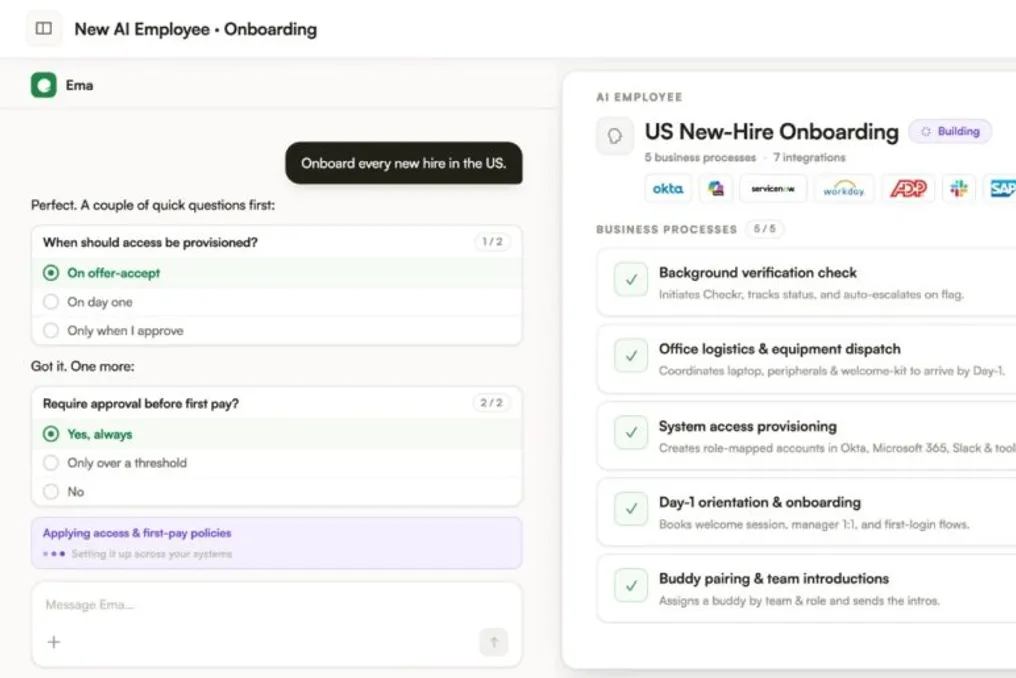
Enterprises spend billions on disparate SaaS tools and manual labor in HR, IT, and finance departments, yet they still struggle to complete work tasks. Company Ema has raised $77 million to solve this problem by creating AI employees that manage entire workflows through existing applications.

The $77 million Series B funding round was led by Creaegis, based in Bengaluru. These funds will be used to scale the platform and implement it in more enterprises currently in pilot testing. All major existing investors joined the round and increased their investments, including Accel, Section 32, Prosus Ventures, Hitachi Ventures, and Wipro Ventures. The company confirmed that the round was 100% funded by primary equity, without debt or secondary sales.

As a result, Ema's total funding reached $140 million. Ema was founded in 2023 by Surajit Chatterjee and Souvik Sen. The company was created to address an obvious problem faced by many organizations.

Most companies use over a hundred different software applications. To complete one task, an employee has to manually move data from one application to another. This leads to wasted time, errors, and increased software costs.

Ema's solution is called AI employees. These are not just chatbots answering questions; they are teams of AI agents that collaborate to execute an entire business process. One agent handles task planning, another executes steps across more than 250 connected enterprise applications, and a third verifies the final result.

The company is specifically targeting the cash flows that enterprises spend on SaaS and IT services. According to Chatterjee, Ema first integrates with existing SaaS applications, utilizing them, and then helps clients reduce their dependency on them. In many cases, clients completely replace large SaaS applications, turning the old software into merely a database while the AI employee performs the actual work.

The company reported that revenue has grown 50 times in the last 24 months, and the total order volume exceeds $150 million, including multi-year contracts. Ema currently has over 50 active enterprise deals and more than a million active users among businesses. Clients include NTT DATA, Hitachi, ADP, PwC, Google, KPMG, Wipro, and Microsoft. The platform is also showing strong expansion among existing customers, reporting a net dollar retention rate of 180%.

This means that clients who spent $100 last year are spending an average of $180 this year. Over 90% of clients who started with one use case, such as IT, expand their usage to two or three additional areas like HR and finance. Clients are now using AI employees in production environments to handle millions of interactions per year, rather than in experiments. Chatterjee emphasized that enterprises do not need more software; they need the work to get done.

He added that clients are already using AI employees for core operations in HR, IT, and finance, not just in test mode, and this funding will help spread this capability to more enterprises that are still stuck in the pilot phase.

Ema will use the $77 million to address two goals. First, expanding the sales department and increasing market reach in the Asia-Pacific (APAC) and Europe, Middle East, and Africa (EMEA) regions. Second, investing more in its corporate platform to support a greater number of workflows beyond HR, IT, and finance. Thus, through this round, Ema positions itself as a replacement layer for traditional enterprise software, focused on delivering completed work rather than selling additional tools.

Numeral raises $100 million to expand AI-powered tax compliance platform
Read more
ventureburn.com

Numeral raises $100 million to expand AI-powered tax compliance platform

Numeral has successfully raised $100 million in a Series C funding round. These funds will be used to scale its artificial intelligence-based sales tax compliance platform.

Insight Partners led this round, with participation from Salesforce Ventures, Geodesic, Benchmark, and Mayfield. Additional investors included FCVC, Y Combinator, and Uncork. This latest round brings Numeral's total funding to $157 million.

The San Francisco-based company plans to use the new capital to accelerate product development. Furthermore, it intends to expand its offerings across software, manufacturing, distribution, and wholesale sectors. Numeral also plans to grow its teams in engineering, sales, marketing, and product development.

Founded in 2023, Numeral was established by CEO Sam Ross and CTO Matt Duval. The company previously raised $35 million in a Series B round in September 2025.

The Numeral platform integrates a deterministic tax mechanism with automation and AI, managing various stages of tax compliance. These stages include nexus monitoring, registration, tax calculations, filing, and payment remittance.

Through the platform, businesses can manage exemption certificates and virtual mailbox services. Numeral supports VAT and GST compliance in over 90 countries and integrates with more than 40 payment and financial systems.

Reports indicate that clients can reduce registration and filing workload by up to 80%. The company also reports a 95% reduction in manual spreadsheet work and filing errors. Exemption certificate management tools can save businesses up to 400 hours annually.

The company notes that 30%–40% of submitted certificates may fail verification, which helps identify previously unnoticed compliance issues. The system provides growing companies with a centralized workflow for monitoring obligations, preparing declarations, and maintaining documentation across different jurisdictions as they expand.

The fundraising followed strong growth in Numeral's transaction processing activity. The company reported a 327% year-over-year increase in total transaction volume. Numeral expects its tax mechanism to process over 80 million transactions.

The company's client base is also expanding across various industries. Software, manufacturing, and distribution are adopting the platform fastest, as these sectors often face complex tax requirements in multiple jurisdictions.

Regulatory changes can also create additional compliance requirements for growing businesses. For example, California recently introduced changes affecting taxes on certain electronically distributed software. These changes are expected to impact software companies starting in 2027.

Numeral is also strengthening its partnerships with accounting firms. Therefore, companies need systems that allow them to track changing obligations in various markets. Numeral recently launched a program for accounting partners, enabling partners to recommend clients or resell the Numeral platform. They can also utilize the technology when providing their own services.

This approach keeps tax consultants involved in important client decisions. Numeral also provides access to internal specialists to resolve complex tax issues. The company asserts that this combines automated infrastructure with human tax expertise.

Numeral plans to extend this model as it enters additional industries. The latest funding will support broader product development and market entry, as well as provide resources to increase the company's international presence.

Numeral positions its platform for enterprises managing increasingly complex tax liabilities, anticipating growing demand for automated compliance across various markets, thereby reducing the burden on internal finance teams.

Popular