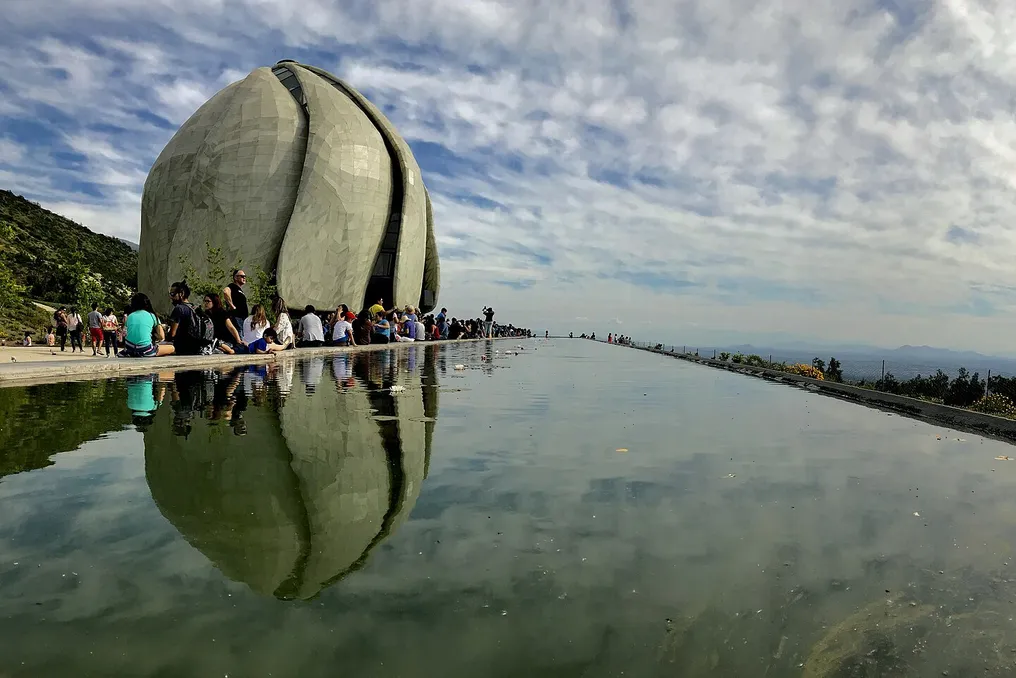
The Baháʼí Temple, located in Santiago, the capital of Chile, is the only example in Latin America. This site attracts visitors of various beliefs, including those without religious affiliation, offering distinct architecture and a spectacular view of the metropolis, situated in an elevated area at the foot of the Andes Mountains.
The Baháʼí Faith is an independent monotheistic religion, established by Baháʼu'lláh, a religious leader originally from Iran in the 19th century. A central principle of its doctrine is the unity of religions, advocating for the existence of a single God, creator of all things and present in everything. Followers believe that this God sent various prophets throughout history, known as Manifestations of God.
According to its teachings, these messengers served as the basis for the development of civilizations, indicating that religions are not antagonistic but rather different divine expressions over time. Figures such as Abraham, Moses, Buddha, Krishna, Zoroaster, Christ, and Muhammad are cited among the Manifestations of God, with Baháʼu'lláh considered the most recent of these messengers.
Currently, the Baháʼí religion has over one hundred thousand sites distributed globally. The Santiago temple is the pioneer in Latin America and was inaugurated in 2016, receiving people of all faiths for prayers and reading sacred texts.
The construction impresses with the fusion of modern elements with carefully designed gardens. The project was developed by the Canadian firm Hariri Pontarini Architects and signed by architect Siamak Hariri. The temple features an unusual shape, resembling a flower with nine petals, structured by nine glass wings that form a kind of dome, arranged around the stem like petals.
Having nine doors, each oriented towards a direction, all converge to the center of the building, symbolizing universal acceptance and the unity of all individuals. The number nine is not random; it represents the maximum point of human integration into a single spiritual and religious essence, as it is the largest single-digit numeral (from 0 to 9).
The petal structures are supported by steel, while the exterior walls are made of cast glass and the interior is lined with translucent marble. The use of this marble ensures the penetration of natural light during the day. The complex is complemented by water mirrors and gardens, creating a contemplative area with a privileged view of the city.
Visiting the temple is free, without the need for tickets or prior scheduling, although it is essential to check the operating hours. The sanctuary operates from Tuesday to Sunday, from 9 am to 6 pm, but entry is permitted only until 5 pm. The temple is located on Diagonal Las Torres, in Santiago. Access is facilitated by car or ride-sharing app, with parking available, or by public transport, using the Grecia Station (Line 4) of the metro, followed by a journey of approximately one and a half kilometers uphill, taking about 40 minutes.