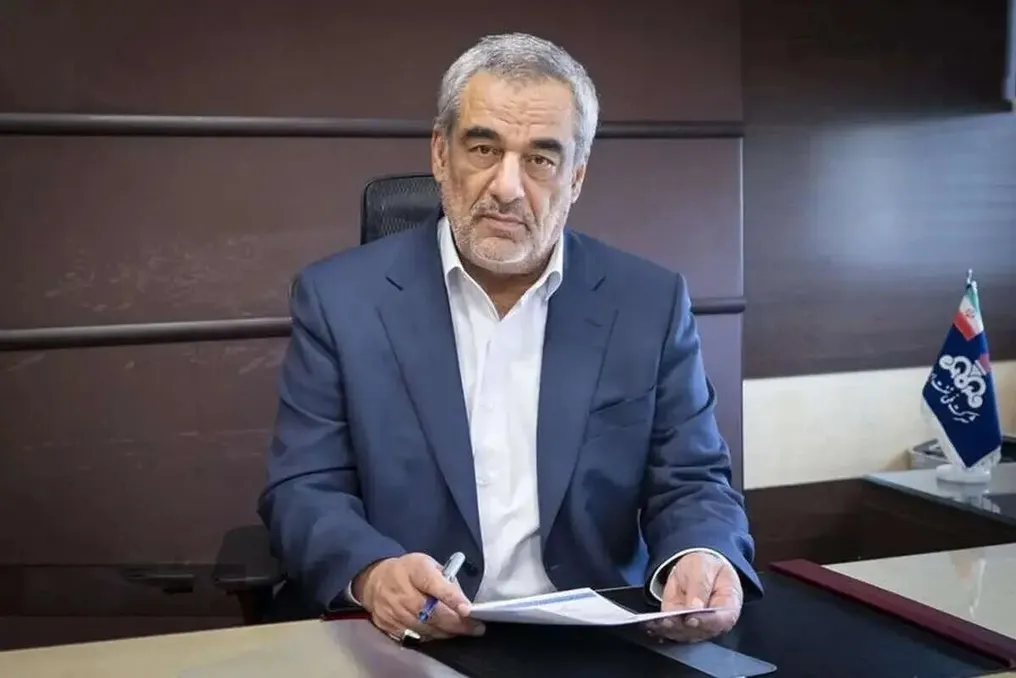
According to Mehr News Agency, citing the Ministry of Oil, Hamid Bovard discussed the ministry's key plans on Tuesday during his presentation ceremony as the acting Minister of Oil. He noted that current industry programs for extraction and development are continuing and being implemented with greater speed and accuracy.
Bovard added that efforts are being made to develop a stronger policy in trade and sales to ensure the oil and gas industry thrives, similar to the past, through the support of all colleagues.
The acting Minister of Oil recalled the issue of oil sales, stating that related matters are proceeding as usual, but he cannot disclose details in this area, and they continue to work seriously in this direction.
Emphasizing the importance of energy management, he appealed to all citizens to avoid wasteful consumption and assist in all areas of energy use to achieve more significant savings this year compared to previous years.
Regarding fuel supply to industries during winter, Bovard reported that comprehensive decisions are being made by the Government in the Fuel Committee, and once decided, they are communicated to all departments.
The acting Minister of Oil, stressing the need for integrated fuel consumption management and strengthening transmission infrastructure, highlighted the importance of a macro-level view when making decisions in the oil industry. On Tuesday, during a meeting with the heads of the National Iranian Oil Refining and Distribution Company at the company's central building, Hamid Bovard, besides expressing gratitude for the work of employees and managers, insisted on applying a strategic, scientific, and comprehensive approach to solving issues in the oil industry, especially regarding the refining and distribution of petroleum products.
Referencing his 35 years of experience in the oil industry, he added that information presented at management meetings should be sequential and in the form of executive summaries to allow for more accurate decision-making and gain a macroscopic view of the problems.
The acting Minister of Oil noted that in large organizations, a high volume of activity sometimes causes major issues to remain unnoticed amidst details and daily difficulties. He stated that an external, top-down view can help identify problems more accurately and find suitable solutions.
Bovard, addressing the gas and petroleum product sectors, emphasized the need for more precise decisions based on the country's internal capabilities, noting: given that a significant portion of the country's necessary resources is supplied domestically, instead of allowing others to make decisions for us, we must have plans and programs with an exact understanding of the situation.
He regarded the management of fuel consumption, especially gasoline and diesel fuel, as one of the country's important tasks, and reminded that measures concerning fuel smart cards are important, but special attention must be paid to threats and cyberattacks, as well as ensuring the security and stability of fuel-related systems.
The acting Minister of Oil stressed that managing consumption and implementing expert plans in the fuel sector can contribute to gradual improvement in the country's situation; however, the main goal should not only be managing current affairs but moving towards reforming the management model and improving the administrative structure of organizations.
Bovard considered the use of universities and scientific centers necessary for developing specialized training and educating young personnel, adding that a foundation should be created so that young employees, especially in their first years of service, are guided along the correct organizational path, and their potential and motivation are utilized effectively.
Addressing the importance of main corridors for transporting and moving oil and petroleum products, he insisted on directing part of the organizational activities and programs along these routes, noting that attention to these capacities can be effective in strengthening the oil industry's infrastructure.
The acting Minister of Oil also, speaking about the country's situation and the need to instill hope in society, stated that effective and tangible measures must be taken in the current situation to create conditions for people's hope to grow. Proper consumption management and optimal resource utilization are among such measures.
Bovard compared this situation to fish in water, adding that sometimes people inside a large organization, due to their constant presence, understand less about the importance and real scale of the work being done. He concluded that in difficult times, if the executive and expert groups of the oil industry were not in place, the country's problems could have become much wider.
Expressing appreciation for the work of expert forces and the management team, he noted the existence of expertise, empathy, and cohesion among leaders as strengths of the organization and expressed hope that this ability would develop across various companies in the oil industry through strengthening the scientific, strategic, and consistent approach.
Mohammad Sadegh Azimfar, CEO of the National Iranian Oil Refining and Distribution Company, presented a report to the acting Minister of Oil at the same meeting. He reported that the National Iranian Oil Refining and Distribution Company, despite the conditions of war, sanctions, and limited financial resources, has focused on four main areas by changing its management approach: balancing supply and demand, developing the value chain, developing human capital, and data-driven management.
Six strategies were defined within this approach, including increasing and improving production quality, consumption management, infrastructure development, improving fuel storage and supply levels, human capital development, and research with digital transformation.
Azimfar recalled that in the production sector, thanks to increased raw materials, implementation of key projects, and capital repairs, average gasoline production increased by approximately 17%; additionally, four quality improvement projects have been commissioned, adding about three percent to product output.
The CEO of the National Iranian Oil Refining and Distribution Company stated that in the consumer sector, the annual growth of gasoline consumption, which was about 6%, has dropped almost to zero due to a number of management measures and became negative in Shahrivar. This year, kerosene consumption also decreased by approximately 2–3%. Price reform, consumption management, and combating smuggling, in addition to reducing consumption, improved targeted subsidy resources.
He continued that LNG is one of the important opportunities for consumption management, and after implementing a three-price scheme, the consumption of this energy source increased by approximately 12%.
Azimfar noted that around 66,000 active cases were organized in the fight against smuggling, about 77,000 waybills were checked and adjusted, and about 2,000 migratory fuel cards were identified and organized; simultaneously, work is underway to organize about 600,000 fuel cards in various sectors.
The CEO of the National Iranian Oil Refining and Distribution Company reported that a plan is being implemented to assign identifiers to free cards at gas stations in Tehran, and the cards will not be canceled; rather, their use will be organized, and misuse prevented.
He stated that in the infrastructure sector, about a thousand kilometers were added to the national pipeline network over two years, and important projects are being completed and commissioned. Furthermore, to develop human capital, a center has been launched where about 100 people have currently undergone specialized courses.
Azimfar announced that the main goal is to limit consumption, increase production, strengthen storage, and maximally reduce dependence on gasoline imports. A plan has also been developed for the diesel fuel sector to reduce subsidies and manage consumption and exports, which could create significant resources for the country.
The CEO of the National Iranian Oil Refining and Distribution Company emphasized that the company's maximum capacity is being used across various sectors to fulfill tasks, increase revenue, and productivity.
The acting Minister of Oil views energy supply stability, especially in cold months, as requiring full coordination across the gas extraction, transportation, and distribution chain. On Tuesday, during a visit to the dispatch center of the National Iranian Gas Company, Hamid Bovard, emphasizing the role of this center in managing the country's gas network, stated that energy supply stability, especially in cold weather, requires full coordination between the gas extraction, transportation, and distribution sectors, and dispatching plays a key role in this.
During this visit, having heard the problems and concerns of the heads of the National Iranian Gas Company, he stressed the need to track and resolve existing issues, as well as maximize the gas industry's capacities to maintain network stability.
The acting Minister of Oil, highly appreciating the round-the-clock efforts of the gas industry employees, stressed that modern technologies must be applied, monitoring systems modernized, and operational readiness enhanced to counter various conditions.
Saeed Tavakoli, CEO of the National Iranian Gas Company, explaining the measures taken to maximize gas supply, reported that the company has made every effort to increase production, and for this, some capital repairs were carried out ahead of schedule.
Referring to the possibility of gas shortages in some provinces of the country this winter, he added that necessary scenarios have been defined for all provinces so that the company can plan network management and gas supply according to the conditions of each region.
The heads and officials of the Gas Dispatch Center presented a report during this visit on the process of gas supply, transportation, and distribution, network readiness for consumption management, and planned measures to maintain gas flow stability. They also shared the most important problems and challenges in various sectors and their proposals with the acting Minister of Oil.
The Ministry of Oil reported that on Tuesday, Hamid Bovard, the acting Minister of Oil, visited the dispatch center of the National Iranian Gas Company and was informed about the latest status of monitoring, management, and control of the country's national gas network.