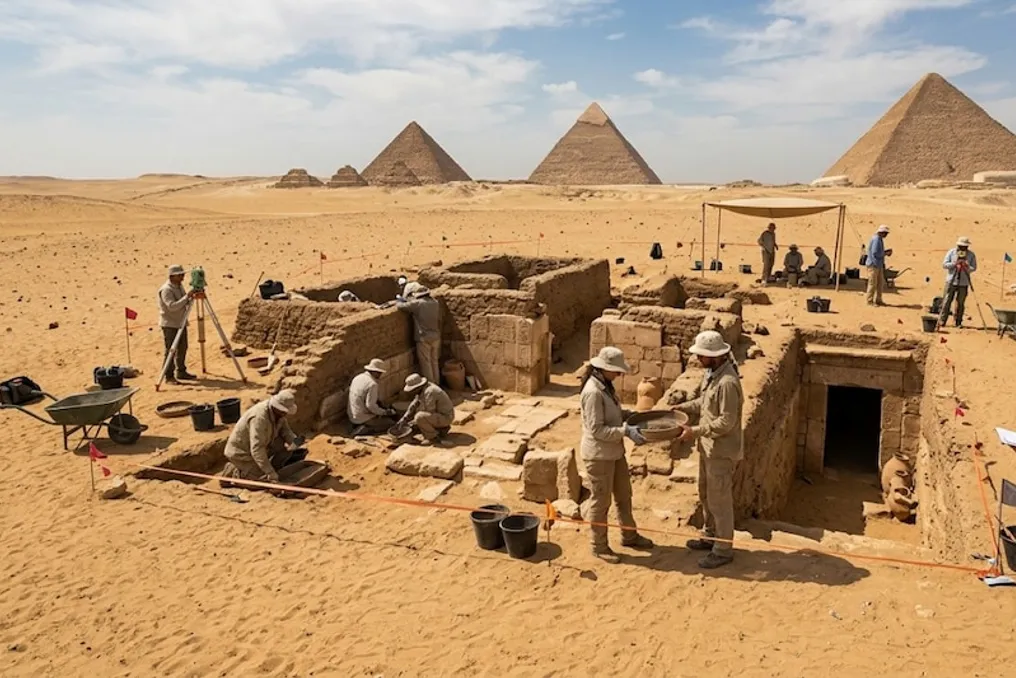
The pyramids and royal burials of Egypt remain among the world's greatest historical mysteries. However, a new discovery related to burials dating back about five thousand years sheds light on the grim reality of life at court during that period. This raises the question of whether human sacrifice of servants and staff alongside the monarch was practiced in Ancient Egypt?
According to a report by The Guardian, a new study uncovered skulls exhibiting signs of fatal trauma. This reinforces an old hypothesis that some early Egyptian pharaohs buried people associated with their court alongside them.
These findings originate from the Umm el-Kab necropolis in Egypt, located near Abydos. It contains tombs of early Egyptian rulers and structures related to funerary rites. This cemetery is considered ancient, dating back to approximately 3000 BCE.
It housed not only pharaohs and queens but also numerous smaller tombs surrounding them, containing the remains of family members and courtiers. Among these individuals were women, staff, seal inspectors, and artisans.
Some tombs dating to the reign of Pharaoh Aha of the First Dynasty of Egypt were found, but later, during the reigns of subsequent rulers, hundreds of small graves were constructed around the royal and burial sites. This prompted questions regarding the reasons for interring these people near the pharaoh's tomb.
In the 1920s, British archaeologist Flinders Petrie excavated these tombs. Petrie hypothesized that these individuals were sacrificed after the pharaoh's death. However, no clear injuries were found on the remains at that time that could prove murder. Thus, another theory emerged: perhaps these people died of natural causes and were subsequently reburied there after the pharaoh's passing.
Now, Dr. Rosalind Campbell from Purdue University in the USA has examined this long-standing question using new methods. She analyzed 46 skulls held in the Duckworth collection at Cambridge University. These skulls were found near the tombs of three noble figures: Pharaoh Djer, Pharaoh Djet, and Queen Merneith. Serious injuries were found on 18 of these skulls.
Some exhibited fractures that could have been fatal. One skull showed a laceration near the eye. These traces have reignited the discussion that the deaths of some individuals might not have been natural, but violent.
It is important to understand that the new research does not prove that all these people were buried alive. Researchers suggest that some individuals may have been killed violently after the pharaoh's death and then buried with him. However, it is currently impossible to state that this happened to everyone. For the skulls without injury marks, no conclusion can be drawn as to whether they were part of a sacrifice. According to Dr. Campbell, the sample size is too small to provide a complete picture of all the people buried at that time.
Researchers also investigated what weapons might have inflicted the injuries. The pattern of these damages does not match the mace used at the time. Instead, there is a suggestion that the injuries were caused by broad, flat objects made of wood or horn. In other words, people might have been killed by a forceful blow to the head with a hard object.
In Ancient Egypt, the pharaoh possessed not only the status of ruler but also a special religious position. Therefore, some experts believe that in the early period, there was a tradition of sending people connected to him into the afterlife to serve him. In Egypt, there was a belief that life continued after death. Thus, burying servants with the pharaoh could imply that they continued to serve him in the afterlife. Nevertheless, some people might not have agreed with this tradition and feared the entire process.
Another interesting aspect related to this study is that the number of additional tombs built around the royal burials began to decrease rapidly over time. It is believed that this tradition almost disappeared by the beginning of the Second Dynasty. In later periods, small figurines and images were used instead of actual people, serving as symbols of people serving the deceased pharaoh in the afterlife.
The hypothesis of human sacrifice is not new. Specialists have discussed it since the discovery of these tombs associated with the early dynasties of Egypt. However, this new study is the first to subject ancient human remains showing signs of trauma to rigorous modern scientific scrutiny. Experts from Egypt consider this research important for advancing this discussion, although definitive conclusions about all the people buried across the entire necropolis cannot be drawn based on only 46 skulls.