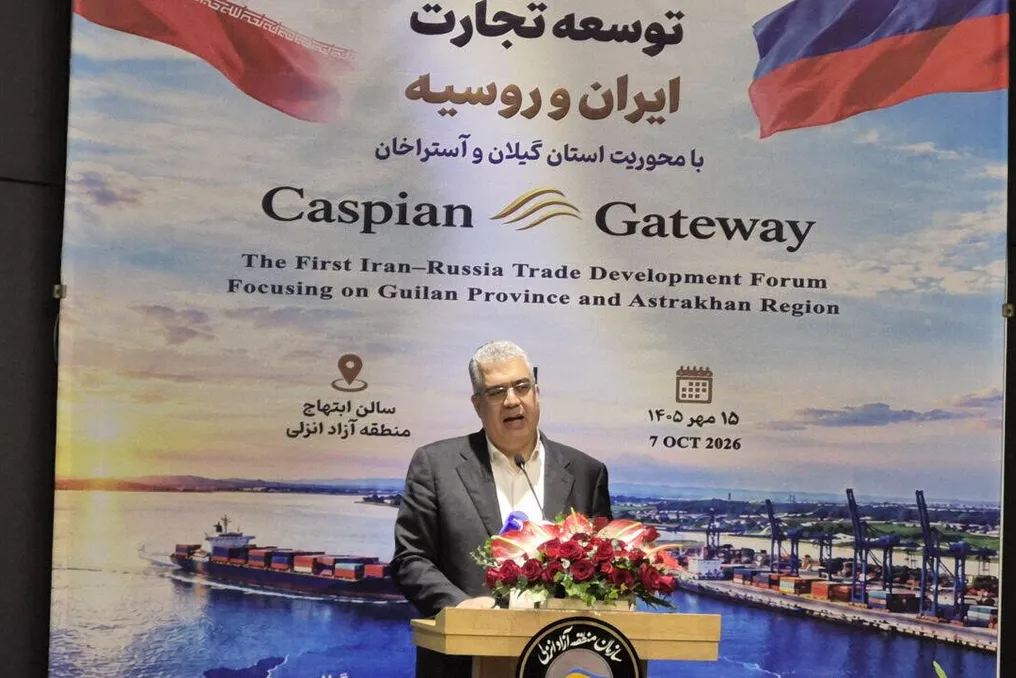
The head of the Iranian Trade Promotion Organization (TPO) noted that Iran's share in the Russian market remains small despite progress, as the country imports about $300 billion annually from various parts of the world.
Mohammad Ali Dehghan Dehnavi stated during the first Summit on Trade Development between Iran and Russia, held in the Anzali Free Zone and dedicated to the provinces of Gilan and Astrakhan. He emphasized that developing economic and trade cooperation with Russia is one of the priority tasks of recent years, and a key step in this direction was the implementation of the Free Trade Agreement between Iran and the Eurasian Economic Union.
According to IRNA, this agreement came into force in April 2025, and thanks to it, tariffs on 87 percent of goods in Iran's trade with five EAEU member countries, including Russia as the largest, were reduced to zero. The Deputy Minister of Industry, Mining, and Trade added that the elimination of tariffs creates a competitive advantage for Iranian traders, allowing exporters to outpace competitors in the markets of EAEU member countries.
He insisted on the need to continue economic and trade integration with EAEU members, stressing the importance of all economic entities utilizing this opportunity and the country's existing capabilities to increase Iran's share in the Russian market. The Head of TPO clarified that according to studies conducted, over $50 billion of Russian imports match goods that Iran can export, and activating this potential could increase exports to this country from the current $1–2 billion to $10 or even $20 billion.
Dehghan Dehnavi also noted that in addition to existing potential, new opportunities must be created, and their realization requires planning and establishing direct contact between business figures from the two countries. The Head of TPO specifically highlighted Gilan, stating that this province holds special significance in trade with Russia because it can act as a logistical hub and trade gateway for the country, in addition to its own production capacities.
He explained that Gilan is connected to Russia, as well as Kazakhstan, Azerbaijan, and Turkmenistan, by sea, land, and rail routes. Part of the railway project is in the final stages, and rail communication at the border has already been established. Furthermore, some goods arriving from China in the region pass through the Port of Anzali via Kazakhstan and Aktau, from where they are distributed throughout the country. Thus, Gilan can become a major commercial center of the country, developing its own trade.
To achieve this goal, according to Dehghan Dehnavi, it is necessary to complete the required infrastructure and define new areas of activity for the private sector. He emphasized the role of sending trade delegations in developing economic ties, noting that the summit and subsequent planning of such missions can be effective. Any interaction, exchange of business cards, and negotiations between economic entities lay the foundation for new contracts, exports, imports, joint cooperation, and investments.
Referring to the long-standing ties between the provinces of Gilan and Astrakhan, he called for developing these relations in the field of investment so that both sides can jointly invest in each other's potential to boost trade. The Head of TPO also pointed out that some problems are related to sanctions and external restrictions, while others are internal issues, such as numerous laws and regulations, instability of norms, and administrative bureaucracy. Efforts have been made to facilitate the trade route, especially regarding internal obstacles under government control.
Dehghan Dehnavi announced the development of an export support package by the Ministry of Industry, Mining, and Trade, which will be presented to the government and implemented next week. He also mentioned measures being taken by the Government Economic Commission together with the Ministry of Industry, Mining, and Trade, the Central Bank, and the Ministry of Economy and Finance. Trade regulations are being discussed, and their approval will eliminate some trade barriers. One of the proposed solutions is the reform of the order registration process, where registration should revert to the function of declaring a trade plan, and control carried out at customs clearance should be excluded from the order registration stage.
Stressing that existing obstacles should not prevent the utilization of the country's trade potential, the Head of TPO noted that Iran's private sector has demonstrated the ability to open trade routes through initiative and effort, despite restrictions. He viewed the holding of the first Summit on Trade Development between Iran and Russia in Gilan as a measure to strengthen economic relations and expressed hope that the results will become apparent in the coming months and years in the form of increased exports from Gilan to Russia and other countries.
Dehghan Dehnavi also announced the appointment of a new trade mission to Gilan from one of the Chinese provinces, expecting that this province can utilize the new trade potential with proper planning. The first Summit on Trade Development between Iran and Russia began on Wednesday in the Ebtehaj Hall of the Anzali Free Zone. This summit, dedicated to the provinces of Gilan and Astrakhan, was attended by Mohammad Ali Dehghan Dehnavi, Head of Iran's TPO; Teymur Purkhaydari, Head of Iran's Export Development in Astrakhan and General Director of Industry, Mining, and Trade of Gilan; Sergey Vladimirovich Azarov, Consul of the General Representation of the Russian Federation in Rasht; Ahmad Heidarian, Consul of the General Representation of the Islamic Republic of Iran in the Russian Federation; Hadi Haqshenas, Governor of Gilan; and Mostafa Taati Mohammad, General Director of the Anzali Free Zone. The purpose of the summit was to study the opportunities, advantages, problems, and challenges of trade between Iran and Russia, especially Gilan and Astrakhan as entry points for bilateral trade. The summit included two specialized sessions: analyzing problems and obstacles to the development of non-resource trade between Iran and Russia through the gates of Astrakhan, and seeking solutions—the role of executive bodies in facilitating Iran-Russia trade and studying ways to access Russian and Eurasian markets through the gates of Astrakhan.