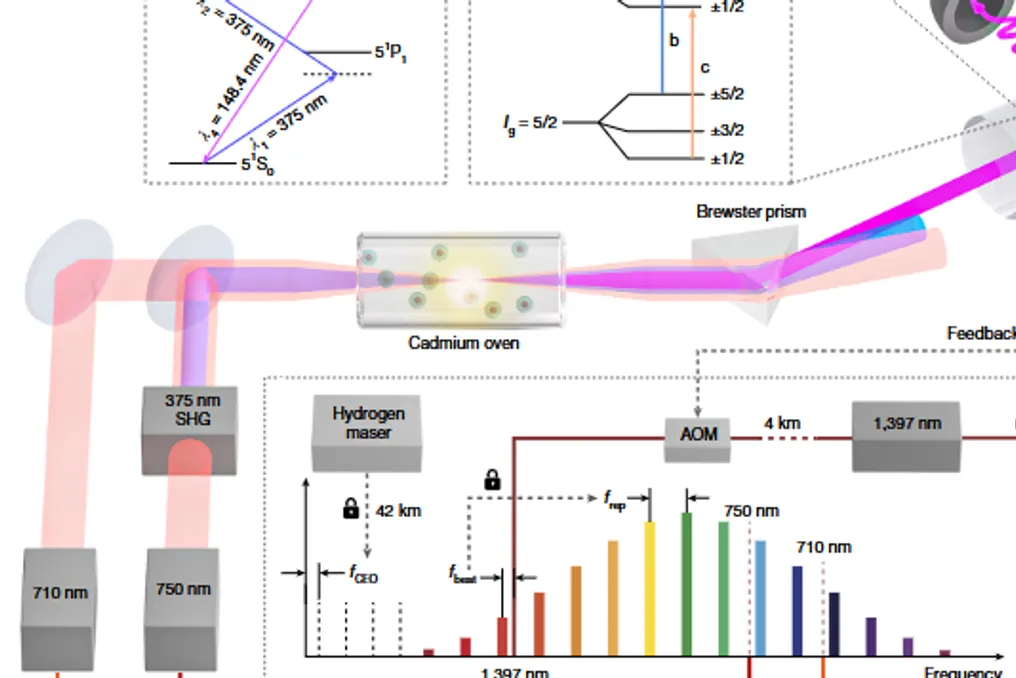
A team of physicists from China has successfully launched nuclear clocks based on the thorium-229 isotope, utilizing self-grown crystals. In these clocks, an ultraviolet laser is constantly calibrated relative to the transition in the atomic nucleus, making them less susceptible to external influences compared to measurements of the electron shell.
The laboratory prototype of the nuclear clock was assembled by Xichen Ding from Tsinghua University together with his colleagues. To generate ultraviolet radiation with a wavelength of 148.4 nanometers, a mixture of two beams is used that pass through pairs of cadmium heated to a temperature of 600 degrees Celsius. The power of this radiation is 10 microwatts, and the authors estimate the linewidth to be less than one hertz.
Nuclear tracking occurs via an absorption process: when the crystal is at resonance, it absorbs approximately 0.01 percent of the light. The direction of the laser frequency shift is determined based on this change in transmitted light.
To improve system stability, the photomultiplier was replaced with a more transparent phototube that transmits 7 percent of the ultraviolet light, and the operating mode was optimized. These modifications allowed the instability to be reduced from an initial value of $1 \times 10^{-11}$ to $5 \times 10^{-13}$. The research results were published in the journal Nature.