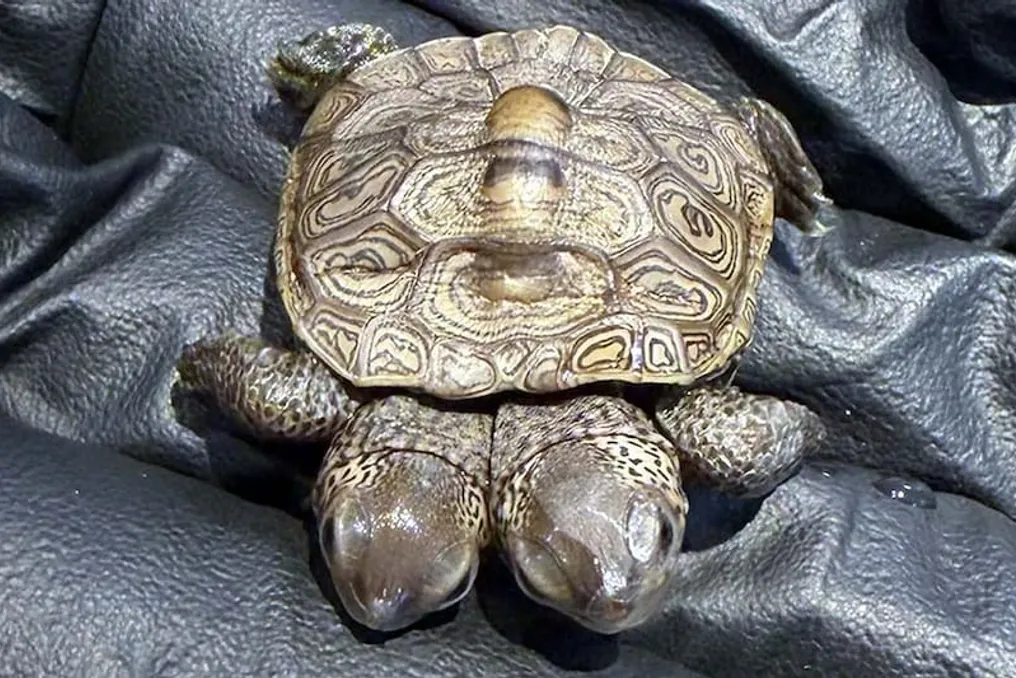
An extremely rare two-headed turtle hatchling has been discovered in the Cape Cod area of Massachusetts, United States. It belongs to the Diamondback Terrapin species and was found at a nesting site in the Wellfleet area. This small turtle possesses two distinct heads on its body, a condition known as bisiphaly.
The weight of this turtle was recorded as approximately 5.1 grams, and it has now been placed under observation at the Cape Wildlife Center. Experts are investigating whether it is feeding properly and how the two heads are coordinating with the body. Notably, this is the third terrapin of this kind found in Cape Cod in the last five years.
Bisiphaly is a very rare condition that occurs during the development of the turtle inside the egg. In the early stages when the body is forming, the two parts of the body fail to fully separate, resulting in two heads on a single body. In such creatures, both heads can function independently while the body remains singular; additionally, some internal organs of the body may be shared, depending on the manner of the hatchling's development.
Due to having two heads, the turtle may face difficulties in walking and eating, as both heads must coordinate with the same body. If essential body organs are also shared, this can negatively affect its health. However, there is currently no definitive information regarding the longevity of this turtle, and experts are continuously monitoring it, which includes observing its diet, movement, and behavior.
The Diamondback Terrapin is a turtle found in the coastal regions of North America. It inhabits brackish marsh areas and other locations near the sea. Its shell has diamond-like structures, which gives it the name Diamondback Terrapin. This species is considered threatened in Massachusetts. Factors endangering its existence include habitat loss, collisions with vehicles on roads, pollution, and fishing nets.
Temperature plays a crucial role in the development of Diamondback Terrapin hatchlings. The temperature inside the egg helps determine whether the hatchling will be male or female. Lower temperatures increase the likelihood of being male, while higher temperatures tend to increase the tendency to be female.
Currently, this rare two-headed turtle is under close observation by experts. Scientists consider such cases special because they help them understand the physical development of the turtle hatchling and sometimes the causes of such abnormal conditions.