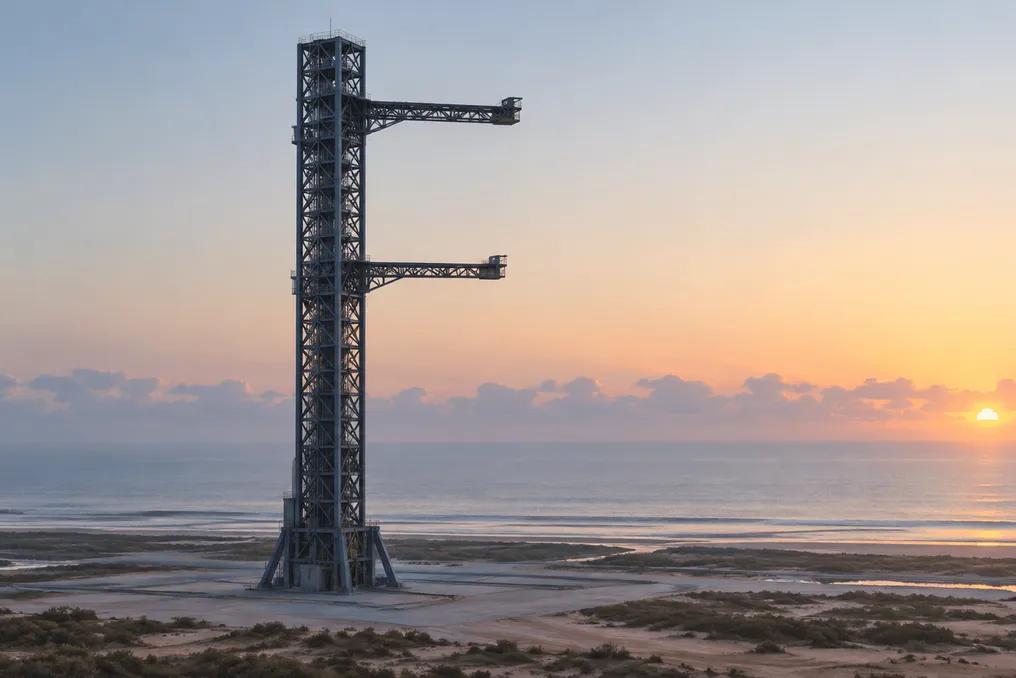
The Chinese company Cosmoleap, which develops reusable rocket boosters, announced on October 7th the completion of the first ground test in China of a tower for recovering 'stick-type' rockets. This system is designed to capture the returning booster using a pair of mechanical manipulators instead of landing it on supports.
Cosmoleap was founded in February 2024 and specializes in creating medium and large reusable rocket engines based on the concept of ground capture combined with intelligent control. It positions itself as the first company in China to develop a liquid-fueled rocket specifically designed for tower-capture recovery, with its development team consulting senior academicians.
As part of this program, the company developed its own controller for the recovery tower, which is undergoing several iterations. This controller is responsible for synchronizing the movement of the capture manipulators as they close around the descending stage. Furthermore, Cosmoleap reported the completion of static and dynamic capture experiments on the tower.
During static load and modal tests, engineers installed strain gauges, accelerometers, and other sensors throughout the structure, collecting data from over a hundred measurement points. This data helps verify how the tower and its manipulators behave under load during rocket capture.
The company plans to build a sea-based recovery platform. Marine recovery will provide greater flexibility in choosing flight corridors and allow for more frequent launches, which, according to Cosmoleap, will usher the tower-capture technology into an era of high-frequency reusability.
Progress on the rocket itself is also accelerating. Leap-1, the company's first reusable liquid-fueled rocket with tower capture, recently underwent a series of ground tests, including second-stage engine calibration testing, cyclic pre-cooling of the fuel and pressure supply system, combined static testing of the second-stage tank body and aft dome, and static structural testing of the second-stage instrument section.
Cosmoleap asserts that these achievements allow it to maintain the schedule for the target first flight of Leap-1 in 2027. Previously, the company described Leap-1 as a two-stage oxygen-methane vehicle about 70 meters high, with the first stage intended to be captured by the tower and reused.
If the approach proves successful, tower capture may eliminate the need for landing legs on the booster, which would reduce weight and decrease the time required to prepare the stage for the next flight, thereby adding another recovery pathway to China's growing reusable rocket sector.