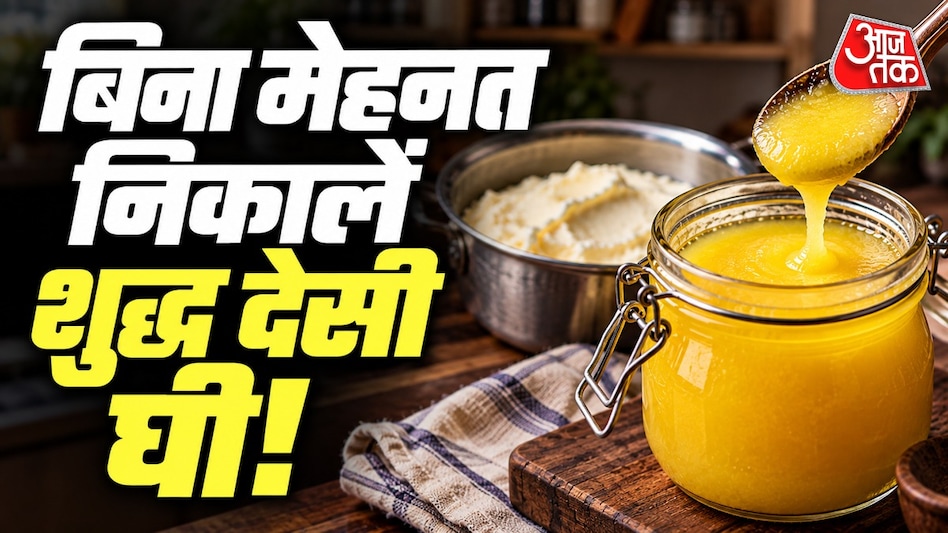
During the holiday season, doubts often arise regarding the purity of milk, ghee, and cottage cheese available in stores. Therefore, many prefer to make ghee themselves from cream collected at home. However, the process of extracting ghee from cream can be laborious: sometimes it requires hours of whipping cream, and other times a lot of time is spent preparing the cream on the stove. Sometimes the ghee turns out to be of poor quality, or there is a risk of it burning.
But what if you could skip whipping the cream and easily obtain a large amount of ghee at home using just one glass? Indeed, with a simple glass, the process of obtaining grainy ghee from cream can be significantly simplified. The advantage of this homemade kitchen trick is that it does not require a mixer and does not oblige you to whip cream for hours. Below is a guide on how to easily prepare grainy desi ghee for holidays.
Preparing cream for ghee extraction
If you are going to extract ghee from cream that has been stored for 8–10 days, you must first ensure its proper storage. Cream should always be stored dry and in minimal amounts of milk. If too much milk remains in the cream, the likelihood of an unpleasant odor increases.
Take a large, thick-bottomed pot and place the collected cream in it. Then add about two to two and a half cups of water and put it on the stove to heat. It is important to note that this method does not require additives such as baking soda.
Easy way to extract oil from cream without whipping
On low heat, stir the cream and water constantly for about 5 minutes. The goal is not to bring the mixture to a boil, but to heat it enough so that the large clumps of cream almost disappear and the mixture takes on a thick, milky consistency.
When the cream is well heated, turn off the gas and leave the mixture for several hours. After that, cover the pot with a lid and place it in the refrigerator. The cream may take about 4 hours or even longer to completely solidify. If you are cooking in the evening, you can leave it in the refrigerator overnight. After cooling, you will notice that a dense layer, resembling oil, has formed on the surface of the mixture, from which the ghee will be extracted.
Separating water from cream using a glass
The most unique part of this method is separating the excess water from the cream. To do this, fill a glass with water and pre-cool it in the freezer. Then place this cold glass on the edge of the solidified oil layer. After that, carefully scoop out the top layer, which resembles oil. To separate the remaining milk, you can rinse the cream with cold water as needed. Cold water helps keep the oil on one side, facilitating the separation of excess liquid.
Thanks to this process, most of the excess water and milk contained in the cream is separated. This can help reduce foaming and unpleasant odors when extracting ghee.
Obtaining pure homemade ghee effortlessly
After the entire oil-like layer has been separated, place it in a large frying pan and put it on the stove to heat. Now you do not need to constantly whip or stir it. It is enough to let it simmer slowly or over medium heat, stirring occasionally.
The oil will gradually melt, and ghee will begin to separate from it. When the ghee is almost ready, watch out that the remaining curd (mawa) does not brown or burn at the bottom. For this, it should be removed in time. It is important to cook the ghee thoroughly to remove all moisture. At the end, the ghee should be slightly cooled and then strained through a clean sieve or muslin cloth. Thus, you will get aromatic ghee made at home.