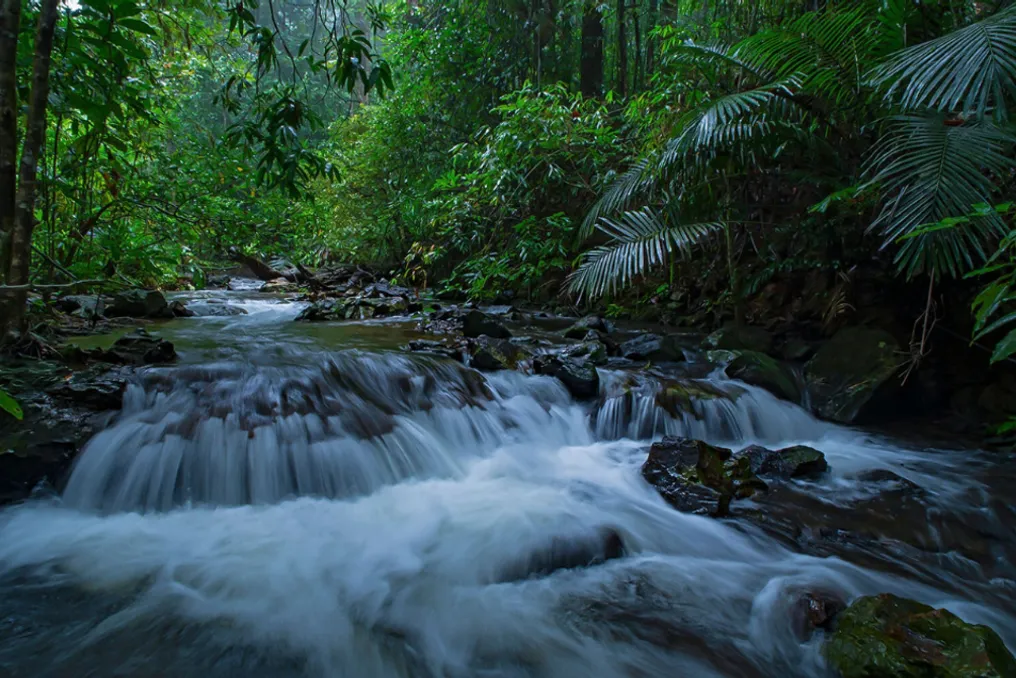
A walk through the forest areas of the southern Western Ghats reveals changes in the landscape: the soil remains moist, small streams flow through the forest, and some trees stand on roots that spread out like supports, while others have thin, finger-like roots protruding from the mud.
The surprising thing is that the entire observed forest area may only cover a few hundred square meters. These places are Myristica swamps—rare freshwater swamp forests existing in scattered pockets of the Western Ghats.
On maps, many of them are barely visible, but these tiny forests are capable of accumulating water, helping to replenish groundwater, sustaining stream flow, and providing habitat for plants and animals found in few other places. Many of these forests are smaller than a playground, and their numbers are steadily declining.
In a paper published in Current Science in 2026 by Ashwin Sivasankar and P. R. Divya, Myristica swamps were named one of India's most primitive and endangered wetland ecosystems. In the state of Kerala, the remaining swamps are scattered in fragmented areas around Kulathuputh, Anchal, and surrounding regions.
To understand the importance of their loss, one must consider their unusual root system. Most trees struggle to survive if their roots remain underwater for long periods. However, trees growing in Myristica swamps have adapted to the opposite.
These forests primarily consist of trees from the nutmeg family, Myristicaceae. Characteristic species include Myristica magnifica and Gymnacranthera farquhariana. Because the soil remains waterlogged and low in oxygen, their roots have developed special adaptation methods. Some spread widely, like supports, helping the trees remain upright in soft soil. Others rise above the soil surface as specialized breathing roots called pneumatophores. Several of these curve upwards in a knee-like shape.
Although they may seem strange, it is these roots that allow the trees to exist where many other forest species cannot. Nevertheless, the places where they can be seen are becoming fewer.
According to the Kerala Forest Department, Myristica swamps occupy only about 0.004% of Kerala's territory. Yet, these small patches support several species endemic to the Western Ghats. Known locations include Kulathuputh, Shendurney, Arippa, Madatara, Palode, and Anchal.
Scientists have been studying these swamps for decades. The first scientific records from the former Travancore region date back to the 1960s, when botanist and forest inspector Krishnamurthy documented Myristica swamps around Kulathuputh, Shendurney, and Anchal.
How a small forest can help preserve a stream
The importance of these forests becomes clearer when looking not only at the trees but also at the water. Rainwater falling on the Myristica swamp does not just run off; it settles on the low-lying land and slowly moves through the moist soil, plants, and surrounding streams.
The ability to retain water is one reason why these forests are important far beyond their boundaries. Sivasankar and Divya note that Myristica swamps can regulate floods, replenish groundwater reserves, and sustain year-round streams. Their waters also serve as a habitat for freshwater organisms, including endemic fish and amphibians.
Thus, when one of these forests is damaged, you lose not only a group of unusual trees but also begin to change the entire surrounding water system. Researchers in Karnataka have observed how quickly this can happen. M. D. Subhash Chandran and Divakar K. Mesta from the Indian Institute of Science documented 51 Myristica swamps in South Uttara Kannada. Together, they covered only about 9.8 hectares. Nearly half of them were less than 500 square meters, which is less than a tenth of a football field.
However, many of them were already losing what made them swamps: water. Researchers found that 17 of them were losing constant moisture conditions due to stream diversion. Another 21 swamps faced issues such as deforestation, burning, and conversion of land to agriculture. Once the water disappears, the trees and other species dependent on constantly moist conditions can struggle to recover. This means the swamp can begin to die even if many of its trees are still standing. Sometimes, simply changing the direction of a stream is enough.
What can live in such a tiny area?
If you saw a forest covering only a few hundred square meters, you might assume it wouldn't have much wildlife. However, research conducted in Kerala suggests otherwise. Over two years of studying Myristica swamps in the Shendurney reserve, scientists recorded 206 species of butterflies, nineteen of which are Western Ghats endemics. Researchers also found 82 species of plants that butterflies use as larval food plants, where they lay eggs, and caterpillars feed on them. Twenty-seven of these species were new records of food plants for the Western Ghats.
This serves as a reminder that the size of a forest says little about how much life it can contain. A small patch of wet land can support hundreds of butterfly species, freshwater animals, specialized trees, and plants upon which they all depend.
In some places, these forests still exist because local people protected them long before anyone calculated their ecological value. Some swamps were preserved because a village decided to protect its forest.
In the Western Ghats, several old forest patches have been preserved as sacred groves, protected by local communities due to their religious and cultural significance. These relationships sometimes protected rare habitats along with them. In 2024, researchers Pravin Desai, Vishal Sadekar, and Shital Desai documented a previously unregistered Myristica swamp inside the Bhalandeshwar sacred grove in Dodammarg, Maharashtra. During fieldwork from November 2023 to January 2024, they discovered a swamp dominated by Myristica magnifica. The surrounding grove continues to be protected by locals due to its religious significance. The researchers described it as the second registered Myristica swamp in Maharashtra. This discovery also raises an interesting question: how many more such forests might be hidden in small areas that scientists have never documented?
However, the discovery is only part of the problem. Their small size makes them particularly vulnerable. A Myristica swamp can depend on a single stream and a few hundred square meters of wet forest. If that stream is diverted, the vegetation around it is cleared, or the surrounding land is altered, the conditions that sustained its life can disappear. Planting the same trees elsewhere will not restore the swamp. The ecosystem functions because many elements come together in one place: trees, constantly moist soil, streams, surrounding forest, and the wildlife that depends on them. Perhaps this is the simplest way to understand why Myristica swamps are so important. They are smaller spaces we pass by without thinking, but within them, water accumulates, streams are fed, and species that are almost nowhere else find a place to survive. For a forest occupying so little space, the loss is enormous.