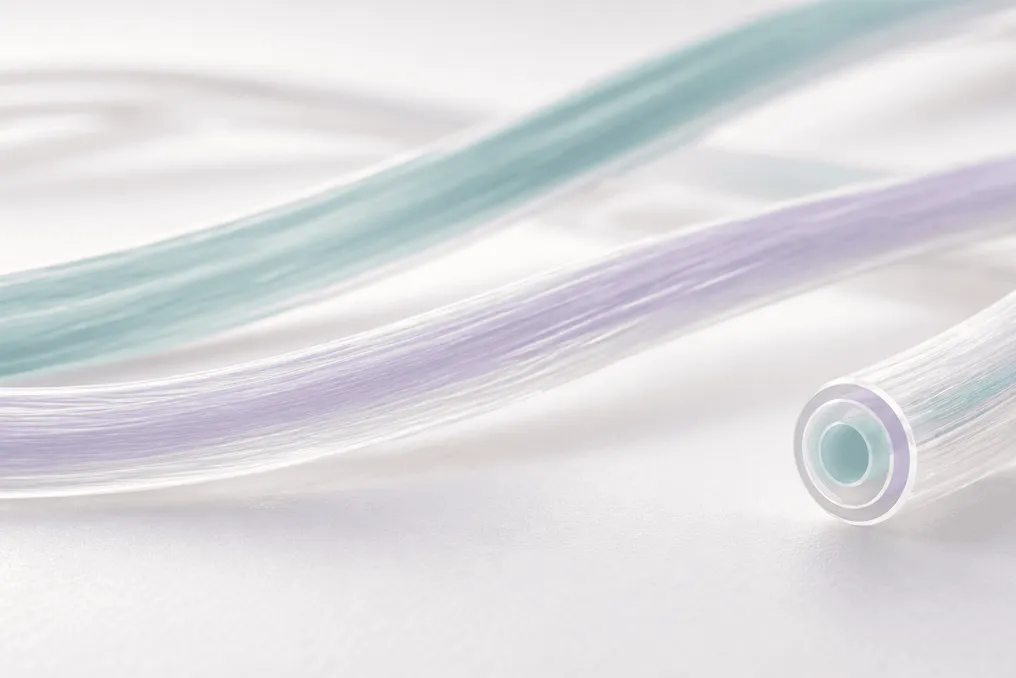
Scientists from Duhua University have developed a method to weave transistors, resistors, and capacitors into a continuous fiber, turning the thread itself into an electrical circuit. This opens prospects for wearable computing and electronic skins for robots capable of bending with soft bodies.
The work, led by Maifan Zhu, an academician of the Chinese Academy of Sciences and a professor at Duhua University, and researcher Gan Wang, was published in the journal Nature Electronics under the title 'Programmable Weaving of Integrated Circuits.' According to university news on September 24, the team used microfluidic coded weaving to place materials and connections inside the fiber as it formed, instead of attaching individual chips afterward.
When examining the cross-section, conductive, insulating, light-emitting, or semiconducting fluids are configured into stable functional layers. By varying the supply of each spin solution along the length, researchers can make these layers either continuous or discontinuous, thereby connecting devices. As a result, stacks of materials, device geometry, and interconnections are formed within a single process, transforming the fiber into a circuit.
On this platform, the group created modules for multi-color electroluminescence, analog signal processing, digital logic, and non-contact spatial sensing. By combining different types of devices into one fiber, they demonstrated configurable filters and inverters, transitioning from individual functional threads to circuits that operate coherently as designed.
In practical tests, the spatial sensing fibers were placed on a robotic gripper. Changes in the electric field coupling upon approach or movement of an object allowed the system to determine its position and automatically direct the manipulator to track it. In another demonstration, a flexible fiber interface and auxiliary system enabled a finger to control a robotic arm and a drone without physical contact.
Embodied artificial intelligence requires electronics that conform to complex shapes and movements. Soft fibers are a natural carrier, but integrating individual fiber devices into complete circuits required simultaneously solving problems of material placement, device structure, and electrical connections. The Duhua University method treats circuit layout as a weaving program while maintaining flexibility, sewability, and weaveability, and offers combinable building blocks for soft robots and multimodal sensory shells.