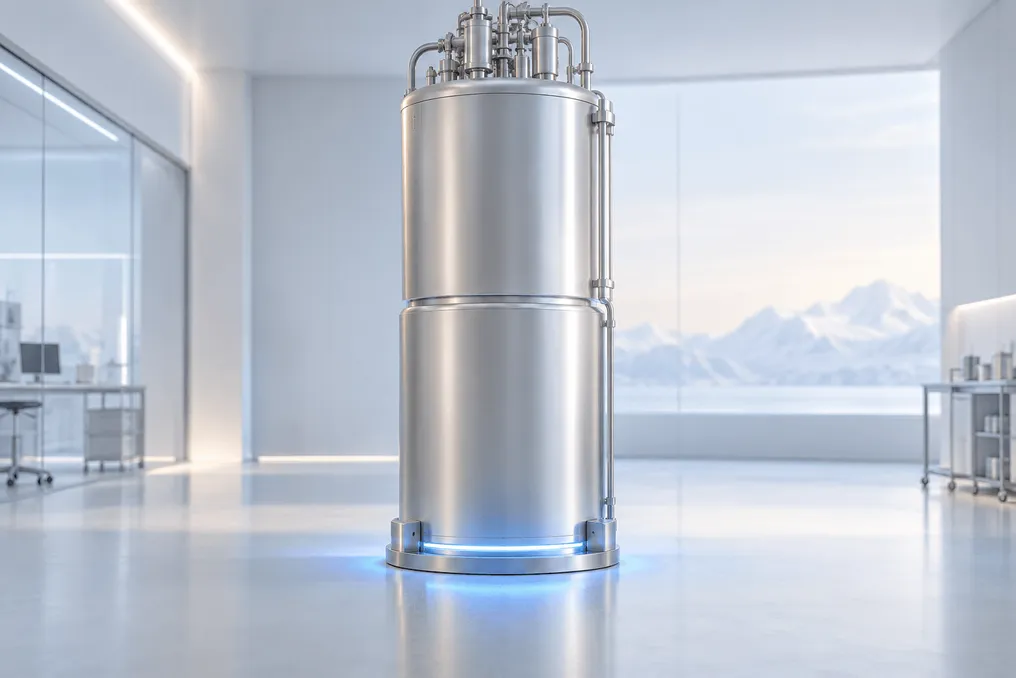
The Beijing Academy of Quantum Information Sciences (BAQIS), in collaboration with the Institute of Physics of the Chinese Academy of Sciences, has presented a prototype of a modular, cryogen-free refrigerator. This prototype is rated at 2000 microwatts and is designed to enhance cooling capacity and increase sample space in superconducting quantum processors.
The article titled 'Modular and integrable cryogen-free dilution refrigerator' was published in Physical Review Applied on September 25th. On September 28th, BAQIS announced that teams from the dilution cooling and quantum computing platform hardware groups had worked on this machine together with the Institute of Physics' quantum computing research center.
As processor scales grow, traditional dilution refrigerators face limitations in cooling power and usable experimental volume. While parallel dilution setups within a single vacuum chamber can help in the short term, they complicate chamber fabrication, slow down pre-cooling, tangle the piping system, and make it difficult to determine flow distribution and heat exchange between units.
The teams assert that the modular integration of individual cooling modules allows for expanding capabilities based on proven cryogenic technologies with a clearer path for upgrades.
Building upon previous work done in the 1000 microwatt class, the group completed a modular route in 2025 and introduced a 2000 microwatt class prototype. When two modules were integrated, both maintained a continuous base temperature below 10 millikelvin. The available cooling power in the expanded mixing chamber sample space approximately doubled compared to a single module in the same temperature range.
Under specified thermal coupling conditions, changes in load on one module had only a minor effect on the temperature or cooling power of the other, demonstrating useful operational independence for flexible scaling.
The prototype was tested on the BAQIS quantum computing platform. Among the joint first authors are Xian Guan and Pei Liu from BAQIS; corresponding authors are Zhongxin Ji from the Institute of Physics and Haifeng Yu from BAQIS. Co-authors also listed participants from BAQIS and Zhongke Liangyi (Beijing) Technology.
BAQIS views this modular scheme as infrastructure for large-scale superconducting quantum experiments, offering a benchmark for cryogenic platforms that require both power and working space without liquid helium logistics.