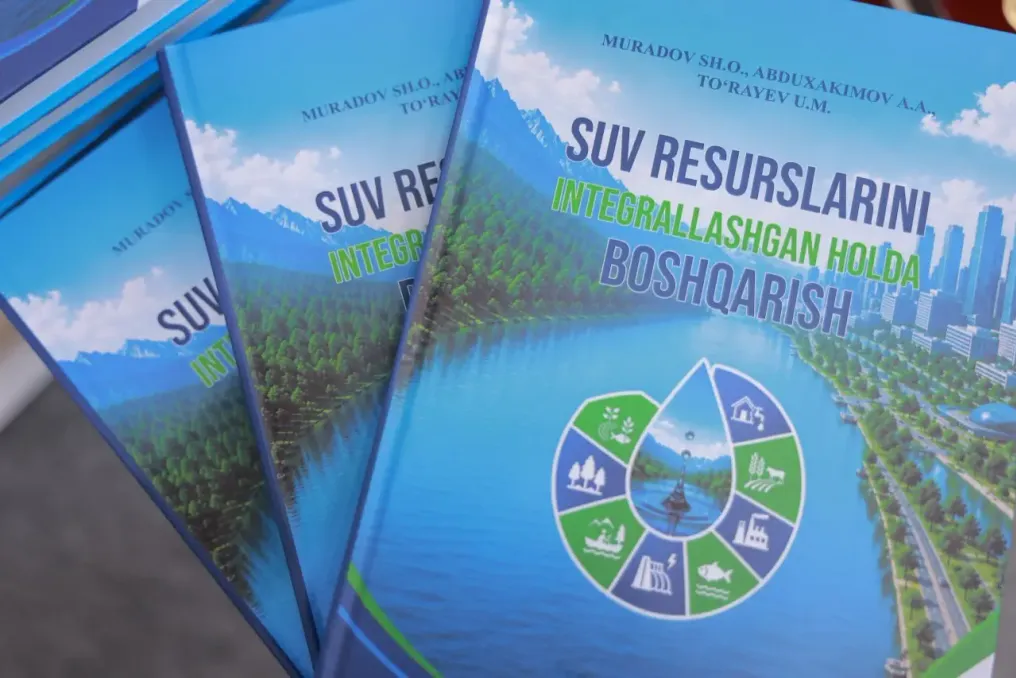
Uzbekistan has introduced a new textbook titled 'Integrated Water Resource Management,' which was developed taking into account modern approaches, international experience, and the country's own practices. The authors of the book are Shukhrat Muradov, A. Abdukhakimov, and U. Turayev.
The presentation event took place at Green University. Attendees included Jassipbek Kazbekov, Deputy Chairman of the National Committee on Ecology and Climate Change; Akiko Fuji, UNDP representative in Uzbekistan; Bakhtiyor Pulatov, Rector of Green University, as well as representatives from relevant organizations, the scientific and educational community, teachers, and students. The total number of participants exceeded 300 people.
According to one of the textbook authors, Professor and Doctor of Technical Sciences Shukhrat Muradov, the need for specialized literature on water resources is growing against the backdrop of climate change and increasing water scarcity.
The publication covers the theoretical foundations and practical tools for sustainable water resource management. It examines the principles of integrated water resource management, basin planning, transboundary water management, water legislation, as well as the experience of Uzbekistan, Central Asian countries, and other states.
The Ministry of Higher Education, Science, and Innovation of Uzbekistan recommended this textbook for publication. Financial support for the project was provided by the 'Aral Sea Wetlands' projects, implemented by the National Committee on Ecology and Climate Change, UNDP, and the Global Environment Facility. This textbook is the first in Uzbekistan in the Uzbek language on the topic of integrated water resource management and is recommended for master's students in 19 specialties at universities in the country. Russian and English versions are also planned.
The creation of the textbook was part of the educational activities of the 'Aral Sea Wetlands' project. Since the beginning of 2026, the project has conducted 17 specialized training sessions on water resources and land use, in which about 700 specialists from different regions of Uzbekistan participated.
The program covered hydrology, efficient irrigation regime management, neutrality of land degradation, integrated water resource management, land resource planning, and sustainable pasture use. Separate programs on integrated water resource management were held in Bukhara Region and Karakalpakstan Republic. These events brought together specialists from water resource management organizations, local government representatives, farmers, and other relevant institutions.
Participants studied methods of water monitoring and distribution, water demand management, modern irrigation approaches, interaction with water users, and mechanisms for preventing conflicts in conditions of water shortage.
The educational programs also pay special attention to increasing women's participation in water resource management. Professor Malika Ikramova, author and developer of the 'Concept of IWRM for the Lower Amudarya Basin,' approved by the Ministries of Agriculture and Water Resources of Uzbekistan, as well as the Committee on Ecology and Climate Change, emphasized the need for greater involvement of women in decision-making in the water sector.
In her opinion, women play a significant role in agriculture and ensuring food security for rural families, but their participation in water resource management remains limited. Ikramova noted: 'When we talk about integrated water resource management, we are talking not only about technology and infrastructure, but also about the people who work with water every day.'
She stressed the importance of creating opportunities for women's professional growth, expanding access to education, and increasing their participation in water resource management at various levels. The project views the training of specialists, the development of modern educational literature, and the dissemination of practical tools as interconnected areas for the long-term development of the water sector. The new textbook is intended to systematize modern knowledge in this field and be used in training specialists who will work under conditions of climate change and increasing water scarcity.