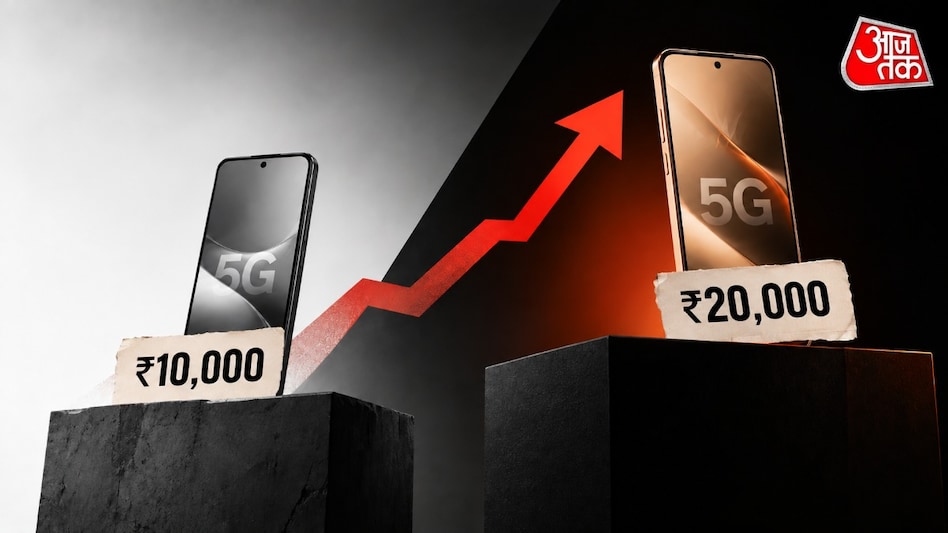
Previously, consumers could choose from many good options among smartphones priced around 10,000 rupees. In this price range, one could find a 5G phone with a good battery, an acceptable camera, and sufficient performance for daily tasks. However, this budget now seems insufficient. Finding a new 5G smartphone for 10,000 rupees has become difficult, and to get a good combination of screen, camera, battery, RAM, and storage, the budget often reaches 15–20 thousand rupees.
The Vivo T series serves as an example. The Vivo T4 Lite 5G was released in 2025 with a starting price of 9,999 rupees, whereas the Vivo T5 Lite 5G, released in 2026, has a starting price of 19,999 rupees. Although these two phones are not identical, this market shift is evident: new models in the same segment are appearing at higher prices than before.
This trend is not limited to Vivo. Many smartphones from Samsung, Realme, Poco, Xiaomi, Nothing, and other brands have also become more expensive recently. In some cases, the prices of older models have increased, and new models have appeared on the market at higher prices compared to the past.
Questions arise: why are smartphones becoming so expensive? Has the cost of goods truly increased for companies? Is the price related to artificial intelligence? And the most important question—are companies inflating prices by using the rise in AI and memory costs as an excuse?
To understand this situation, it is necessary to examine the factor exerting the greatest pressure on smartphone costs today—memory and storage. Smartphones use types of memory such as DRAM and NAND. Recently, there has been a sharp increase in the prices of these components. According to Counterpoint Research, the rise in memory prices in 2026 has noticeably affected smartphone production costs, especially in low-cost models where memory now accounts for a very large share of the total hardware cost.
Counterpoint reports that the Bill of Materials (BOM) for models with similar configurations in budget smartphones has increased by approximately 70%, and the main reason for this is the surge in memory prices. The increase in costs has also occurred in the mid-range segment. This means that it has become more expensive for companies to provide the same level of hardware at the previous price.
But why has the price of memory risen sharply? This is where artificial intelligence comes in. The use of AI is rapidly growing worldwide. Large technology companies are building massive data centers to train and run AI models. The servers used in these centers require much more and faster memory compared to regular computers. Demand for high-speed memory and other server memory has particularly increased. The AI and data center market has become critical for memory manufacturers. When demand for memory in this sector grew, pressure arose across the entire memory supply chain, leading to price increases.
This affects smartphones in the following way: the number of AI data centers has increased, demand for memory for these centers has grown, memory prices have risen, smartphone production costs have increased, and companies have incorporated part of these expenses into the final phone price. Thus, it cannot be argued that companies are simply using AI as an excuse to raise prices; the rise in memory costs has a real impact on company expenditures.
However, there is another important question: must the entire burden of rising memory costs be passed on to the consumer? Is the company using AI as a cover to inflate prices?
The final price of a smartphone is determined not only by the cost of its components. In addition to the processor, display, camera, battery, and memory, it includes software, research, marketing, logistics, retail markup, and company profit. Consequently, if the production costs of a phone rise, the company has several options: reduce its margin, cut other expenses, make changes to the hardware, or raise the price.
Therefore, the rise in memory prices cannot be considered the sole reason for any increase in smartphone price. The decision on how much to raise the price of a specific model depends on the company's own business strategy. That is, although the rise in AI and memory prices is a real reason, every price increase cannot be explained solely by the name 'AI', and market data shows that companies are addressing this issue not only by raising prices.
The market below 15,000 rupees in India is feeling the greatest pressure. According to Counterpoint Research, in the second quarter of 2026, the volume of smartphone shipments in India decreased by 10% year-on-year. However, in the segment priced under 15,000 rupees, the drop was about 45%. This figure is significant because a large number of customers in India purchase smartphones in this price range.