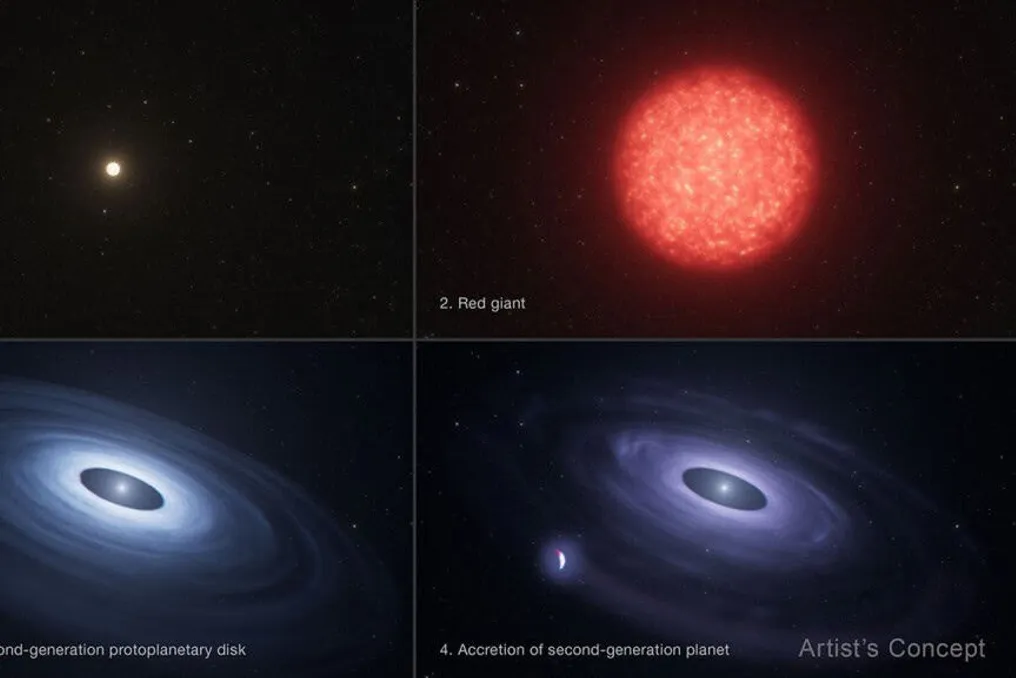
A dying star may be gradually consuming a hypothetical planet that formed from material ejected into space during the end of its stellar life. This theory was proposed after analyzing the white dwarf HS 0209+0832 and its atypical chemical composition.
White dwarfs represent the remnant cores of low-mass stars after they have exhausted their fuel and expelled their outer layers. In the specific case of HS 0209+0832, the detection of rare elements and luminosity fluctuations suggest the probable existence of a very close planetary giant.
The study began with data collected by the Hubble Space Telescope in 1999, when about one hundred chemical characteristics in the white dwarf's atmosphere had not yet been identified. Later, researcher Jamie Williams, affiliated with the University of Warwick, reexamined these records using an updated chemical database and identified a notable match: niobium.
This is the first record of niobium in the atmosphere of a white dwarf. Compared to calcium, niobium is more than a thousand times more abundant in HS 0209+0832 than in the Solar System, implying that the components that formed this planet must be extremely rich in niobium.
Furthermore, the chemical composition differs from the pattern found in rocky and icy materials of the Solar System. While large volumes of oxygen, magnesium, and iron were expected, scientists discovered an abundance of copper and zinc, along with a small amount of silicon.
The importance of niobium lies in the fact that heavy elements of this type are not generated in the interior of stars through conventional nuclear fusion; they can arise under extreme conditions related to the final stages of stellar life. Its presence helps explain how material originating from stellar death could reach the region where the planet would be located.
If this hypothesis is confirmed, the celestial body would be classified as a 'second-generation' planet: a world that developed after the star's evolution, using matter that it itself had expelled. However, researchers maintain consideration of other possible scenarios.
The main indicators supporting this theory include:
- During a four-month monitoring period, TESS captured periodic variations in the brightness of HS 0209+0832, occurring every 4.39 days. This pattern is consistent with the presence of an object orbiting the white dwarf.
- Researchers calculate that the candidate is a gas giant comparable in size to Jupiter, located approximately 6 million kilometers from the star—a distance significantly shorter than Mercury's orbit around the Sun.
Due to its proximity, the planet is exposed to intense radiation. Since the white dwarf is still young and hot, its energy may be stripping gases from the possible planet's atmosphere. Some of this material may form a tail, similar to a comet's, while another portion may fall onto the star's surface.
It is this mechanism that underpins the idea that the star would be 'devouring' the planet. It is a potential gradual atmospheric loss, not an instantaneous destruction.