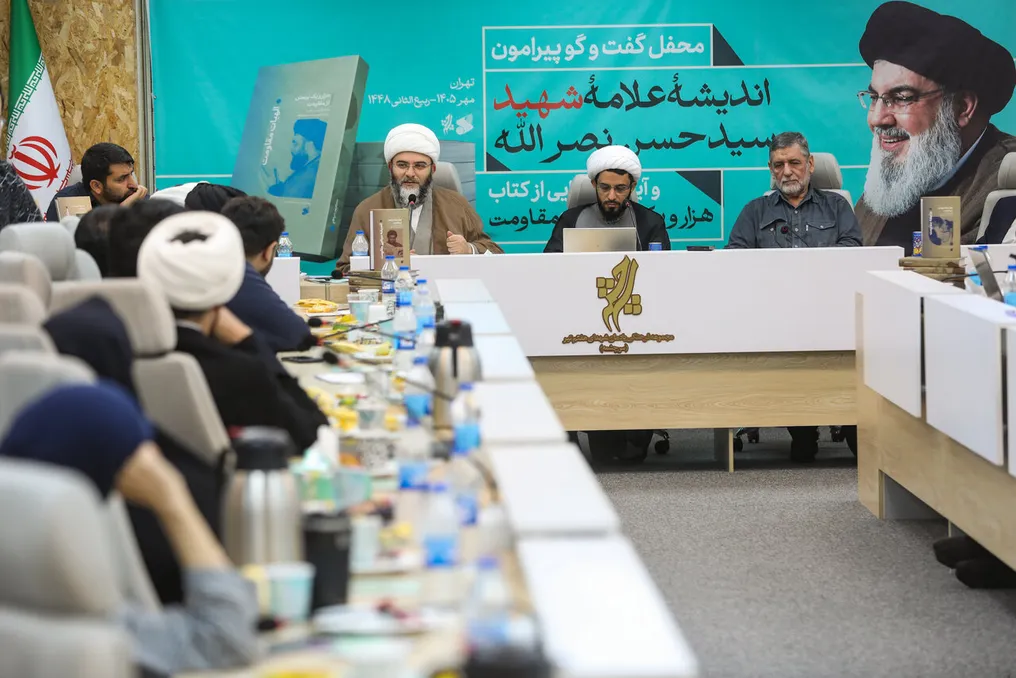
A ceremony was held in Tehran at the Sarcheshmeh Cultural Center on Monday to present the six-volume edition of '1001 Questions on Resistance.' This book is based on three decades of conversations with the late Hezbollah leader, Sayyed Hassan Nasrallah, and was presented as part of an event dedicated to his legacy and ideas.
Attendees at the ceremony included Hojjatoleslam Mohammad Komi, head of Iran's Organization for the Dissemination of Islamic Ideology; Mohammad-Hossein Saffar-Harandi, a member of the Council for Dispute Resolution; Hojjatoleslam Asad Kasir, theologian and director of the Center for Authentic Islam; Hojjatoleslam Ahmad Rahdar, a lecturer at Baker al-Oloom University; Abbas Khomeyari, former Iranian cultural attaché in Lebanon; Mehdi Afraz, the book's author, as well as a number of religious, academic, and cultural figures.
Speaking at the event, Afraz characterized resistance as one of the most important ideas of modernity, noting that despite extensive discussions, crucial questions regarding its intellectual and social aspects remain unresolved. He explained that the six-volume collection was compiled to clarify the ambiguities surrounding the concept of resistance in public discourse and social life.
Afraz stated that the personal views and figure of martyr Sayyed Hassan Nasrallah were chosen as the primary source, as his entire life and work were closely linked to the issue of resistance, and his statements offer strategic guidance for Muslim societies. He described Nasrallah as a strategic architect of resistance, adding that the collection covers six key areas: the theology of resistance, the political thought of resistance, the society of resistance, the strategic equations of resistance, the resistance bloc, and resistance in Lebanon.
According to Afraz, the publication presents Nasrallah's statements in a 1001 question-and-answer format, pursuing two main goals: forming an emotional and spiritual connection with him that can contribute to media and artistic productions, and allowing readers to interact more directly with his ideas.
Komi, speaking at the ceremony, called '1001 Questions on Resistance' an example of efforts to clearly and accurately articulate the history and ideas of resistance. He emphasized that Nasrallah's legacy cannot be reduced solely to his military role, stressing that the late Hezbollah leader presented resistance as a path to the progress and dignity of the oppressed, supported by rational, innate, and religious arguments.
Komi added: 'We all feel a duty towards Sayyed Hassan, and much still needs to be done,' insisting that today's task is not merely to remember his character, actions, and courage, but to explain the path of resistance he offered to humanity.
Khomeyari, a researcher of West Asia and former Iranian cultural attaché in Lebanon, called for greater attention to the various dimensions of Nasrallah's thought and the values he established in Lebanon. He noted that Iranian media and public platforms have mainly focused on Nasrallah's military role over the past two years, which, in his opinion, ignores other aspects of his legacy. Khomeyari stated that it is necessary to examine the diverse values established by Sayyed Hassan in Lebanon and subsequently spread to other Arab and Islamic countries.
Referring to the concept of the 'Sayyed Hassan Nasrallah School,' he urged the study and highlighting of its less explored facets. According to him, understanding the resistance movement in Lebanon requires analyzing Nasrallah's managerial capabilities, his rationality, realism, ethical conduct, and emphasis on nurturing a new generation. He stressed that 'Sayyed Hassan conducted classes more than he gave speeches,' noting that Nasrallah regularly organized sessions for the families of martyrs and youth, paying significant attention to training and human resource development.
Saffar-Harandi asserted that Nasrallah filled the vacuum of a hero in the Muslim world, establishing a new standard of political leadership. He presented Nasrallah as a victorious model of resistance, creating expectations among contemporaries and subsequent generations that are difficult to change. Saffar-Harandi also drew attention to Nasrallah's deep religious convictions, his close connection with the people, and his courage in difficult circumstances. He noted his understanding of Lebanon's diverse social structure, stating that despite leading a Shiite movement, he received support among Sunnis, Maronites, and other Christian communities.
He also characterized Nasrallah as a bridge between the Islamic Revolution in Iran and the Arab world, including Iraq, Yemen, Palestine, and Syria. Rahdar called for the compilation and publication of Nasrallah's speeches in a format similar to 'Sahife-ye Noor,' a collection of speeches and writings by the late Imam Khomeini. He called Nasrallah a 'scholar' in the truest sense, believing that a full understanding of the various aspects of his personality and thought would take time. He concluded that the wisdom evident in Nasrallah's speeches is not merely the result of theoretical study but developed over many years of practical and ethical struggle.
The collection '1001 Questions on Resistance' consists of six volumes, covering the theology of resistance, political thought, society, strategic equations, the resistance bloc, and Lebanese resistance, offering a thematic presentation of Nasrallah's views through 1001 questions and answers.
Sayyed Hassan Nasrallah became the Secretary-General of Hezbollah in 1992 after the assassination of his predecessor, Sayyed Abbas al-Musawi. He led the movement for more than three decades, a period that included the withdrawal of Israeli troops from South Lebanon in 2000 and the 2006 war between Hezbollah and Israel. Under his leadership, Hezbollah transformed into a major political and military force in Lebanon and took on a broader role in regional affairs.
Nasrallah was also widely known for his television appearances, where he addressed supporters and commented on major events in Lebanon and the wider region. Born and raised in Beirut, he came from a family with roots in Bazurieh in Southern Lebanon. Although his public life was closely monitored across the region, his private and family life largely remained out of the public eye. Tragically, he died at the age of 64 during a series of intense Israeli airstrikes in South Beirut on September 27, 2024. The attack that claimed his life was carried out by Israeli fighters targeting Hezbollah's headquarters, resulting in the martyrdom of several high-ranking Hezbollah commanders and Iranian Revolutionary Guard Lieutenant General Abbas Nilfouroushan, who was present at the scene. Under his leadership, whose name means 'victory through God,' Hezbollah evolved from a grassroots armed movement into the largest political party in recent Lebanese history. Known for his captivating speeches, Nasrallah attracted attention across West Asia and beyond, establishing himself as a significant figure in the Axis of Resistance, which includes Hezbollah, Palestinian groups Hamas and Islamic Jihad, the Houthi movement in Yemen, and various Iraqi militia factions.