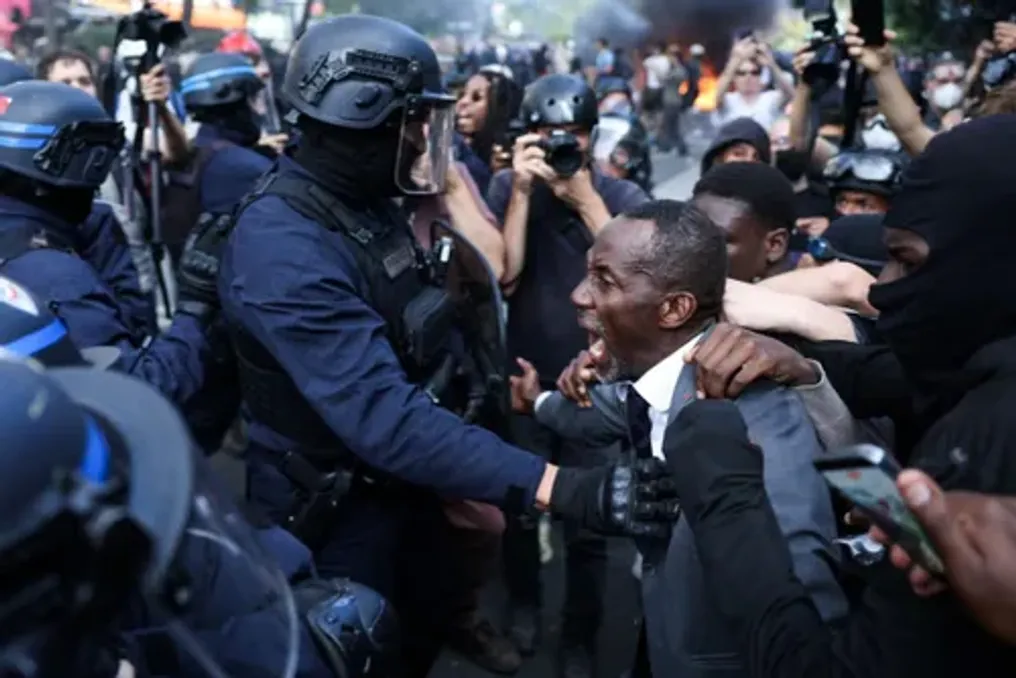
Tens of thousands of demonstrators took to the streets across France on Tuesday, joining schoolchildren, trade unions, and teachers. For several days, they have been demanding improvements to learning conditions during protests that were accompanied by violent clashes.
Students aged 15 to 17 have been blocking entrances to hundreds of high schools since late September. Their grievances concern the lack of teachers, overloaded schedules, dilapidated classrooms, and buildings that cannot cope with rising temperatures.
Trade unions, human rights groups, and the students themselves have accused the authorities of using disproportionate force. On Monday, a police flashbang tore an arm from one teenager, and last week, another young man had his teeth knocked out after police fired a grenade launcher at his head.
In the Place de la République in central Paris, the aroma of grilled merguez sausages hung over the crowd—a traditional French protest food. Two people in climbing gear climbed onto a nearby monument, where they unfurled a plastic banner reading 'Neglected Schools, Sacrificed Youth.'
19-year-old Lilia told AFP during a mass march in central Paris that 'Generation Z has risen up and wants to be heard,' adding that she hopes the president will listen to their demands.
These unrest flared up just a few months before the 2027 elections, which will see the successor to centrist President Emmanuel Macron chosen, despite veteran far-right party member Marine Le Pen holding high poll positions while having a corruption conviction.
Selma, 15, told AFP, without giving her surname, among thousands marching in the country's second-largest city, Marseille: 'I am afraid for my future.'
The Ministry of the Interior reported that 86,000 people participated in the protests nationwide on Tuesday, whereas the CGT union cited the figure as 260,000 people.
Prime Minister Sébastien Lecornu responded to the demonstrations, telling members of the National Assembly that 'there is no room for tolerance of violence.' He stressed to parliament that 'burning down a high school does not improve the condition of high school buildings' and called the claim that the government ordered 'police suppression' of protesters a lie.
Although many protests were peaceful, some demonstrators set buildings on fire, destroyed bus stops, or clashed with the police. The police responded with batons, tear gas, and ammunition to disperse the crowds.
The government states that 215 students and 715 police officers have been injured since the start of the movement. A 15-year-old lost an arm from a sting-ball grenade fired by police officers in the northern city of Lens on Monday.
Meanwhile, the prosecutor's office in the northeastern city of Metz announced it had initiated a police investigation into possible sexual assault of a person under 15 after videos appeared online allegedly showing a plainclothes police officer touching a detained student.
The government seeks to address the problems while simultaneously blaming the hard-left French party La France Insoumise (LFI) for organizing the movement.
LFI veteran presidential candidate Jean-Luc Mélenchon strongly supported the protests, calling for non-violent methods.
Thomas, a 17-year-old student from the suburb of Val-de-Marne near Paris, told AFP that some classrooms in his school lacked desks and chairs, and the toilets lacked doors, toilet paper, and soap. He told AFP: 'We just want better learning conditions.'
On Tuesday, adults also came out in large numbers to support the young demonstrators. At a school in western France, in Rennes, teacher Romain Dubourg told AFP that he and his colleagues 'discussed the police brutality we witnessed' and decided to appear in support of the students.
In the eastern city of Lyon, Sandrine Buto was among dozens of parents who organized themselves to support the youth. She noted: 'As adults, we are somewhat like a protective cordon.'
A teacher from Lyon, Rindala Younes, said she was present to help the students 'peacefully convey their message.' She emphasized: 'The demands of the high schoolers are legitimate.'
Amnesty International stated late Monday that French authorities must 'end the disproportionate police repression observed in recent days during student protests.'
Interior Minister Laurent Nuñez announced late Monday that the police had launched 10 internal investigations into allegations of brutality since the protests began.
According to the Ministry of Education, 24 schools have been burned or looted since the start of the movement. More than 5,000 people have been arrested, 87 percent of whom are minors. The Prime Minister's office reported that 85 teachers were also affected.