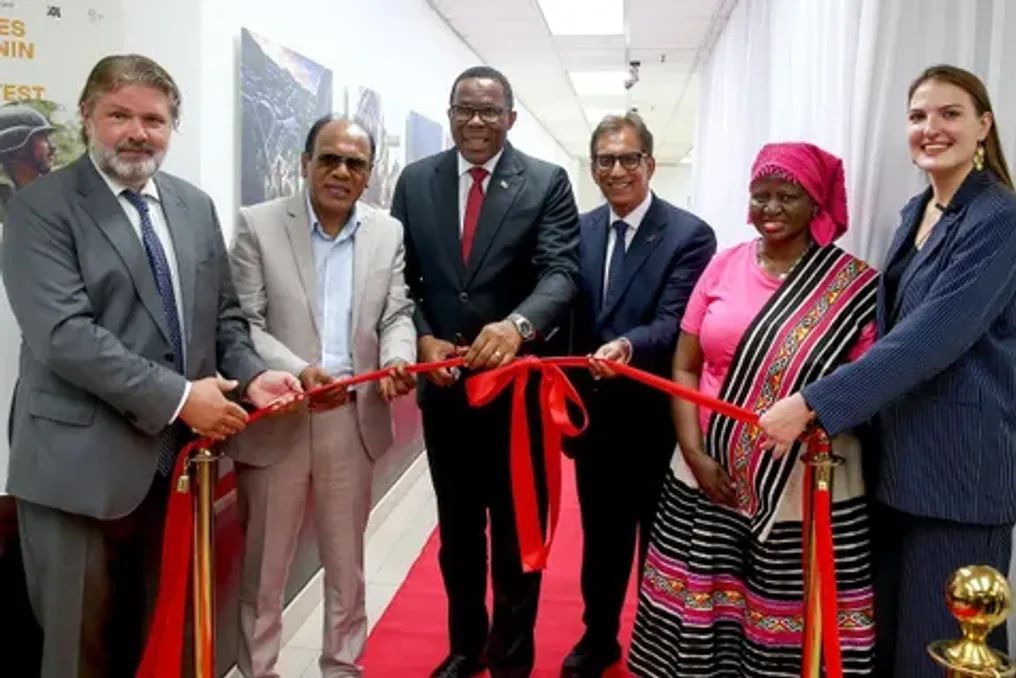
Dr. Iqbal Surve, Chairman of Survé Group Holdings, officially opened the Andrey Stenin International Photojournalists Competition in Durban on Tuesday. Diplomats, photographers, media representatives, and guests were present at the ceremony.
During his speech at the exhibition opening, Dr. Surve emphasized photography's ability to transcend borders, preserve human stories, and foster mutual understanding. He noted the significance of holding an international photo exhibition in Durban, highlighting that it is the first time the city hosts such an event.
The exhibition features thirty award-winning photographs taken by photojournalists from different countries and social strata. According to Dr. Surve, despite documenting very diverse situations, the images are united by a common theme—the human experience.
He stated that each photograph captures a specific moment but simultaneously serves as an invitation to examine that moment more closely. In an information-saturated era, he argued that one powerful image can sometimes convey more than entire pages of text.
Dr. Surve particularly focused on the concept of perspective, pointing out that every shot reflects the choice of the person behind the camera—from where they stand to what they decide to capture. However, he added that the viewer also brings their own point of view to the image.
He noted that two people can look at the same photograph and see something different because they carry different histories, cultures, and life experiences. Instead of viewing these differences as a limitation, Dr. Surve called them one of photography's greatest strengths.
He advocated the view that photojournalism can challenge the idea that there is only one way to understand any event or society, allowing the audience to connect with people and experiences that might otherwise remain distant from their own lives.
Dr. Surve also recalled the legacy of Andrey Stenin, the Russian photojournalist in memory of whom the international competition was established. He described Stenin's work as embodying the risks, responsibility, and courage associated with documenting events as they unfold, while also emphasizing the competition's role in creating an international platform for emerging photographers.
For Dr. Surve, this exhibition is also linked to a broader commitment to international friendship and cultural exchange. He mentioned receiving the Medal for Cooperation from the Ministry of Foreign Affairs of Russia from Minister Sergey Lavrov in Cape Town in June 2023 during the BRICS foreign ministers and international relations meeting. This recognition followed Dr. Surve's contribution to the BRICS Business Council.
He stated that the principles of non-alignment, peaceful cooperation, and international friendship continue to define his approach to international engagement.
Dr. Surve also spoke about the role of culture and art in strengthening ties between nations. He recounted his participation in the opening of the 'BRICS Universe' photo exhibition at the Iziko Planetarium in Cape Town in 2024 during Russia's chairmanship of BRICS, where he shared the platform with cosmonaut Sergey Kud-Sverchkov.
Reflecting on South Africa's history, Dr. Surve noted the support provided by the Soviet Union, China, India, and Brazil during the country's struggle for liberation. He stressed that such relationships demonstrate that international friendship is built not only on political agreements or economic partnerships but also through culture, education, art, ideas, and human contact.
He deemed Durban a suitable location for the exhibition, given the city's history of cultural exchange, its status as a major international port, and its deep Indian heritage. Photography, in his opinion, provides a form of communication that does not always require translation.
Dr. Surve concluded that an image can travel from Russia to South Africa, from Asia to Africa, and from one generation to another, yet still convey something deeply human.
Against the backdrop of growing global division, Dr. Surve asserted that cultural exchange can offer an alternative way of engaging with differences. He argued that art can encourage curiosity instead of suspicion and allow people to look beyond political categories and statistics, focusing on the individuals behind major world events.
Photography, he said, has the power to 'humanize people who would otherwise be reduced to statistics, headlines, or political categories.' It can also preserve memory, challenge stereotypes, and draw attention to traditions and experiences that might otherwise be overlooked.
Dr. Surve expressed particular gratitude to the young photographers featured in the exhibition. While technology allows almost anyone to create and disseminate images, he considers professional photojournalism indispensable because its value extends beyond simply creating a striking shot. He emphasized that observation, timeliness, responsibility, context, and the courage to bear witness remain central to this profession.
He addressed the photographers, saying: 'Your work matters. You are not just documenting how the world looks. You are helping us think about what the world means.'
He urged visitors to spend time with the photographs rather than quickly moving from one image to the next. He strongly recommended that the audience consider not only what they see but also what they might be missing, reflecting on both the photographer's perspective and their own.
Concluding his address, Dr. Surve noted that the exhibition was ultimately about more than just photography. 'It is about connection,' he stated. He argued that despite differences in language, history, and national identity, people share experiences of grief, joy, courage, beauty, uncertainty, and hope.
Dr. Surve reported that staging the Andrey Stenin exhibition became part of his broader mission to unite people through images and shared stories, expressing hope that this would strengthen ties between South Africa and the rest of the world. He also called for continuous support for young journalists and artists, as well as the creation of spaces where different viewpoints can be heard.
He called to 'celebrate photography not only as an art form but as a language of humanity.' For the attendees in Durban, the exhibition provided precisely this opportunity: to encounter stories beyond their own borders through images that do not require translation to convey their most fundamental message—our shared humanity.