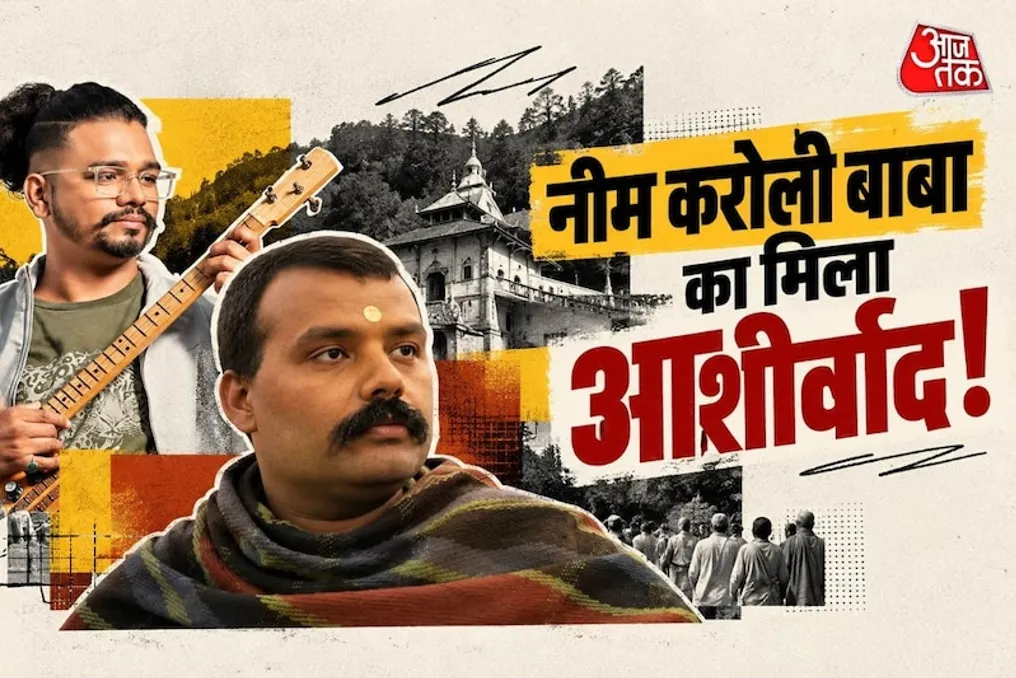
The fate of musician Dhirendra Mulkavar, who previously created jingles, changed with the acquisition of the 'Hanuman ANSH' project, which many consider a miracle. He had long tried to visit the Kainty Dham temple and finally managed to reach the Nim Karoli Baba ashram last April. Just a few months later, he received an offer that fulfilled a long-held dream.
Director Vishal Chaturvedi invited him to compose music for his film 'Hanuman ANSH'. For Dhirendra, this was not just a movie, but something akin to a miracle. In an interview with India Today/Aajtak, he shared his story.
Dhirendra Mulkavar's connection with Nim Karoli Baba dates back to a much earlier period, preceding the creation of this film. Around 2010, he saw a video of the American spiritual teacher Rama Das, who was a disciple of Nim Karoli Baba. It was then that Dhirendra developed an interest in Baba.
He began researching information about Baba, listening to stories about his influence and followers worldwide. His curiosity grew with stories about Baba linked to names such as Steve Jobs and Julia Roberts. However, achieving the goal of visiting Kainty Dham took about four years. Finally, he arrived there in April. He did not suspect that this journey would open the next big door in his life.
Approximately two months after the trip to Kainty Dham, Dhirendra contacted director Vishal Chaturvedi, who offered him the opportunity to compose music for a film about Nim Karoli Baba. Dhirendra himself recalls the entire process, considering it a miracle. The link from the trip to Kainty Dham to the music for the film was so direct that it was difficult for Dhirendra to consider it mere coincidence.
The most special song in the film, 'Siavar Ramchandra Ki Jai', was also not created according to plan. In fact, Dhirendra was working on background music for an important scene in the film. In this scene, the revolutionary takes the guise of a sadhu to avoid persecution by the English, and Nim Karoli Baba helps him.
While working on this scene, an idea suddenly occurred to Dhirendra—chants in honor of Sita and Rama. He presented this idea to Vishal Chaturvedi, who approved it. Thus, what was initially just part of the background music later became a full-fledged song. This song, combining patriotism and spirituality, became the film's signature piece.
The musician, whose name is now associated with 'Hanuman ANSH', did not begin his journey in a big city or within a film family. Dhirendra grew up in Chandrapur, Maharashtra, and his childhood was spent in very modest conditions with limited resources. Music was not a direct path to a career for him.
His mentor, the late drummer Rajiv Pillai, introduced him to music. Furthermore, his older brother showed him music that awakened in Dhirendra a dream of doing something great. Gradually, he began to think that he could become a music director.
After moving to Mumbai, Dhirendra mastered audio engineering. He worked in radio for about a year, but his dream did not stop there. After his day job, he prepared his musical demos at night and met with people. Then, he was offered a job creating jingles for advertisements. Soon, he worked on over 500 commercials and jingles, but the dream of recognition in cinema as a composer remained unfulfilled.
Dhirendra's story also holds another beautiful connection—with nature. The area near Chandrapur, around the Tadoba-Andhari sanctuary, was part of his childhood. He was also involved in wildlife rescue and conservation. The time spent in the forest gave his music a unique perspective. According to him, sounds were sometimes heard in the forest that rivaled a symphony. He would close his eyes and feel these natural sounds as music.
Perhaps this is why nature, spirituality, and emotion are so naturally combined in his music.
It took Dhirendra about two decades to realize his dream of becoming a film composer. He said that he knew how to play music, but understanding the business of the film industry was entirely different. Because he was from a small town, it took him time to master this aspect of the industry.
During this time, his work was featured in films such as 'Uri: The Surgical Strike' and 'Article 15'. It was this work that attracted the attention of Vishal Chaturvedi, leading to the 'Hanuman ANSH' project. The film 'Hanuman ANSH', released in August, received more positive reviews from audiences than expected. Even during screenings, the team realized that an emotional connection was forming with the audience.
Now, 'Hanuman ANSH' has opened new opportunities. According to Dhirendra, some viewers were so moved during the preview that the team felt the film's spiritual message had reached the public. But the commercial success of the film exceeded his expectations. Now, following this success, Dhirendra has started receiving calls about new projects, and negotiations are underway for several films.