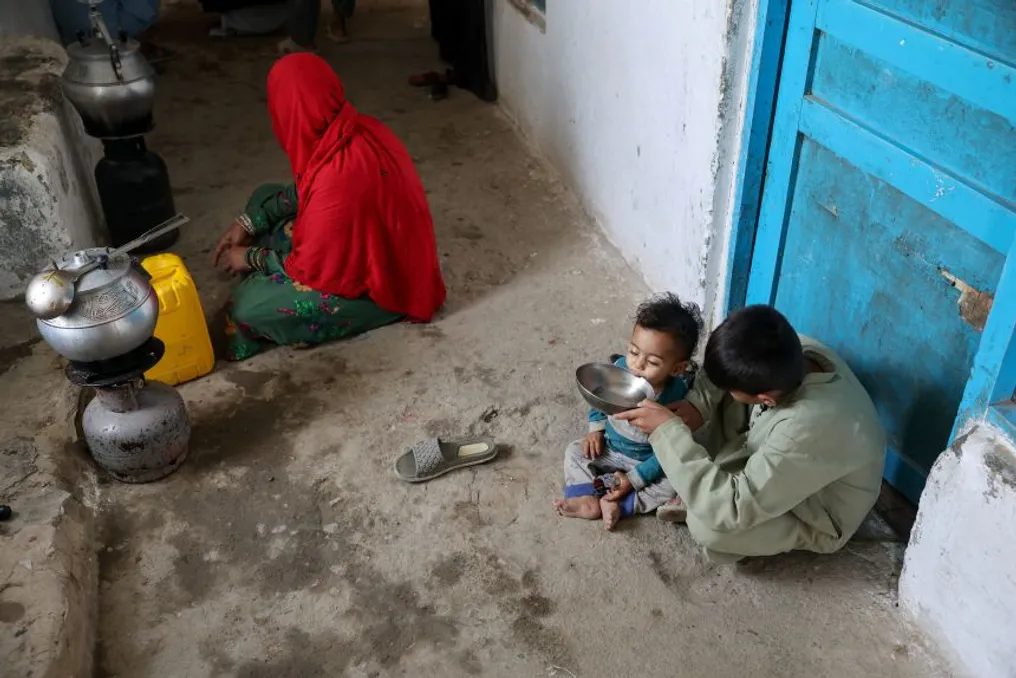
This city is on track to deplete its water reserves by 2030. However, for many local residents, that day has already arrived, and life under severe water scarcity has become unbearable.
34-year-old Shazia lives in the Hair Khan neighborhood of Afghanistan's capital, Kabul, with three children and her husband, who earns a living as a street vendor. They lack running water and cannot afford to buy water from tankers, which often outnumber cars on the city streets.
Every day, she and her children have to walk to the local mosque and stand in queues for hours to fill buckets from a hand pump, after which they return with heavy loads. She complains that her back hurts and she dislikes carrying the children after school, but as she said, 'we have no choice.'
According to a recent report by the NGO Prosper Global, Kabul could become the first modern city to face water shortages sooner rather than later, possibly as early as 2030. Nevertheless, for Shazia and many other residents of this rapidly growing city, this critical moment has already come. They find themselves at the forefront of a spiraling urban water crisis that is not limited to Kabul.
Similar crises are observed in many cities around the world, from Corpus Christi, Texas, to Tehran, the capital of Iran. Residents of these cities are preparing for a 'day zero'—the point when tap water stops working in large parts of the city. These crises usually share common features: rapid population growth meets insufficient and underfunded water infrastructure, all against the backdrop of a climate crisis causing hotter and drier weather and disrupting the water cycle.
The situation in Kabul may be the most acute among all urban areas facing a 'day zero.' It is one of the fastest-growing cities located in one of the countries most vulnerable to climate change. Afghanistan has also suffered from decades of conflict, and global aid has practically ceased since the Taliban regime returned in 2021.
Mohd Faize, a professor at the UN University for Water, Environment and Health, stated that Kabul faces a 'humanitarian catastrophe,' adding, 'We only have limited time.'
On the streets of Kabul, the topic of water is actively discussed, notes Mirza Yan, who lives in the Taymani neighborhood. All segments of the population are affected. When Yan's family bought a house in 1990, they could draw water manually from a shallow well. Over time, he had to deepen the well as it continued to dry up. It is now deeper than 700 feet—a costly undertaking made possible by funds sent by his two sons living in the US.
As groundwater depletes, those who can afford the initial costs, like Yan, continue to dig deeper; others are forced to rely on expensive tanker water or hand pumps at mosques. None of these options is sustainable. Yan emphasized, 'It is an invisible disaster in progress; the city will soon run dry.'
Although Kabul should not be experiencing water shortages, it sprawls across a wide valley framed by the Hindu Kush Himalayas. The rocky peaks of the Afghan part of this vast mountain range serve as catchment areas. Snowmelt and glacial melt feed the Kabul River, which flows through the city, and replenish the aquifers that form the basis of the city's water supply, providing for 80% of residents. Yet, only one-fifth of the population has access to piped water.
However, over the last decade, groundwater levels have dropped by nearly 100 feet, according to Prosper Global. Water is now being pumped out significantly faster than it can be replenished, leading to an estimated deficit of over 1.55 billion cubic feet annually. Nearly half of the wells in the city have dried up. Faize noted, 'In many areas, the water is already gone.'
The cause is increasing demand from homes, greenhouses, and businesses. But the human climate crisis also plays a role. The country has experienced six consecutive years of drought, with last year being one of the harshest. According to the UN, last year saw snowfall in Afghanistan at a level not seen in 25 years, which is part of a long-term trend of snow levels decreasing by almost 20% between 2014 and 2020.
When it rains, Kabul's hard, impermeable surfaces prevent water from replenishing aquifers; instead, it runs off the city in sudden floods, destroying homes, taking lives, and washing them away.
Najibullah Sadid, a water and environmental researcher from Germany working with the Afghanistan Water and Environment Specialists Network, believes that the disappearance of groundwater in Kabul is not a crisis. He prefers the term 'water insolvency,' arguing that 'you are exhausting a resource that cannot be restored.'
Sagha and his family live in an apartment in the densely populated Karte Naw district of Kabul. He earns a decent income working for a company, but the city's water crisis affects few. Their building houses 14 families but depends on a single well that dries up every few months. They often only have running water for short periods; sometimes it is shut off for days.
Agha is convinced that the city's aquifers will soon run out, and he doesn't know what to do. His job is related to Kabul, and leaving would be a 'catastrophe.'
Sadid notes that Kabul is expanding vertically, with multi-story buildings constructed atop existing structures. Instead of one family occupying a plot of land, there are now dozens, sharply increasing pressure on already strained water resources.
Kabul is one of the fastest-growing cities in the world. Experts estimate that its population has grown from less than 1 million in 2001 to 6 million today. People have migrated here for various reasons. Many returned after the fall of the Taliban in 2001 hoping for better opportunities. Recently, there has been a surge due to the mass displacement of Afghans from neighboring Iran and Pakistan amid rising regional tensions. People are also moving from rural areas to the city in search of work and, ironically, sometimes in search of better water conditions.
For the last two years, Asadullah Ahmadi spends no less than 150 Afghanis (2.35 dollars) per day, which constitutes a significant portion of his income, to provide enough water for his family of seven. Even then, the water they receive is dirty and requires boiling. He says, 'It is unsustainable, and I don't know how long we can afford this.'
The lack of water comes at a high cost. Many in Kabul, like Ahmadi, are forced to rely on water delivered by private companies via tankers. Marianna von Tsan, former Program Director for Prosper Global in Afghanistan, notes that while some of these companies are motivated to help people, others simply seek greater profit. They pump groundwater and sell it to residents at inflated prices.
The consequences are felt most acutely by residents already in extreme poverty, according to an UN official based in Afghanistan. Analysts estimate that poor people spend up to 30% of their total income on water. The UN considers acceptable water expenditure to be no more than 3% of household income.
To compound the difficult situation, up to 80% of groundwater in large parts of the city is contaminated with both sewage and natural substances such as arsenic. Jalal Naser Fakiryar, a water specialist from the Netherlands and former director of the Kabul River Basin, calls this 'another hidden crisis.'
Kabul residents have few options. Ahmadi fears he may have to leave his home, but 'even if I leave, where do I go to find water? The whole city suffers from this problem.'
Some may leave Kabul entirely, but water scarcity is widespread across Afghanistan. Leaving the country is fraught with difficulties. Neighboring Iran and Pakistan forcibly return Afghans, and in Europe, far from here, fierce anti-immigrant rhetoric makes the situation very difficult. An UN official stated, 'There is hardly anywhere to go.'
There are plans to mitigate Kabul's impending disaster by utilizing surface water. The Shahtut Dam, which is planned to be built on a tributary of the Kabul River, could provide water to over 2 million people in the city. India agreed to finance this project, but it stalled after the Taliban returned to power in 2021. The Taliban insists on a quick start, but construction has not begun, and the project faces strong opposition from Pakistan, which claims the dam will significantly reduce the volume of water flowing to it from the Kabul River.
Another plan involves a 124-mile pipeline that would transport water from the Panjshir River to Kabul to supply 2 million city dwellers, but it is still in the feasibility and design stages. Even if these projects move forward, their construction will take years, and purification facilities and a proper network for delivering water to people's homes will be necessary. Faize noted, 'The Taliban does not have the capacity to handle such a large problem, and they know it.'
Matiullah Abid, spokesperson for the Ministry of Energy and Water Resources of Afghanistan, stated that the water situation in Kabul is 'moving towards a serious crisis.' He reported that the ministry is taking measures, including building dams and thousands of wells in the city to replenish groundwater, controlling commercial water use, and completing the construction of the Shah Va Arus Dam in 2024, intended to supply 20,000 households. Abid added that despite numerous ongoing efforts to solve the water problem, 'these measures require time and resources.'
The Taliban itself presents an additional complexity in Kabul's water history. Most of the international community does not recognize it as a legitimate government due to human rights violations, including the deprivation of rights for women and girls. As a result, international aid has sharply decreased, while Kabul and other parts of Afghanistan approach a water catastrophe. Faize said that the world is 'watching the crisis unfold' instead of preventing it now. 'Later, it will require emergency responses, such as water trucking, disease outbreaks, and population displacement.'
For now, people 'will continue to suffer in silence,' said Suzanne Schmeier, Professor of Water Resource Cooperation, Law and Diplomacy at the Institute for Water Education (IHE Delft) in the Netherlands. Kabul demonstrates what a 'day zero' looks like. It is not a sudden drying up of every tap, but a slowly developing catastrophe that forces residents to make increasingly difficult decisions.
Should they invest money in expensive, deeper wells that will inevitably run dry, or rely on private water tankers that exacerbate their poverty? Or must they undertake arduous daily trips to hand pumps, pulling children away from school and play while risking their physical health and safety? Or should they leave the city and lose their jobs, risking ending up in an equally bad water situation?
What is happening provides insight into what many other cities may face when climate change meets urban water systems designed for a completely different world. For the residents of Kabul, it is trauma upon trauma. As resident Sagha said, 'Years ago, we were running from bombs and rockets in Kabul. Now, we might have to run because of water scarcity.'