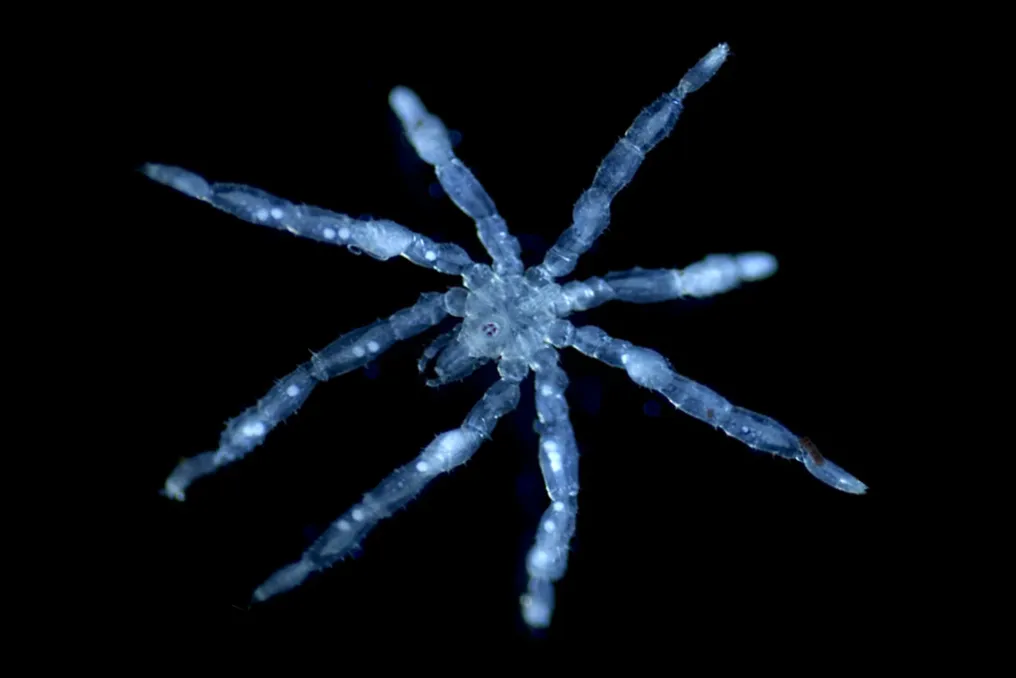
Researchers have discovered two new species of sea spiders that may cause concern due to their unusual appearance. These creatures belong to the family of sea spiders and were found in the shallow waters of Selish Bay, located between Washington State in the USA and the province of British Columbia in Canada.
One of the discovered species, named Callipallene pilosuspedes, attracts attention with its peculiar appearance: its limbs are covered in long spines, its eyes are red, and its mouth is triangular with three lips. This species also possesses appendages used for hygienically cleaning its own legs.
The second species, named Tanystylum kiixin, resembles a swamp monster. Unlike its 'relative,' it has shorter legs and significantly smaller appendages, which apparently limits its ability to self-clean. This is confirmed by the fact that 82 specimens found during the study were covered in dirt, detritus, and parasites.
However, researchers emphasize that these creatures pose no threat: the red-eyed species is only about 8 millimeters in size, and the second species is even smaller. Furthermore, there is no evidence that they inhabit outside of Selish Bay. According to scientists, this is the first time a sea spider has been described in this region in almost a century.
To identify the new species, researchers collected over 150 samples of sea spiders at depths of up to 18 meters in Selish Bay. After studying the animals' physical characteristics and analyzing their DNA, it was determined that these creatures correspond to five shallow-water sea spider species—two of which had not been previously described.
The lead author of the study, Cormac Toller-Scott, stated in his announcement: 'To understand how marine invertebrates suffer from factors such as climate change, and how we can better protect these vital ecosystem elements, we must be able to identify them.'
Sea spiders belong to an ancient lineage that appeared about 500 million years ago. They are relatives of spiders, scorpions, and clawed crabs, but unlike these examples, they are fully aquatic. To date, science has documented only about 1400 species of sea spiders.
Interestingly, even by the standards of arthropods, their appearance is often quite bizarre. Some species can have up to 12 legs, and their size varies greatly: from less than one centimeter to more than 70 centimeters. Due to their small size and similarity, the new sea spiders may be difficult to recognize.
Moreover, many of them, including the newly discovered ones, are transparent and take on the color of what they eat. For example, Tanystylum kiixin feeds on parasites, which partially explains its unique appearance. Another characteristic is that they do not spin webs or prey on their food like terrestrial spiders. In the case of the discovered specimens, they were attached to a hydrozoan—a marine animal resembling a plant.
Additional dives are planned, during which researchers hope to discover more sea spider species in the future. The full description of the new species was published in the journal Organisms Diversity & Evolution.