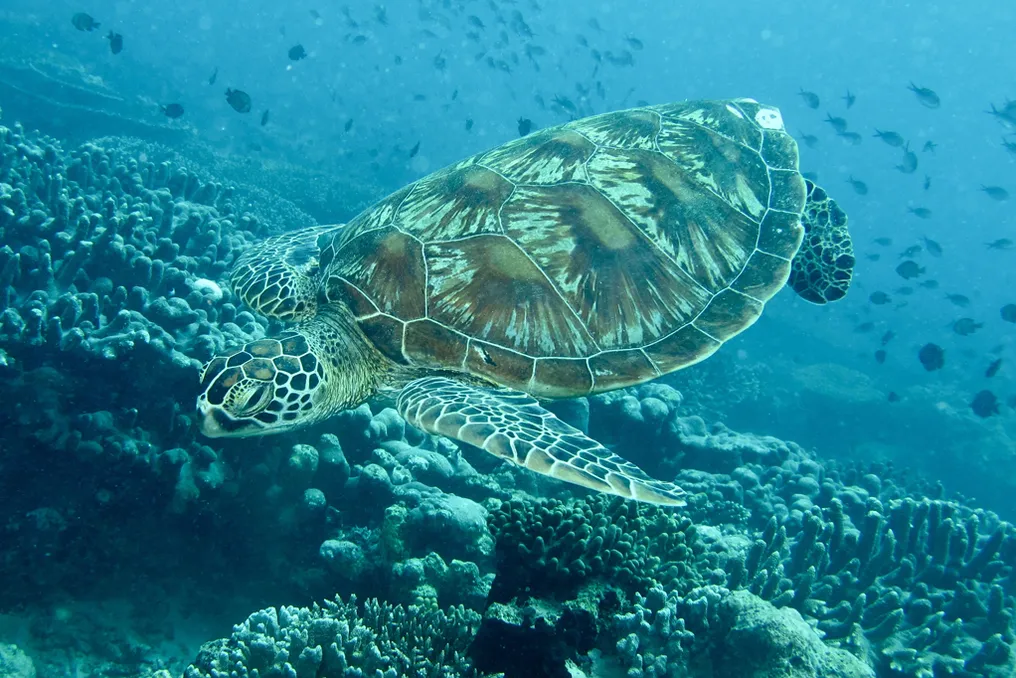
A study involving green turtles (Chelonia mydas) in the state of Rio de Janeiro found that this species shares similar bacterial types with those found in environmental plastic waste.
The scientific work was conducted by Professor Filipe Berbeti under the coordination of Enrique Fragoso das Santos from the Laboratory of Environmental Microbiology and Microbiotechnology at the Federal University of Fluminense (UFF). Scientists from the Federal University of Rio de Janeiro (UFRJ) and the Aruanã project, which focuses on marine turtle conservation in Guanabara Bay, also participated in the research.
Berbeti analyzed microorganisms inhabiting the turtles' bodies on Itapú beach in Niterói (Rio de Janeiro state) and compared them with bacteria found in pieces of plastic, in seawater, and in algae of the region.
The results indicated that the turtles' bacteria were more similar to those found on plastic than to those collected from algae (which serve as the animals' food) and water (where the turtles spend most of their time).
The researcher noted: 'It was expected that the turtle's microbiota would resemble the microbiota of its own food [algae]. That is what the literature states. But when we compared the bacterial types, we saw that they were more like those found on plastic. This is the first sign that the link between the turtle and plastic is likely much closer than we assumed.'
The data suggests that plastic consumption and contact with this material may represent a significant source of microbial impact on the animals.
Berbeti added: 'Today we already know that plastic causes many problems. Whether it is visual pollution, animals eating the material, or ingesting it. We did not know much about the interaction of microbiota and plastic upon ingestion.'
Among the groups of bacteria found both on plastic and in turtles are Vibrio, Pseudomonas, Bacillus, Staphylococcus, Streptococcus, Chryseobacterium, and Clostridium. These groups of microorganisms include species that cause diseases in both animals and humans. However, no analysis was conducted to correlate these bacteria with diseases in green turtles, nor was an in-depth identification performed to determine the species and confirm pathogenicity for some of them.
Berbeti explained: 'It is difficult to achieve species identification when assessing the microbiome. We took some DNA for amplification and attempted to detect the organism. We could only reach the genus classification level. Therefore, we cannot definitively state that a particular species caused pathogenicity.'
According to the study, plastic waste can be a potential source of microbes with pathogenic significance. In turn, green turtles may act as potential carriers of marine bacteria, linking contaminated environments to distant areas through their natural migration.
Five turtles collected by the Aruanã project participated in the study. The results were published in the journal Environmental Pollution in August of this year.