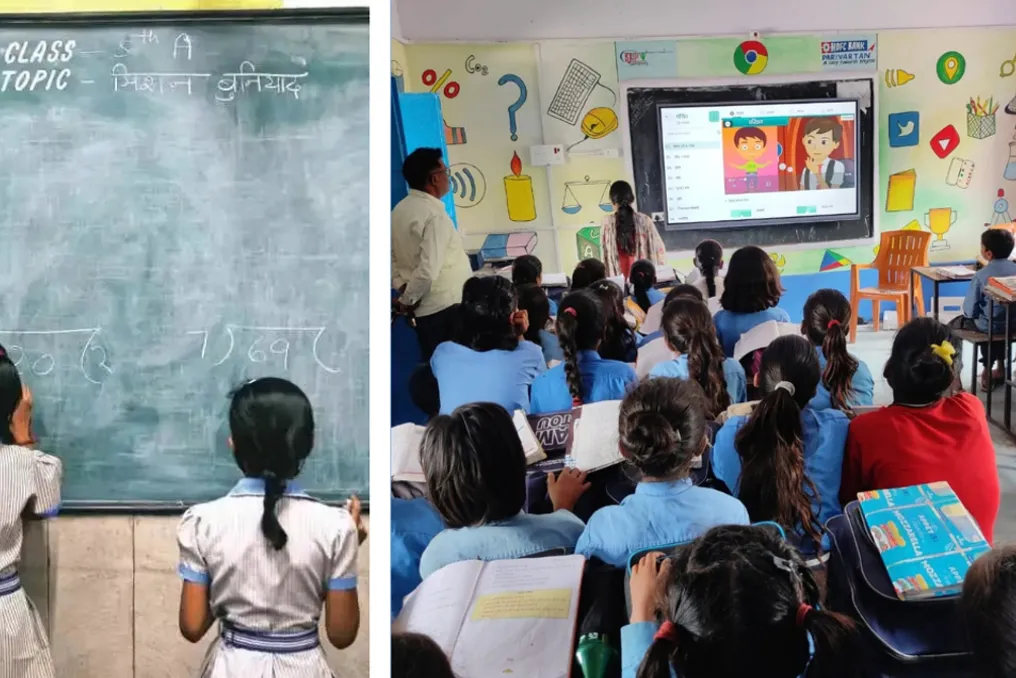
In the series 'How Technology Has Changed' by The Better India, it is reported how technology has transformed various aspects of life, including education. Technology is capable not only of introducing new gadgets but also of fundamentally changing the work of entire sectors, making processes more efficient, accessible, and intelligent.
In the village of Sarai Tand, Bihar state, students can now receive scientific lessons that were previously unavailable. This village is located approximately 63 kilometers from the district center of Gaya.
Students from six neighboring villages travel to the Government Middle School, and for many, this is the only way to access opportunities outside their native settlements. A special Smart Classroom has been equipped in this school.
In this room, teachers use an interactive digital panel to bring educational material to life. The lesson, which previously relied heavily on textbooks, blackboards, and oral explanation, can now include animations, visual demonstrations, practical exercises, and tests. For a student who finds it difficult to grasp a concept through verbal description alone, viewing this material on a screen significantly eases comprehension.
Currently, this classroom serves 660 students and 14 teachers from different grades. Since the educational content is stored offline, classes can continue even without a stable internet connection.
The situation in Sarai Tand is part of a broader transformation occurring in Indian schools. Across the country, over 149 thousand schools are covered by government initiatives in Information and Communication Technology (ICT) and digital learning. The government has allocated funds to create more than 176 thousand smart classrooms and 179 thousand ICT labs, integrating digital tools into classrooms that previously relied almost exclusively on traditional teaching methods.
Changes are visible in small details: a teacher can show a three-dimensional model instead of drawing a complex diagram on the board, and a student can review a difficult topic using a video. A lesson can include an interactive exercise instead of ending with note-taking from the board.
These additional ways of explaining material make the classroom more engaging and accessible for children who learn differently.
A deeper change lies in creating a wider learning ecosystem around the classroom itself. Computer availability in schools has increased to about 57–64.7%, and internet coverage has reached 53.9–63.5%. Some states, such as Kerala, Tamil Nadu, Punjab, and Haryana, report digital access levels exceeding 98–99% in their state school systems.
Concurrently, programs like DIKSHA and PM e-VIDYA have expanded access to digital educational content, textbooks, television-based learning, and other resources. Under Samagra Shiksha, government support is also directed towards strengthening ICT infrastructure, creating smart classrooms, and ensuring connectivity.
For teachers, this means having more tools to explain material, and for students, it means the ability to understand it in multiple ways.
However, placing a screen in the classroom is just the beginning of the process. In Sarai Tand, the school prepared a separate room, set up tables and electrical connections, creating a space specifically for digital learning. Teachers were then trained to learn the content and understand how animated videos, practice modules, and assessments can be integrated into their regular lessons.
This sense of involvement is crucial. Technology becomes useful when it goes beyond being just new equipment and becomes an integral part of classroom functioning. A similar situation is observed across India: while some schools possess extensive digital infrastructure, others are still working to improve access to computers, the internet, and basic connectivity.
Nevertheless, the direction of change is clear. For a child sitting in a classroom in Sarai Tand, technology does not replace the teacher, the textbook, or the familiar blackboard; it simply opens an additional window into the lesson.