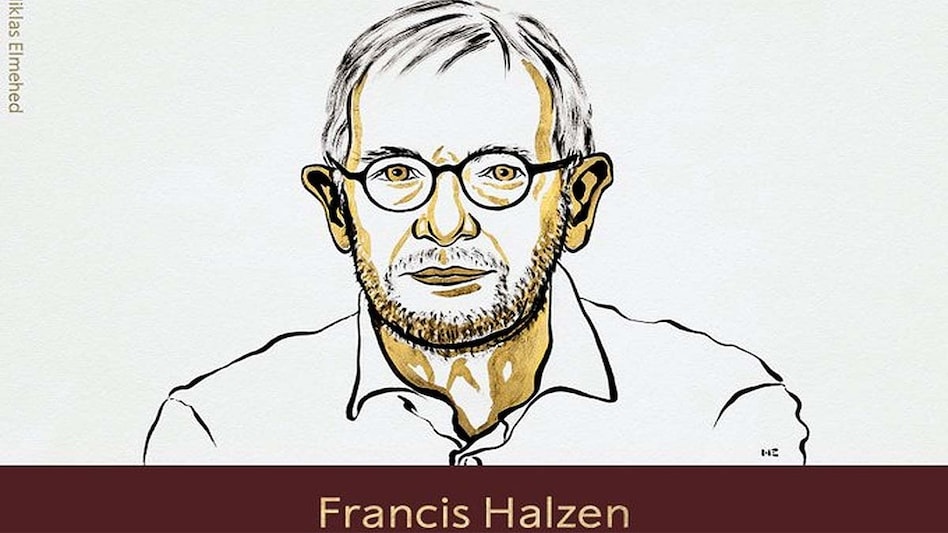
The Royal Swedish Academy of Sciences has decided to award the Nobel Prize in Physics for 2026 to Francis Hallzen. This award is given for his contribution to the work of the IceCube Neutrino Observatory and for the detection of high-energy neutrinos of astrophysical origin.
Hallzen recognized the potential of using the ice at the South Pole to track particles known as neutrinos. His scientific leadership and vision made possible the creation of the IceCube Observatory—a vast network of light sensors installed in a cubic kilometer of ice. Thanks to this system, scientists are able to detect neutrinos originating from extremely energetic processes in the distant Universe.
Scientists have long known about the existence of natural particles in the Universe that emit particles with energy millions of times greater than what can be obtained in terrestrial laboratories. Many aspects of these sources remain a mystery: what they are, where they are located, and what fundamental processes occur inside them still lack answers. High-energy neutrinos are formed in these environments along with other particles.
Unlike other particles, neutrinos reach us without changing direction or losing energy. This allows them to provide information inaccessible by other methods. Neutrinos are considered the most elusive particles in the Universe because they interact weakly with matter and pass through it easily.
Francis Hallzen first presented his concept for capturing neutrinos at the South Pole in 1988. When a neutrino collides with an atomic nucleus, a flash of light occurs, which the sensors installed in the pure glacier can track. The ice at the South Pole has several advantages: there are no various types of disturbances here, and the region is geologically stable, ruling out earthquakes.
Hallzen's idea soon gained support from other researchers, and preliminary tests of the sensors in the ice began a few years later. Over time, the project developed, and today IceCube is the world's largest neutrino observatory.
With the help of IceCube, scientists have confirmed the presence of high-energy astrophysical neutrinos. This discovery helps to understand the most powerful events in the Universe, such as supernova explosions, processes around black holes, or gamma-ray bursts. Neutrino astronomy opens a new field of study, allowing the Universe to be studied from a perspective other than visible light or other waves.
Hallzen's leadership not only allowed overcoming technical difficulties but also strengthened international cooperation. The creation of such a large observatory in such challenging conditions as the South Pole is in itself an example of scientific courage. This prize marks the convergence of nuclear physics and astrophysics.
This award will serve as an incentive for young researchers, showing how large-scale and bold ideas can change the course of science. The data obtained from IceCube will continue to help unravel the mysteries of the cosmos. Francis Hallzen's contribution reminds us that even seemingly impossible goals can be achieved through patience, foresight, and collaboration.