New evidence of Bronze Age life has been discovered at the Jarkutan archaeological site in the Surkhandarya region of Uzbekistan. Among the findings are ancient structures, four complete ceramic vessels, utility pits, and a child's burial.
These discoveries will allow for a deeper understanding of the lifestyle, construction methods, and burial rites of the population that lived here thousands of years ago.
Continuation of excavations and main findings
Work is underway at Jarkutan in the Sherabad district of the Surkhandarya region, which is one of Uzbekistan's most important archaeological sites. Research began in October 2026. The process is being led by Komil Rakhimov, Candidate of Historical Sciences and Senior Researcher at the Yakho Gulomov Samarkand Archaeological Institute.
Students from Termez State University and a postgraduate student from the Italian University of Salento, Francesca Condedo, are participating in the expedition. During the excavations, remains of ancient dwellings and utility buildings, as well as fragments of ceramic ware, were identified.
Particular attention is drawn to the constructions made of adobe bricks and a hearth with a diameter of approximately 70 centimeters. These elements will help scientists understand the principles of house construction during the Bronze Age, as well as the layout of interior spaces and the functions of individual rooms.
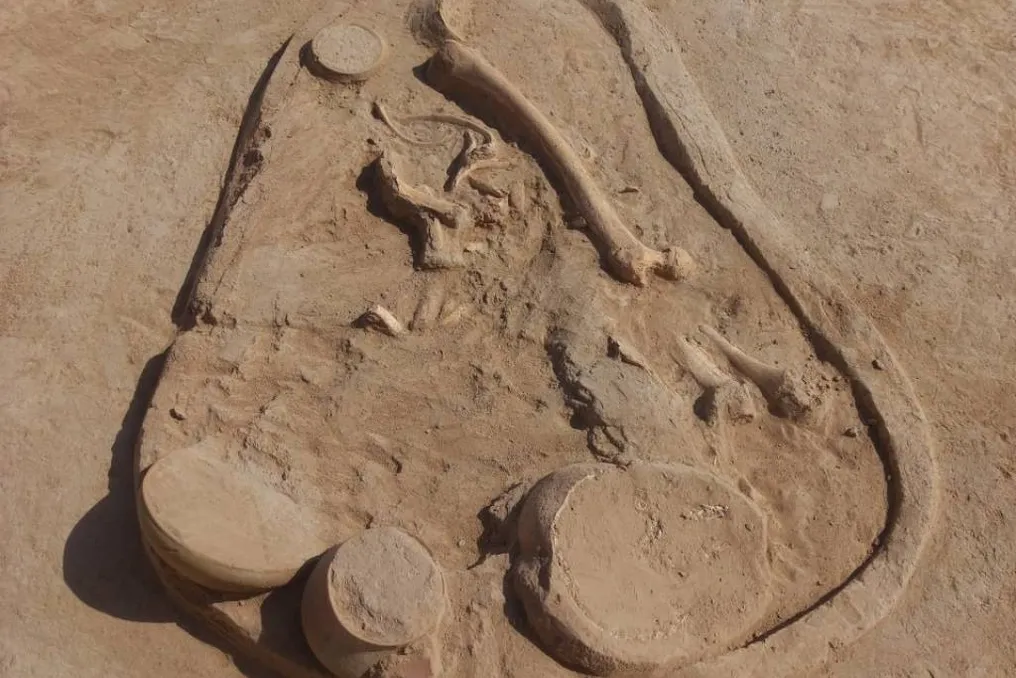
In the western part of the settlement, archaeologists found four complete ceramic vessels. Additionally, outside the main area of the monument, a child's burial, a utility pit belonging to the Sapallin culture of the Bronze Age, and two round pits filled with ash were found.
Specialists intend to conduct a comparative analysis of the discovered items and structures with other archaeological data. This approach will allow for determining the purpose of different sections of the settlement and tracing the evolution of these elements over time.
Jarkutan is recognized as a key site for studying the history of Uzbekistan and the Sapallin Bronze Age culture. Previously, a skull of a child, about four thousand years old, showing signs of trepanation—a surgical procedure involving creating an opening in the skull—was found in this area. According to researchers, this finding represents one of the earliest evidence of such medical procedures in Central Asia and Asia as a whole.