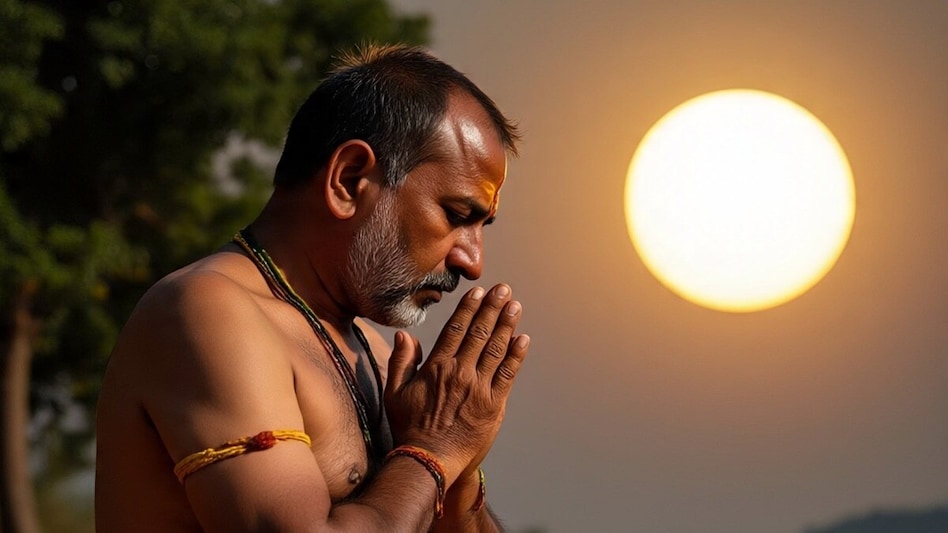
Sarvapitri Amavasya, which falls during the Pitr Paksha period, holds special religious significance. It is the last day of Pitr Paksha when Shraddha, Tarpan, and Pindadaan rituals are performed for all ancestors whose date of death is unknown or whose Shraddha was not conducted in a timely manner.
In 2026, Sarvapitri Amavasya will be observed on October 10, a Saturday. This day is also known as Mahalaya Amavasya and marks the conclusion of Pitr Paksha.
Specifics of Sarvapitri Amavasya
According to religious traditions, this day is considered special for ancestors whose dates of death are forgotten or whose Shraddha was missed for any reason. According to the religious Panchang, if an ancestor's date of death is unknown or Shraddha was not performed on the correct day, they can be honored on the day of Sarvapitri Amavasya. On this day, it is customary to remember all known and unknown ancestors and reverently perform Tarpan and Shraddha.
What should be done on Sarvapitri Amavasya?
On this day, Tarpan, Pindadaan, and Shraddha rituals can be performed according to family traditions and the priest's advice. There is a tradition of offering Tarpan with water and sesame seeds while remembering ancestors. Furthermore, in many families, it is customary to feed cows, crows, and dogs during Shraddha, as well as donate grains and clothes to the needy. In some regions, this is connected to the Panchbali tradition.
If resources and family tradition allow, a meal can be organized for Brahmins and they can be offered tribute. If there is no possibility to arrange such a feast at home, one can reverently donate food and grain to a temple or a needy person.
Dietary Questions Before Shraddha
The rule regarding whether to abstain from food before Shraddha is not universal for all families. Some traditional methods recommend moderation and consuming sattvic food for the person performing Shraddha, while other traditions have the practice of fasting until the completion of the Shraddha ritual. However, this should not be presented as a mandatory rule for every individual. Rules may vary depending on the fast, health, age, and family tradition. Therefore, if you are performing Shraddha according to all rules, you should consult your priest in advance about when to eat within this procedure.
Who can act as the Shraddharta?
Different Dharmic traditions have varying protocols regarding who can be the Shraddharta. Generally, the tradition of the son performing the Shraddha has prevailed, but there are mentions that other close relatives can perform this rite in the absence of a son. In some traditions, a wife, daughter, or other family members can also perform the Shraddha under special circumstances. Thus, it cannot be asserted that only the eldest son can perform the Shraddha in every situation. The choice of the Shraddharta is determined by family tradition and the corresponding ritual.
If there are multiple sons in the family, there are different traditions regarding sons living separately. In such a situation, it is most appropriate to consult a local priest about the correct procedure.
What diet should be followed during Pitr Paksha?
Many families have a tradition of consuming sattvic and moderate food during Pitr Paksha. Special attention is paid to the purity and method of cooking food on the day of Shraddha. The tradition of avoiding meat and alcohol is widespread. Nevertheless, rules regarding onions, garlic, lentils, urad, and chickpeas or other products may differ depending on the region and family tradition. Therefore, it is incorrect to call this a universal classical prohibition for every family.
Important Actions on Sarvapitri Amavasya
Part of the tradition of many families is reading religious texts and remembering God during Pitr Paksha. One can reverently read the Shrimad Bhagavad Gita. However, it is not entirely accurate to state that sacred scriptures mandate reading all 18 chapters of the Bhagavad Gita or specifically only the seventh chapter on the day of Sarvapitri Amavasya. It is more appropriate for a person to read the Bhagavad Gita, practice mantras, or remember God according to their faith and family tradition.