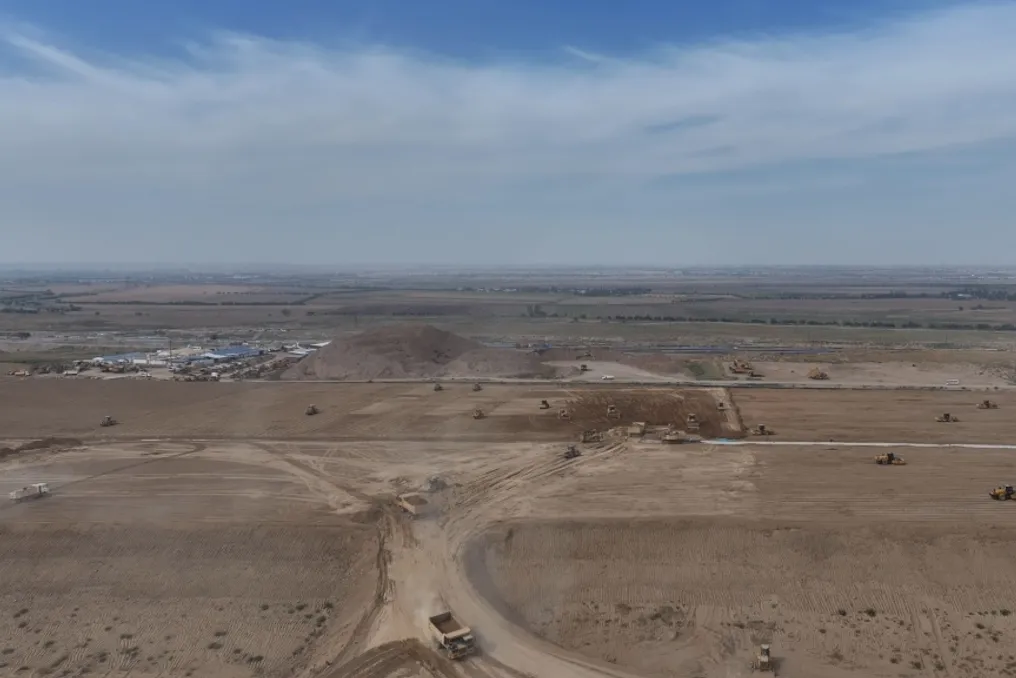
A tailings storage facility is a critically important element in mining and metallurgical production, as the safety of both the environment and the local population directly depends on the choice of site and construction technologies. Currently, a similar facility is being built at Almalyk Mining and Metallurgical Complex near Copper Concentrating Plant No. 3, which is gradually reaching full design capacity.
Work on this facility began parallel to the development of the 'Yoshlik' quarry; during the same period, the design for a new concentrating plant, water intake, and the tailings storage facility itself was launched. Experts from the O'zGEORANGMETLITI institute were involved in the project, and the structure was developed in strict accordance with international engineering standards.
A Project Without Analogs in the CIS
The chief project engineer, Vladimir Kanonyuk, noted that designing the tailings storage facility for MOF-3 required analyzing numerous factors: mining engineering, geo-engineering, environmental, and technological. Since this facility is classified as a hydraulic structure intended for perpetual use, it is subject to the highest requirements. Although the team had previously worked on similar projects, the MOF-3 tailings storage facility differs in its unprecedented scale. The project had to ensure complete dam stability and reliable environmental protection, so global experience was studied, and discussions were held with leading foreign companies.
According to Kanonyuk, the result is a facility that fully complies with advanced global standards and is the only one of this level not only in Uzbekistan but across the entire CIS. Such structures are extremely rare worldwide.
Construction on a Landscape Scale
An impressive scene unfolds at the construction site: giant basins of future reservoirs are reshaping the landscape, while dozens of pieces of equipment work in coordination. Powerful excavators and bulldozers are leveling the foundation, exposing ancient soil layers, while dump trucks deliver tons of earth material for building the dams.
Alexander Ten, head of the construction site sector for the project, reported that about 300 units of specialized equipment are involved at the site, including excavators with a 6 m³ bucket, 60-ton dump trucks, 36-ton vibratory rollers, and bulldozers. Over a thousand qualified specialists from various fields support all processes.
The main focus of work is currently on constructing the retaining dam, which will be 7 kilometers long and have a maximum height of 57 meters. A pit measuring 176 hectares is being prepared for the dam's foundation, involving an excavation depth of 4 meters. Following this, layer-by-layer backfilling and compaction are carried out using local soil, which significantly simplifies logistics. Thanks to the extensive technical fleet, the average daily volume of earthworks reaches 70–80 thousand cubic meters, and over 2 million cubic meters per month.
Quality Control at Every Stage
The construction process is accompanied by the strictest quality control. Every layer of soil undergoes geodesic verification to ensure compliance with approved elevations. Subsequently, field laboratory specialists take samples to determine the moisture content and density of the material. These checks are not formalities but serve as a guarantee of the longevity and reliability of the entire structure.
The 'Clay Lock' as Natural Water Protection
One of the most important components of the structure is the so-called clay lock. Madir Adylzhanov, the project's civil engineering engineer, explained that clay and water-soil mixtures are used to achieve the required density of the foundation and the body of the dam. The resulting mass is laid in layers 20–25 centimeters thick on the bottom and slopes of the pit, and then carefully compacted with rollers. This layer, measuring half a meter thick, functions as a powerful natural waterproofing barrier: upon contact with water, the clay swells and forms a dense, impermeable barrier.
The principle of operation of this element is simple but very reliable: fine clay particles almost completely clog the pores when saturated with water. Furthermore, the clay acts as a natural filter because the montmorillonite contained within it can bind heavy metals and other substances from technological waste. The plasticity of the clay mixture is also an advantage: unlike concrete or dry soil, which can crack under load, clay can adapt to minor changes in the foundation while maintaining its integrity.
Water Cycle and Digital Management
Technologies aimed at increasing environmental safety and rational resource use have been implemented during construction. A key decision was the closed-loop water supply system: treated water after the flotation process is returned to the production cycle via floating pumping stations. This solution is being applied for the first time at the complex and significantly reduces the consumption of water from natural sources.
For additional protection, the tailings storage facility foundation and critical areas will be covered with high-strength geomembrane, preventing technological water from entering the soil and protecting groundwater. Observation wells will be installed to monitor filtrate waters, and a drainage system will ensure the safe collection and diversion of filtrate waters and gases from the waste.
In parallel, on the second map of the tailings storage facility, located approximately 7 kilometers from the plant in the northwestern part of the Kuramin Range, existing engineering communications are being relocated. The total area of the facility will be about 2,800 hectares: the first map covers 1,420 hectares, and the second covers 1,380 hectares. Post-flotation waste will be fed into the tailings storage facility via a hydrotransport system—slurry pipelines approximately 9 kilometers long. The facility is designed to accept up to 300 million cubic meters of concentrate tailings annually, of which the solid fraction will amount to more than 59 million tons.
All production processes at the facility will be fully digitized. Their parameters will be controlled by a unified management system, and real-time data will be analyzed in the central dispatch center. This will ensure process stability, allow for prompt detection of failures, and enable timely decision-making.
Non-Stop Construction
Even at dusk, work at the site does not cease, only changing its appearance. Powerful spotlights illuminate the pit, turning it into a futuristic location: in the dark, the silhouettes of the machinery look even more imposing, and the beams of light emphasize the shine of metal structures, clouds of dust, and the figures of workers in reflective vests. The hum of engines in the cool evening air sounds deeper, and the noise of working rollers resembles the beating of a huge mechanical heart. This is a time when human will and engineering thought operate at their limit, bringing the moment of commissioning the facility as a reliable element of environmentally clean production closer.
This ecopolygon will become another significant strategic asset of AGMK, designed with modern requirements for industrial and environmental safety in mind. Information provided by Umida Karshibayeva, Head of the Information Service of AGMK.