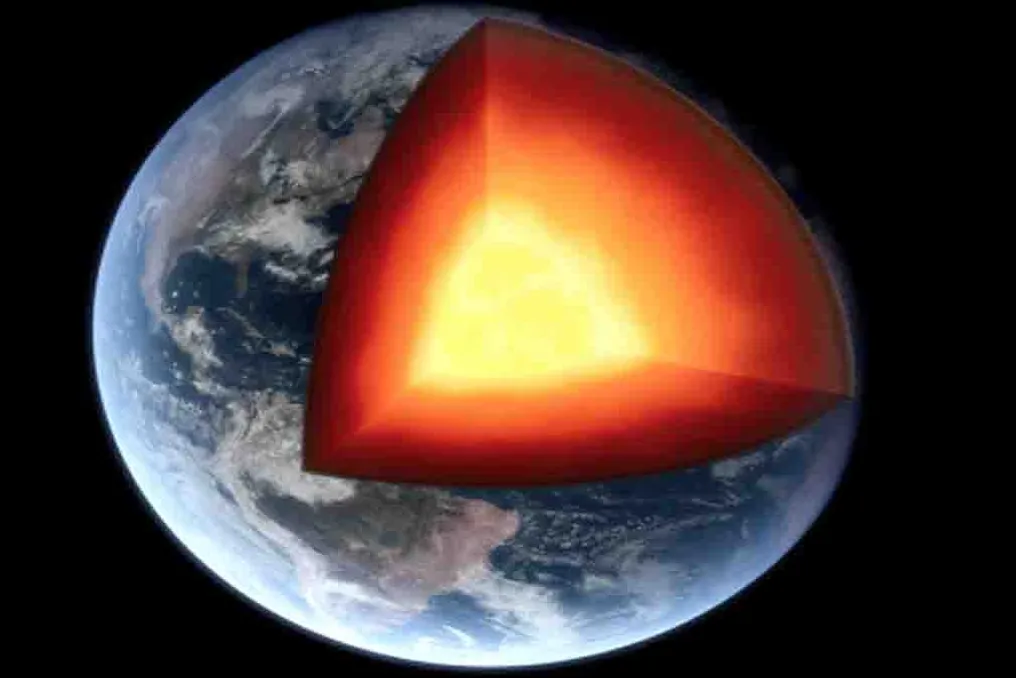
At a depth of about 5150 kilometers from the Earth's surface, the temperature can reach approximately 5500 degrees Celsius. However, the innermost part of the planet, or the core, remains in a solid state. Scientists explain this by stating that the immense pressure present there prevents the melting of iron and nickel.
It is impossible to study the Earth's internal structure directly because humans cannot reach it. Therefore, scientists use seismic waves generated during earthquakes. By analyzing the trajectories and speed of these waves, they gain information about the different layers of the planet.
Although the Earth appears as a solid sphere externally, it has numerous layers inside, the main ones being the crust, mantle, and core. The core, in turn, is divided into two parts: the outer core and the inner core.
The outer core is in a liquid state, while the inner core is solid. It primarily consists of iron and also contains nickel and other elements. The radius of the inner core is about 1220 kilometers, making it a very large solid section at the center of the Earth.
Typically, metals melt at such high temperatures. However, in the inner core, besides the high temperature, there is extremely high pressure. It is this pressure that alters the melting conditions of iron, allowing the core to maintain a solid state despite the temperature of about 5500 degrees Celsius. The outer core has lower pressure, so its metallic component remains in a liquid phase.
Information about the inner core is obtained using seismic waves. Since the core is thousands of kilometers beneath the surface, direct investigation is impossible. During an earthquake, various types of waves pass through the Earth; they move differently in solid and liquid parts. By analyzing these changes, scientists have determined that the inner core is solid, and the surrounding outer core is liquid.
Furthermore, the core is related to the Earth's magnetic field. The movement of liquid metal in the outer core plays a key role in forming the planet's magnetic field. This magnetic field functions as a protective barrier around the Earth, reducing the impact of charged particles from space.
The inner core is unique because it simultaneously possesses extremely high temperature and high pressure. Scientists continue to study the structure of this inner part of the Earth and the changes occurring within it over time, using seismic data and other research.