At the beginning of the national holiday, as the sound of the anthem faded, Wang Fan watched 101,000 people gather in Tiananmen Square in Beijing at 4 am to await the sunrise of the five-star red flag. For Wang, who was visiting Beijing with her school-aged son for the first time after a long trip from Linyi, Shandong province in eastern China, this moment became not just a ceremony, but a memory reflecting the significance of National Day for an ordinary family.
The arrival of October across the country evoked a similar sense of solemnity. What began as a day celebrating the founding of the nation turned into one of the longest breaks of the year—the week-long 'Golden Week,' which mobilized millions of people.
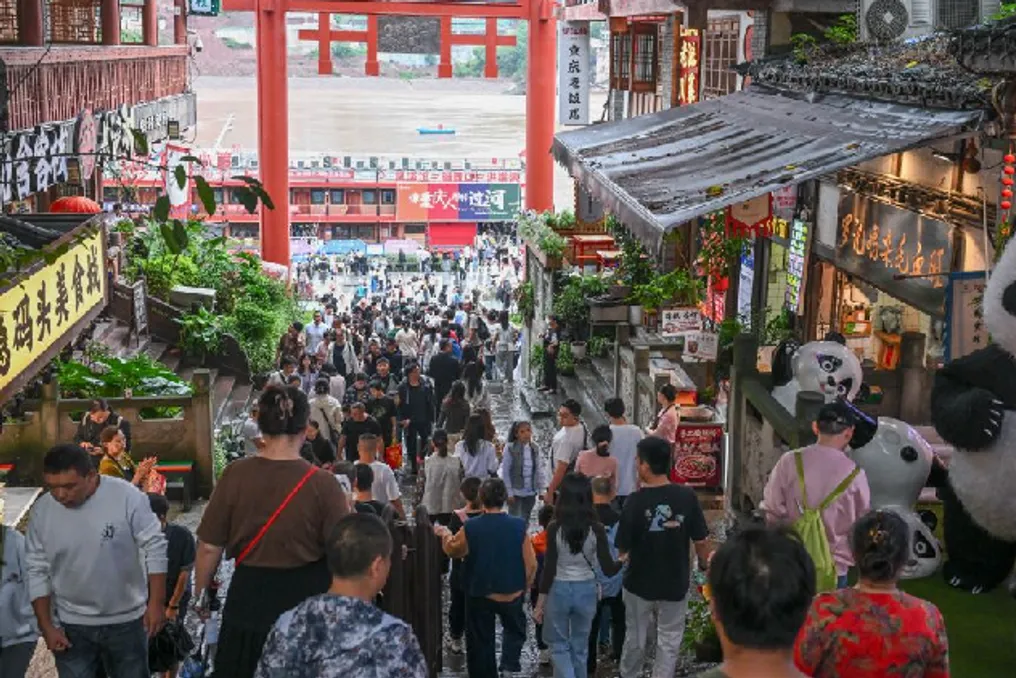
This holiday showcased a vivid picture of China, where strong emotional ties combine with an active consumer economy, reflecting the vitality and resilience of its high-quality development.
Iconic Red Attractions Attract Crowds During Holidays
National pride became the defining theme of China's National Day, prompting travelers to visit iconic sites, learn about revolutionary history, and turn their trips into a meaningful cultural experience. Sales of tours related to 'red tourism' also significantly increased compared to previous years, as many families include visits to revolutionary sites in their vacation plans.
This year marks the 90th anniversary of the victory of the Great March of the Red Army. In Yudu County, Jiangxi province in eastern China, a memorial park dedicated to the start of the Great March of the Central Red Army attracted a large number of students and tourists. It is expected that nearly 300,000 visitors will visit this site over the seven days of the holiday.
Dai Bin, president of the China Tourism Academy, noted that the growing popularity of revolutionary monuments indicates a deep emotional attachment to China's history and revolutionary traditions. He emphasized the importance of accurately presenting historical facts while simultaneously providing engaging narratives so that visitors of all ages can better understand, connect with, and reflect upon history.
Immersive Experiences Stimulate New Forms of Consumption
Beyond traditional tours, immersive experiences are transforming consumer demand, making cultural and tourism offerings increasingly diverse. For example, in Chongqing, southwestern China, restaurants have begun offering hot pot combined with events thematically related to the city's port history, industrial heritage, and nature camping.
Visitors can also participate in activities combining low-altitude flights with practical experiences such as fishing and preparing traditional snacks, allowing them to experience rural life in Chengdu, Sichuan province in southwestern China.
In the first three days of the holiday, from October 1 to 3, pedestrian traffic and revenue on 78 major shopping streets and commercial districts monitored by the Ministry of Commerce increased by 3.4% and 5.3% year-on-year, respectively. Notably, the state program for consumer goods exchange generated sales worth 19.63 billion yuan (about $2.91 billion USD) during the same period, benefiting 3.48 million consumers.
Cinema is also creating new business opportunities during the holidays. Family films are becoming a key draw this year, offering a wide range of genres—from animation and crime thrillers to comedies and socially oriented dramas for viewers of all generations.
Simultaneously, cinemas are expanding their functions beyond regular screenings. At a cinema in Nanshan District, Shenzhen city, Guangdong province in southern China, viewers can find a city bookstore, a spa, and wellness services, as well as an esports zone, allowing them to read, relax, or unwind before or after watching a film.
The Film Museum in Qingdao, Shandong province in eastern China, houses an extensive collection of audiovisual artifacts dating back to the 1950s. Its exhibition halls recreate the appearance of household appliance stores from the 1980s and 1990s. By including film and television resources in its collection and exhibitions, the museum explores new ways of preserving local folk art while making cultural services more accessible to society.